A decades-old bug in Knuth's long division (TAOCP Vol II, Algorithm 4.3.1D)
Source Entity
Hacker News
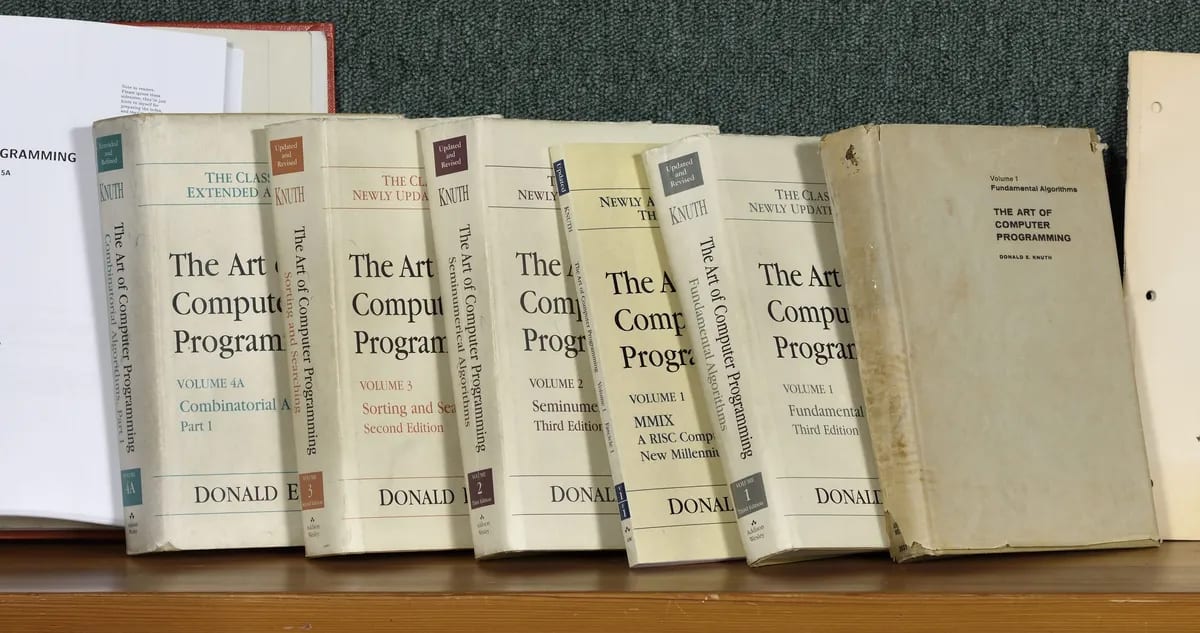
A developer identified a long-standing error in Donald Knuth's Algorithm D from The Art of Computer Programming. The discovery highlights the complexities of verifying historical foundational algorithms and has prompted a revision of the theorem.
The Unveiling of a Foundational Flaw
Donald Knuth’s The Art of Computer Programming (TAOCP) is widely regarded as the 'bible' of computer science, serving as a foundational text for generations of engineers. For decades, Algorithm 4.3.1D—commonly known as 'Algorithm D'—has been the gold standard for implementing long division in binary systems. However, a recent discovery has revealed that this cornerstone algorithm contains a subtle, long-standing bug, challenging the reliability of implementations that have relied on its mathematical proofs for years.
Deconstructing the Mathematical Error
The discovery originated during a rigorous re-implementation of Algorithm D. The developer noted that Theorem B, which underpins the correctness of the division process, relied on a convoluted and seemingly unnatural proof. Upon attempting to independently verify the theorem, the developer identified a counterexample that exposed a flaw in the logic. This specific issue had persisted undetected for decades, illustrating how even the most scrutinized academic works can harbor hidden errors when subjected to modern, high-precision implementation standards.
The Intersection of Theory and Practice
Beyond the mathematical error in the text, the investigation also uncovered a related issue within the LLVM compiler infrastructure. This highlights the bridge between abstract algorithmic theory and concrete software engineering. When foundational algorithms are codified into compilers, errors at the mathematical level can propagate into real-world software, potentially affecting memory safety or arithmetic precision in systems that rely on these core libraries for low-level operations.
Implications for Algorithmic Verification
The fact that a bug could remain hidden in such a widely studied text underscores the difficulty of formal verification. TAOCP has been reviewed by thousands of experts, yet the complexity of Theorem B effectively obscured the error. This event serves as a critical reminder that even 'proven' algorithms require constant re-evaluation, especially as we push for higher levels of correctness in safety-critical computing environments.
Future Trends in Computational Mathematics
This incident is likely to spark a renewed interest in the formal verification of historical algorithms using modern automated theorem provers. As the industry shifts toward more robust formal methods, the legacy of Knuth’s work will be preserved not by blind acceptance, but by rigorous, iterative testing. The correction of Algorithm D marks a significant moment in computer science history, demonstrating that even the most definitive texts are subject to the evolution of human knowledge and error detection.