‘Svabodh’ and national unity: Bhagwat’s top quotes as Dhankhar attends RSS event
Source Entity
ABHISHEK MISHRA
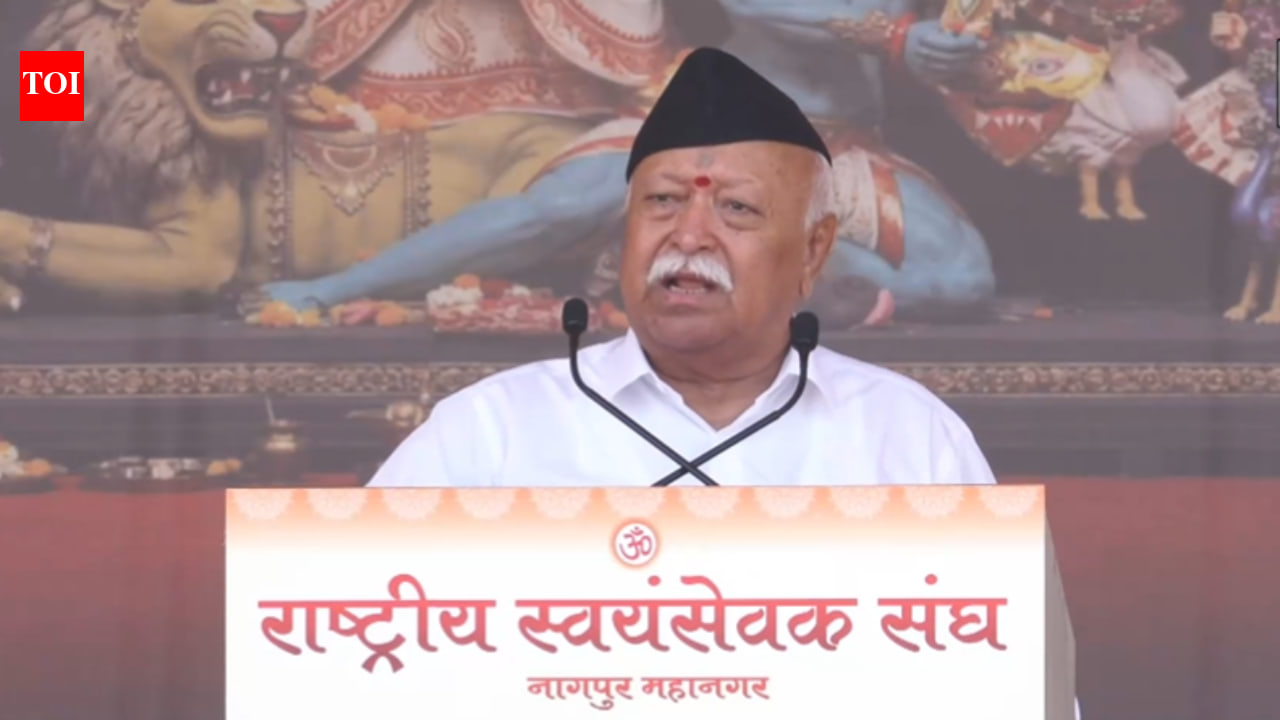
RSS Chief Mohan Bhagwat emphasized national unity and social harmony while cautioning against the belief that regime change alone solves societal issues. He warned that global forces are attempting to destabilize India and urged that solutions should emerge from within society rather than through disruptive agitation.
The RSS Vision: National Unity and Societal Resilience
During the recent RSS Vijayadashami celebrations in Nagpur, Sarsanghchalak Mohan Bhagwat delivered a comprehensive address that bridged historical wisdom with contemporary geopolitical concerns. Central to his message was the concept of 'svabodh'—an awakening of the self—which he framed as the foundational pillar for India’s national unity. By invoking the life and teachings of Sant Ravidas, Bhagwat highlighted how historical figures once comforted a society under pressure, suggesting that the current challenges facing India require a similar focus on 'svadharma nishtha' and social harmony.
Embracing Diversity as a National Ethos
Bhagwat underscored that India’s traditional character is defined by its innate ability to accept and protect diversity. In an era often marked by polarized discourse, his emphasis on diversity serves as a philosophical pivot for the RSS. He argued that the organization’s century-long efforts are centered on awakening the national 'sva' (selfhood) to foster unity. This narrative positions the RSS not merely as a political stakeholder, but as a cultural custodian dedicated to preserving the ethos that has sustained India through centuries of external pressures.
The Critique of 'Regime Change' Politics
Perhaps the most striking element of Bhagwat’s address was his direct skepticism toward the efficacy of regime change as a panacea for national problems. Drawing parallels to recent political instability in nations like Bangladesh, Nepal, Albania, and France, he contended that replacing governments does not inherently improve the conditions of a society. This assertion serves as a critique of protest cultures that prioritize political upheaval over structural, internal reform. He firmly stated that such changes have historically failed to deliver the promised systemic improvements.
Addressing External Threats and Internal Agitation
Bhagwat warned of 'evil forces' that seek to dismantle India, claiming that the country’s recent progress under decisive policies has made it a target for global interests driven by narrow agendas. He suggested that these forces aim to disrupt India’s trajectory because they cannot compete with its current momentum. By framing external threats alongside domestic protests, he attempted to shift the focus from political confrontation to societal consensus, arguing that agitation often creates divisions rather than providing functional solutions.
A Call for Internal Solutions
Ultimately, the RSS chief’s message was a call for introspection and internal growth. By stating that solutions to problems must emerge from within society, he challenged the notion that political shifts are the only mechanism for progress. As the RSS marks its 101st anniversary, this rhetoric reflects a strategic attempt to solidify its influence as a moral and social arbiter, emphasizing that the strength of the nation is inextricably linked to the unity and 'svabodh' of its citizenry, rather than the shifting fortunes of political regimes.
Multiple Citing Sources