New Forest firefighting to continue overnight as cars abandoned
Source Entity
BBC News
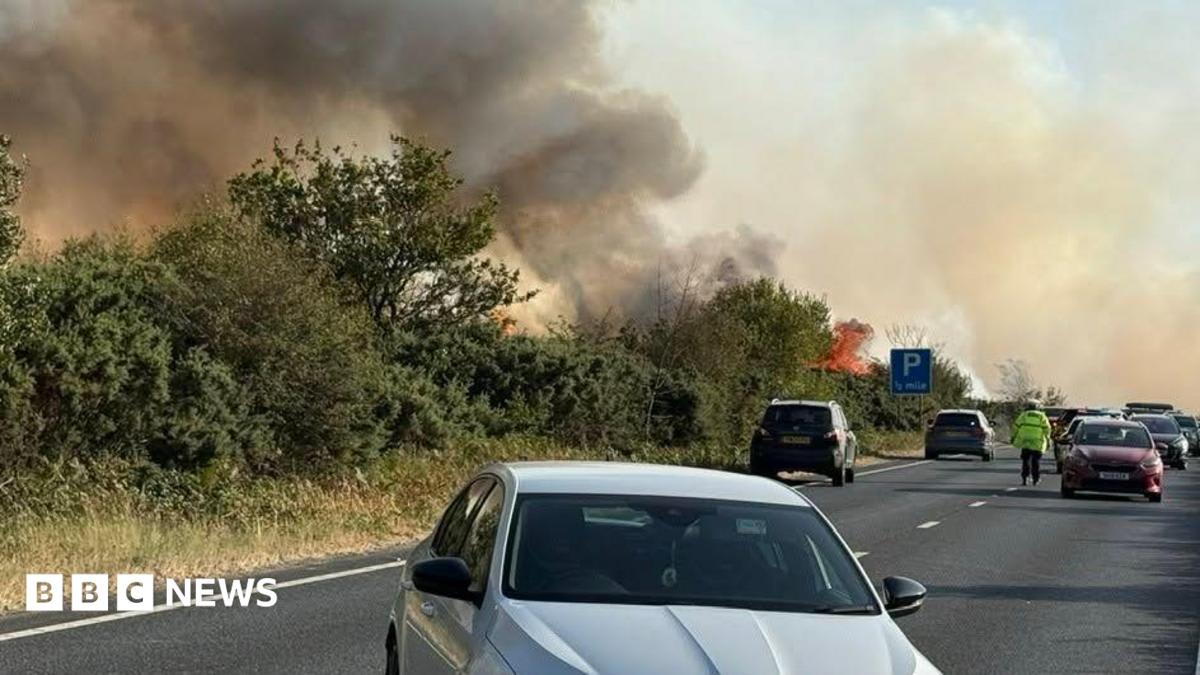
A major wildfire in the New Forest, sparked by a vehicle blaze on the A31, has forced the closure of the dual carriageway and the abandonment of over 20 vehicles. Emergency services continue to battle the flames across 250 acres to ensure public safety.
Crisis in the New Forest: A Rapidly Escalating Emergency
A significant firefighting operation is currently underway in the New Forest national park in Hampshire, following a large-scale blaze that erupted on Sunday. The incident, which originated from a van fire on the A31 near Bratley Wood, has rapidly expanded to affect approximately one square kilometre—or 250 acres—of protected parkland. The sheer scale of the fire has necessitated a massive response, with over 120 firefighters from the Hampshire and Isle of Wight Fire and Rescue Service deployed to combat the flames under what officials have described as "challenging conditions."
Chaos on the A31: Public Impact and Safety Concerns
The immediate aftermath of the initial vehicle fire caused significant disruption to public safety, forcing the abandonment of more than 20 vehicles along the A31 dual carriageway. Eyewitness accounts, such as those provided by Lindsey Legg, highlight the harrowing experience of families caught in the crossfire of the emergency. Legg reported that police intervention forced her family and others to leave their vehicles, leading to a scene where families with young children and buggies were forced to navigate the road on foot while the blaze took hold. This chaotic evacuation underscores the volatile nature of fire incidents on major transport arteries.
Infrastructure and Environmental Implications
The closure of the A31 in both directions remains in effect until further notice, as confirmed by National Highways. This closure is not merely a logistical inconvenience; it represents a critical disruption to a major transport route through the national park. Beyond the infrastructure impact, the environmental toll on the New Forest—an area of significant ecological importance—is a major concern. The loss of 250 acres of habitat highlights the fragility of protected landscapes when faced with sudden, human-induced fires.
The Operational Challenge: Fighting Fire Overnight
Fire crews are now tasked with the arduous challenge of maintaining containment efforts throughout the night. Working in the dark adds a layer of complexity to an already high-stakes operation, as firefighters must navigate terrain while managing the potential for fire spread due to unpredictable winds or dry conditions. The ongoing operation reflects the high level of coordination required between emergency services and transport authorities to secure the area and prevent further damage to both property and the environment.
Future Trends and Resilience
This incident serves as a stark reminder of the risks associated with vehicle fires on major thoroughfares adjacent to sensitive environments. As climate patterns shift and periods of dry weather become more frequent, the vulnerability of national parks to wildfires sparked by roadside incidents is likely to increase. Future policy may need to focus on improved emergency evacuation protocols and more robust fire-suppression infrastructure within national parks to protect both the public and the unique biodiversity of these regions.
Conclusion: A Situation in Flux
While the immediate priority remains the containment of the fire and the restoration of safety, the event highlights the necessity of rapid, integrated emergency responses. As the situation remains fluid, the focus will soon shift to investigating the exact cause of the van fire and assessing the long-term ecological impact on the New Forest. For now, the persistence of the firefighting operation signifies the gravity of the threat posed by this incident to the local community and the environment at large.