New NVIDIA Cosmos 3 Open Models for Interactive World Simulation
Source Entity
Hugging Face - Blog
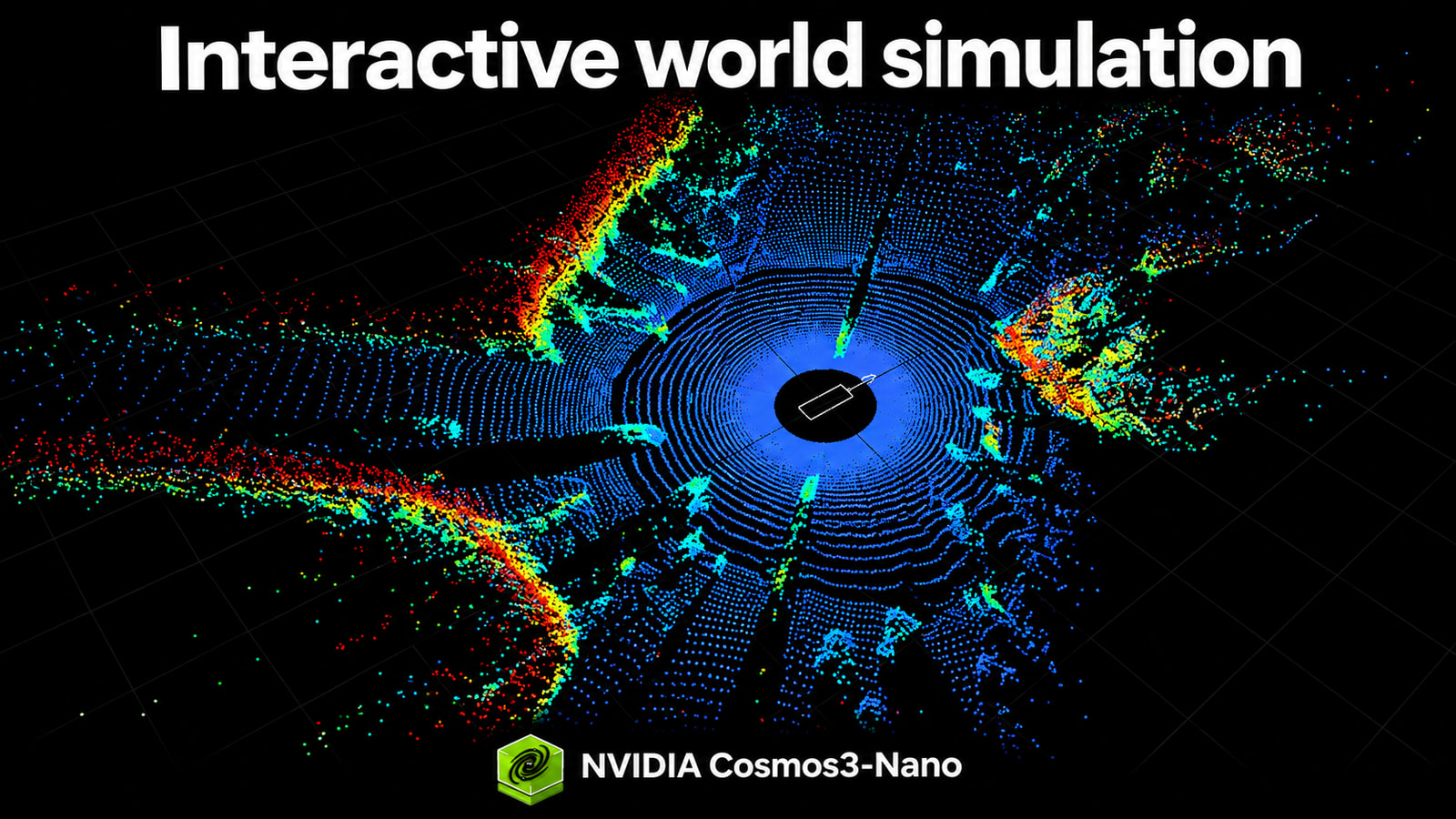
NVIDIA has expanded its Cosmos 3 world model platform by releasing four new open-weight checkpoints. These models are designed to advance interactive simulations, specifically for autonomous driving and robotic bimanual manipulation.
NVIDIA Advances Simulation Capabilities with Cosmos 3 Open-Weight Models
NVIDIA has significantly bolstered its generative AI ecosystem by introducing four new open-weight checkpoints to the Cosmos 3 model family. This development marks a pivotal shift in how developers approach world simulation, moving beyond static data generation toward highly interactive, multi-sensor environments essential for the next generation of artificial intelligence.
Empowering Autonomous Vehicle Development
Two of the new checkpoints, Cosmos3-Nano-Transfer-Auto and Cosmos3-Nano-Sim-Auto, are specifically engineered to address the complexities of autonomous driving. By allowing for the generation of multi-view driving data that includes dynamic lighting, shifting weather patterns, and time-of-day variations, NVIDIA is providing developers with the tools to create diverse, high-fidelity training scenarios. Furthermore, the ability to stream synchronized camera and LiDAR observations bridges the gap between synthetic data and real-world sensor fusion requirements.
Bridging Realism and Control
The Cosmos3-Nano-Sim-Transfer checkpoint represents a substantial leap in photorealistic rendering. By enabling the transformation of simulator controls and text prompts into high-quality video, this model allows researchers to test autonomous systems in "what-if" scenarios that would be too dangerous or logistically impossible to replicate in physical testing environments. This capability is crucial for training AI agents to handle edge cases in real-time navigation.
Expanding into Robotics
The introduction of Cosmos3-Nano-Sim-Bimanual signals NVIDIA’s intent to move beyond automotive applications and into the realm of dexterous robotics. By predicting video sequences specifically for bimanual tasks, this model provides a framework for training robots to interact with their environment using two-handed coordination, a notoriously difficult challenge in embodied AI. This move suggests that the Cosmos 3 architecture is designed to be a versatile foundation for various physical AI applications.
Broader Implications for AI Training
Historically, the bottleneck for high-level AI training has been the scarcity of high-quality, diverse simulation data. By releasing these checkpoints under an open-weight model, NVIDIA is democratizing access to complex simulation technology. This ecosystem approach lowers the barrier to entry for smaller firms and academic researchers, potentially accelerating the pace of innovation in self-driving car technology and humanoid robotics simultaneously.
Future Trends in World Modeling
Looking ahead, the shift toward "interactive world models" suggests a future where AI systems are no longer just passive observers of data but active participants in simulated environments. As these models continue to integrate multi-modal sensor inputs—such as the fusion of LiDAR and visual data seen in these new releases—we can expect autonomous systems to become increasingly robust. NVIDIA’s expansion of the Cosmos 3 family positions the company as the primary infrastructure provider for the emerging era of physical AI.