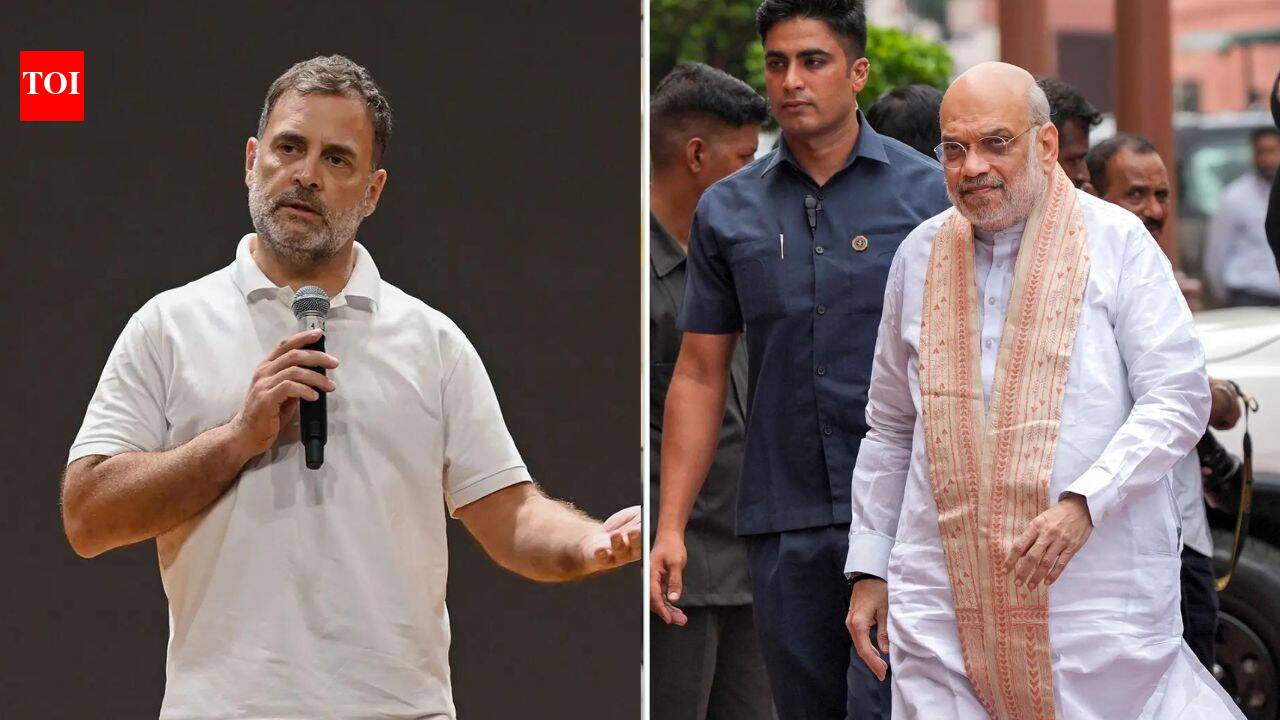
'Why is Amit Shah scared?' Rahul on 'brutal' violence against student protesters
Source Entity
KANCHAN YADAV
Opposition MPs led by Rahul Gandhi and Priyanka Gandhi Vadra staged protests in Parliament against alleged police brutality toward student protesters. The coalition also raised concerns regarding reported financial irregularities involving Ram temple donations.
Political Tensions Escalate in Parliament
On July 30, 2026, the Indian Parliament witnessed a significant escalation in political confrontation as opposition members staged a protest at the Makar Dwar. Led by prominent figures including Priyanka Gandhi Vadra, the demonstration served as a dual-pronged attack against the Union government, focusing on the alleged use of excessive police force against student protesters and claims of financial misconduct regarding donations at the Ram temple in Ayodhya.
The Demand for Accountability
Central to the opposition’s rhetoric is the question, "who gave the order?" This slogan, prominently displayed on banners, underscores a demand for institutional transparency regarding the chain of command that authorized security personnel to utilize force against students. Rahul Gandhi has further intensified this narrative by directly challenging Union Home Minister Amit Shah, questioning his absence from parliamentary proceedings and suggesting that the lack of executive engagement implies a sense of culpability regarding the handling of student unrest.
Allegations of Corruption and Mismanagement
Beyond the concerns regarding civil liberties and police conduct, the opposition has introduced the issue of alleged embezzlement of temple funds. By symbolically placing money into a donation box during their protest, lawmakers sought to draw public attention to claims of "theft" concerning the Ram temple donations. Slogans such as "chadhawa chor, gaddi chor" (thieves of offerings, thieves of the throne) were utilized to link the alleged financial irregularities directly to the ruling administration’s governance.
The Opposition’s Strategic Approach
This protest marks a coordinated effort by a diverse coalition of opposition parties, including the Samajwadi Party (SP), the Trinamool Congress (TMC), and the Jharkhand Mukti Morcha (JMM). By bridging the gap between student rights advocacy and religious institutional oversight, the opposition is attempting to create a multi-faceted critique of the government’s moral and administrative authority. The call for a Supreme Court-monitored probe into police actions signifies a move to bypass standard executive inquiries in favor of judicial oversight.
Broader Implications and Future Outlook
The persistence of this parliamentary disruption indicates a deepening rift between the government and the opposition. As the demand for the Home Minister’s presence in the House grows, the government faces the challenge of addressing these allegations without appearing defensive. If these claims of police brutality and financial corruption continue to dominate the legislative agenda, the upcoming sessions may remain marred by gridlock, potentially stalling key policy initiatives while the public discourse remains fixated on these contentious issues.