I ran Photoshop on a £0.60 computer chip
Source Entity
Hacker News
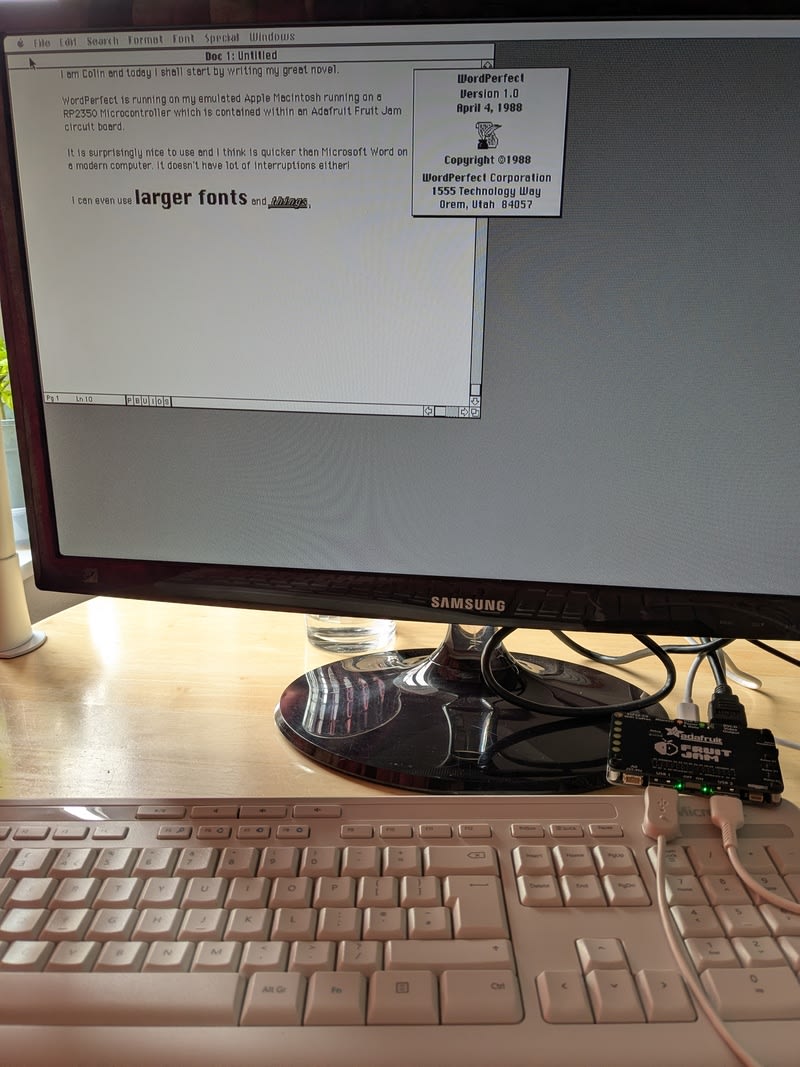
A developer successfully ran Adobe Photoshop on a 60 pence Raspberry Pi RP2350 chip by emulating an early Apple Macintosh. This project highlights the incredible efficiency and accessibility of modern microcontrollers compared to 1990s computing hardware.
The Intersection of Modern Microcontrollers and Legacy Software
In a fascinating exploration of computational limits, a developer has successfully executed Adobe Photoshop on a Raspberry Pi RP2350 microcontroller. Priced at approximately £0.60, this chip represents a significant leap in the democratization of hardware. By emulating an early Apple Macintosh environment, the experiment demonstrates that the processing power once reserved for high-end creative workstations in the 1990s can now be replicated on a component that costs less than a cup of coffee.
The Technical Achievement: Emulation on a Budget
The core of this project lies in the RP2350’s ability to emulate legacy architecture. While modern Photoshop is a resource-heavy suite requiring gigabytes of RAM and powerful GPUs, the version running here is a vintage iteration designed for the Macintosh OS of the 1990s. The developer utilized the chip's processing overhead to bridge the gap between contemporary silicon and historical software, proving that the 'cost' of entry for creative computing has plummeted exponentially over the last three decades.
Historical Context of Desktop Computing
To understand the significance of this feat, one must look at the hardware landscape of the 1990s. During that era, a machine capable of running Photoshop was a luxury item, often costing the modern equivalent of thousands of dollars. Today, the RP2350—a chip designed for low-power, embedded applications—can simulate that entire ecosystem. This transition reflects the broader trajectory of Moore’s Law, where the baseline for 'sufficient' computing power has shifted from expensive, monolithic desktop towers to tiny, affordable microcontrollers.
The Aesthetics of Low-Power Computing
The visual output of this experiment, displayed on a monochrome screen, serves as a poignant reminder of the evolution of user interfaces. Running Photoshop in a monochrome, emulated environment is not about achieving high-fidelity photo editing, but rather about the technical triumph of making complex software function on hardware that was never intended for such tasks. It challenges the modern perception that creative tools require top-tier hardware, highlighting the efficiency of earlier, more streamlined software architectures.
Broader Implications and Future Trends
This project hints at a growing trend in the maker community: 'retro-computing' through emulation. As hardware becomes smaller and more energy-efficient, the ability to run legacy software on inexpensive chips will likely see further development. This lowers the barrier for educational purposes, allowing students and enthusiasts to explore the history of computing without the need for fragile, aging vintage hardware. It suggests a future where the history of technology is preserved not just in museums, but in the active, functional environments of modern low-cost electronics.
Conclusion
Ultimately, while running Photoshop on a 60p chip may not be a practical solution for professional graphic design, it serves as a brilliant proof-of-concept. It bridges the gap between the past and the present, showcasing how far engineering has come. By turning the price of a small snack into a functional, historical computer, the developer has provided a compelling look at the democratization of technology, where the barriers to entry for complex computing have effectively vanished.