40 years ago October 28, 1986: Curfew in Hoshiarpur
Source Entity
The Indian Express
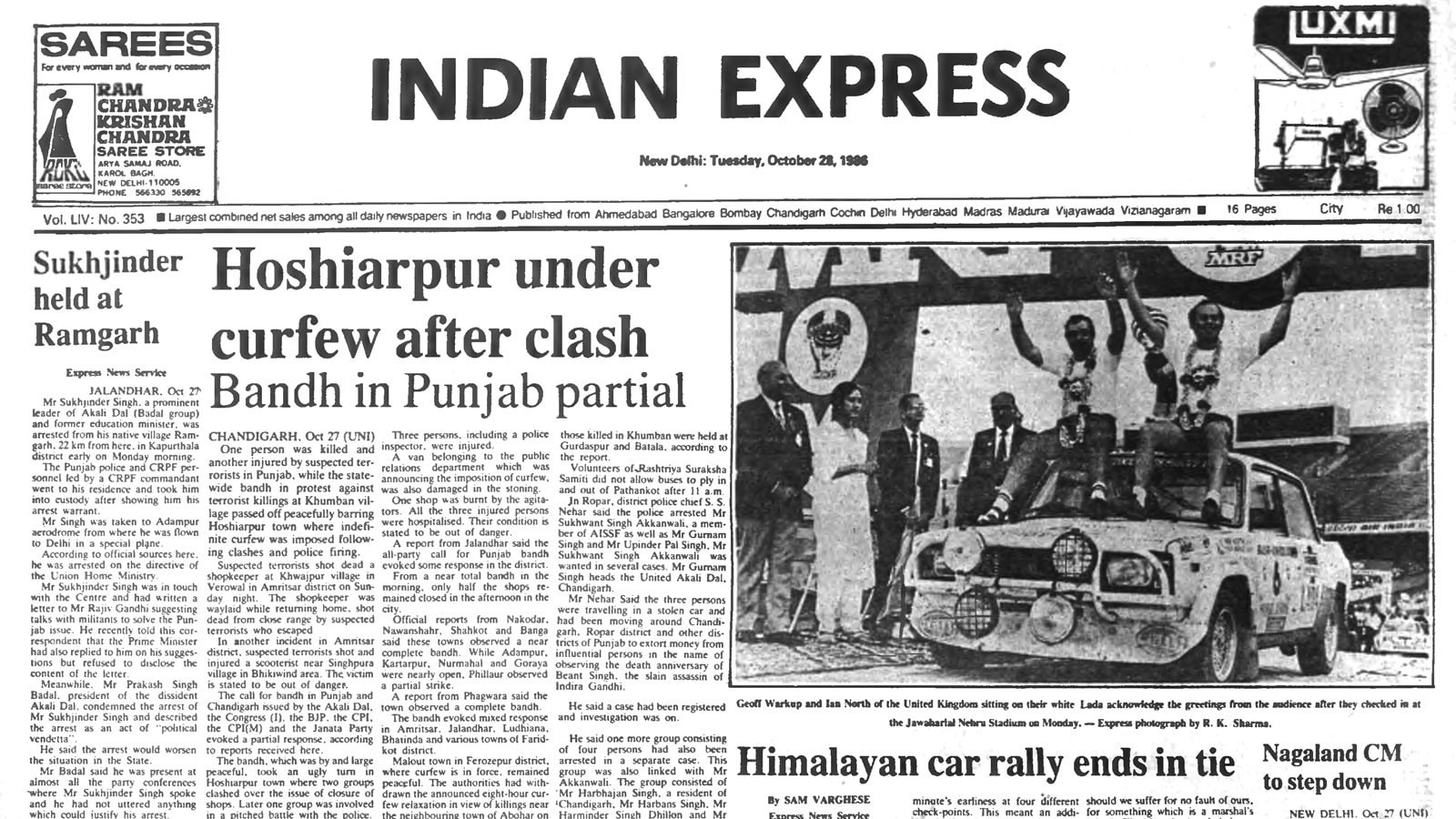
In October 1986, Punjab faced significant unrest marked by terrorist violence and subsequent civil protests, leading to a curfew in Hoshiarpur. Concurrently, authorities arrested Akali Dal leader Sukhjinder Singh as part of intensified state security measures.
The Volatile Climate of Punjab: October 1986
On October 28, 1986, the state of Punjab found itself gripped by a severe security crisis, characterized by targeted violence and civil unrest. Reports from the era indicate that suspected terrorists were responsible for the death of a shopkeeper in Khwajpur village, Amritsar district, and the injury of another individual. These acts of violence were part of a broader, destabilizing campaign that plagued the region throughout the 1980s, forcing the state and central governments to resort to extreme measures, including the imposition of indefinite curfews.
The Hoshiarpur Curfew and Civil Protest
The unrest reached a boiling point in Hoshiarpur town, where authorities were forced to implement an indefinite curfew following violent clashes and subsequent police firing. This localized escalation occurred against the backdrop of a statewide bandh (general strike) organized to protest the earlier terrorist killings in Khumban village. While the strike remained largely peaceful across the rest of the state, the situation in Hoshiarpur underscored the fragility of public order during this period and the government's reliance on strict curfews to prevent further communal or political instability.
Political Arrests and State Security
Compounding the security challenges was the political crackdown on prominent opposition figures. Sukhjinder Singh, a former education minister and a key leader within the Akali Dal (Badal group), was apprehended by a joint force of Punjab Police and CRPF personnel at his residence in Ramgarh, Kapurthala district. His swift transport to Adampur aerodrome and subsequent flight to Delhi in a special aircraft signaled the central government's intent to isolate influential political figures who were perceived as threats to the state's tenuous stability during the ongoing insurgency.
Historical Context and Broader Implications
The events of October 1986 were symptomatic of the deep-seated political and social fractures in Punjab during the mid-1980s. The detention of high-ranking Akali Dal leadership suggests that the administration viewed the political leadership of the time as being inextricably linked to the escalating chaos. By removing key figures like Sukhjinder Singh, the state aimed to dismantle political networks that were believed to be fueling, or at least failing to contain, the militancy that had paralyzed civic life.
Conclusion: A Legacy of Conflict
The convergence of targeted violence, civil protest, and the arrest of political leaders illustrates the multifaceted nature of the crisis in 1986. The imposition of an indefinite curfew in Hoshiarpur serves as a stark reminder of the limitations placed on civil liberties during this era. As the state grappled with internal security, the reliance on police force and the removal of political opposition became the standard, yet highly controversial, mechanisms of governance meant to restore order in a deeply fractured society.