Qwenputer: A functioning, deterministic RISC-V CPU inside Qwen3.5
Source Entity
Hacker News
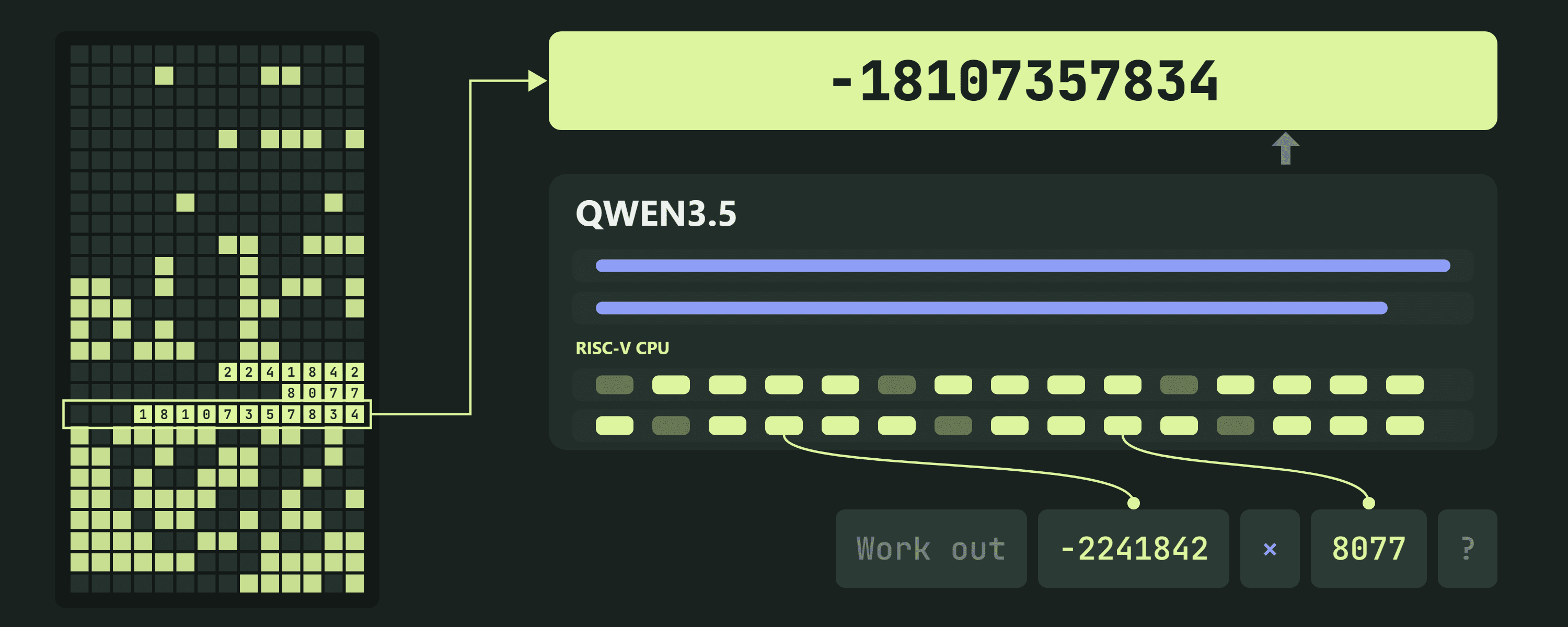
Qwenputer is an experimental AI model that embeds a fully functional RISC-V CPU within Qwen 3.5 4B weights. It utilizes Gated DeltaNet attention layers as RAM to execute C and MicroPython code natively during forward passes.
The Emergence of Qwenputer: Architecture and Innovation
Qwenputer represents a significant leap in experimental AI, functioning as a stock Qwen 3.5 4B model augmented with a native RISC-V CPU embedded directly within its weights. Unlike traditional implementations that rely on external plugins, tool-use APIs, or sandboxed environments, Qwenputer operates entirely within the model’s forward pass. This architectural choice effectively turns the neural network itself into the host environment for deterministic computation, blurring the lines between static inference and dynamic execution.
Leveraging Gated DeltaNet (GDN) as Memory
The most striking technical innovation in this project is the utilization of Gated DeltaNet (GDN) layers as the model’s Random Access Memory (RAM). By repurposing these attention layers, the developer has created a mechanism where the model can store and retrieve state information necessary for computational tasks. This transformation of attention mechanisms—typically used for weighting input importance—into functional storage is a novel approach to in-model memory management, allowing the system to maintain the persistence required for executing complex code.
Deterministic Execution and Code Processing
By embedding a RISC-V architecture, Qwenputer gains the ability to execute arithmetic operations, C code, and MicroPython scripts without requiring an external runtime environment. Because this occurs inside the forward pass, the execution is deterministic, meaning the model behaves like a traditional processor rather than a probabilistic language generator for these specific tasks. This capability bypasses the latency and security vulnerabilities associated with external 'code interpreter' tools, as the entire process is encapsulated within the neural weights.
Theoretical and Practical Implications
The implications of an in-model file storage system and integrated CPU are profound for the field of AI research. By demonstrating that a model can manage its own storage and computation, the project suggests a future where AI agents are self-contained ecosystems. This reduces the dependency on external cloud-based runtimes, potentially enabling more robust offline AI applications that are capable of reasoning and executing logic in a single, unified pass.
Future Trends in Hybrid Neural Architectures
As the developer has hinted with follow-up projects, the evolution of hybrid models—specifically those that can 'hide' reasoning within their own internal states—points toward a shift in how we design LLMs. The ability to perform complex reasoning and logic inside the weights suggests that future models may evolve from mere text predictors into sophisticated, autonomous computational engines. Qwenputer serves as a foundational proof-of-concept for this paradigm shift, signaling a move toward more integrated, efficient, and self-reliant artificial intelligence architectures.