Rajnath Singh launches Navy’s first indigenous fleet support ship ‘Surya’ at Visakhapatnam
Source Entity
India Latest News: Top National Headlines Today & Breaking News | The Hindu
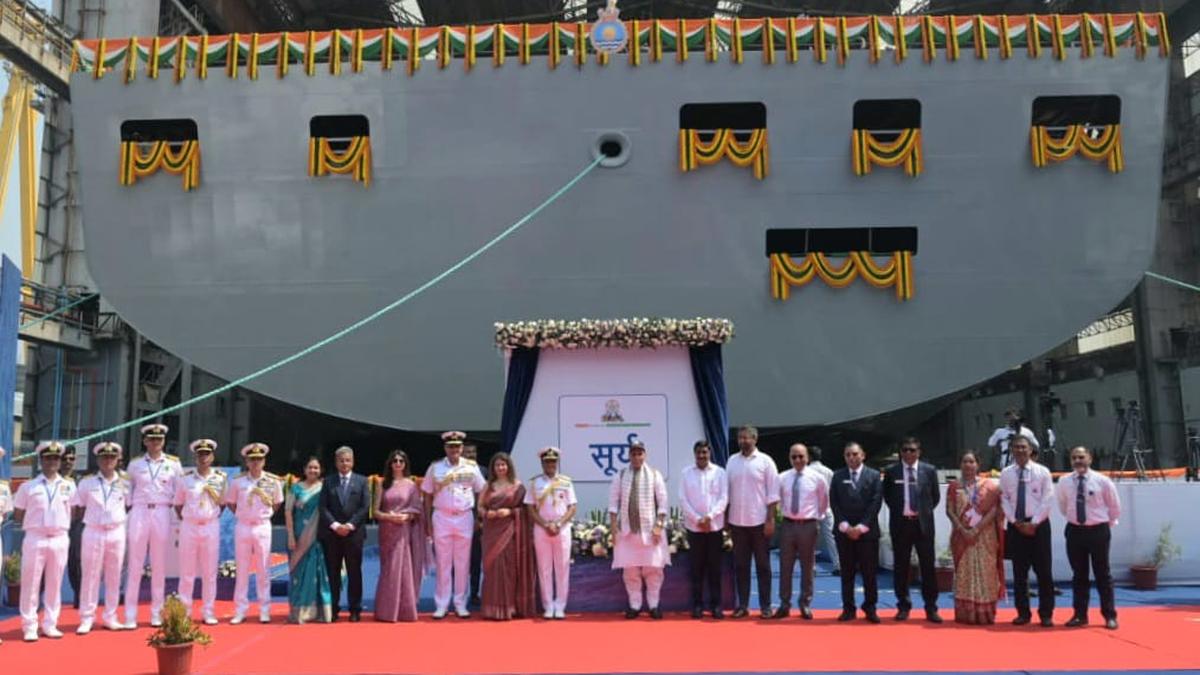
Defence Minister Rajnath Singh launched India's first indigenous Fleet Support Ship, 'Surya,' in Visakhapatnam. This ₹19,000-crore project aims to significantly enhance the Indian Navy's maritime endurance and global operational reach.
Strengthening India’s Blue Water Ambitions
On October 6, 2026, Defence Minister Rajnath Singh presided over a landmark event at Hindustan Shipyard Limited (HSL) in Visakhapatnam, marking the launch of the Indian Navy’s first indigenous Fleet Support Ship (FSS), named 'Surya.' This event represents a pivotal shift in India's naval strategy, moving from a coastal defense focus toward establishing a formidable blue-water capability. By launching the first of five planned vessels, India is systematically addressing the logistical constraints that have historically limited its naval reach.
The Strategic Significance of the FSS-1 'Surya'
The FSS-1 'Surya' is a massive 43,500-tonne vessel designed to act as a lifeline for the fleet while at sea. Unlike traditional combatant ships, these support vessels are engineered to refuel and resupply multiple warships simultaneously. This capability allows the Indian Navy to maintain a persistent presence in the Indian Ocean and beyond without the necessity of returning to port, effectively extending the operational range of the fleet and ensuring sustained maritime dominance.
Indigenous Manufacturing and Economic Impact
A notable aspect of this project is its commitment to the 'Atmanirbhar Bharat' (Self-reliant India) initiative. The 'Surya' has been constructed with 82% indigenous content, showcasing the growing technical sophistication of Indian shipyards like HSL. The ₹19,000-crore investment not only bolsters defense infrastructure but also invigorates the domestic manufacturing ecosystem. The inauguration of an upgraded slipway and a 300-tonne crane at the shipyard further underscores the government's intent to modernize India’s maritime industrial base.
Historical Context and Fleet Evolution
Historically, the Indian Navy has relied on a limited number of fleet tankers, such as the INS Shakti and INS Jyoti on the eastern coast and INS Deepak and INS Aditya on the western coast. While these vessels have served the navy well, the induction of five new, state-of-the-art indigenous FSS vessels will modernize and expand this support capacity. By simultaneously launching the 'Surya' and laying the keel for the fifth vessel (FSS-5), the Ministry of Defence is demonstrating an accelerated pace of production designed to meet modern security requirements.
Future Trends and Global Maritime Power
As Rajnath Singh stated, the goal is to transcend simple self-reliance and establish India as a global maritime power. The integration of these support ships is a prerequisite for sustaining long-term carrier battle group operations in international waters. As geopolitical dynamics in the Indo-Pacific evolve, the ability to project power far from home bases will become a defining feature of India’s naval influence, ensuring the safety of sea lines of communication and enhancing India's status as a net security provider in the region.
Verification Required?