Rare wheel-like stone unearthed at Megalithic burial site in Keralam’s Kannur
Source Entity
News Today: Breaking News, Top Headlines & Live Updates | The Hindu
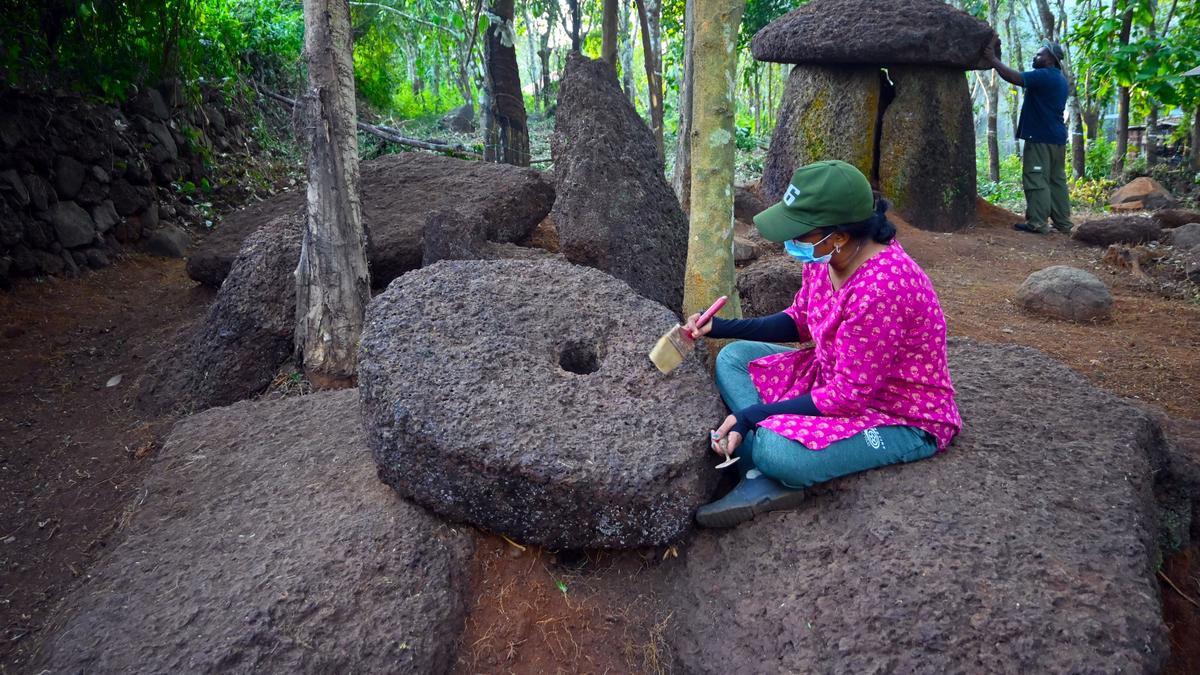
Archaeologists have discovered a rare, wheel-like stone with a central post hole at a Megalithic burial site in Kannur, Kerala. This unique artifact was found near a cluster of existing umbrella stones and hat stones, prompting further investigation into its historical function.
Rare Megalithic Discovery in Kannur
Recent archaeological investigations at Kuzhummal-Peralam in Karivellur, Kannur, have yielded a fascinating discovery: a rare, wheel-like stone featuring a central post hole. This artifact was unearthed on a residential plot, adding a new layer of complexity to the existing cluster of Megalithic burial monuments previously identified in the region. The discovery, facilitated by the Kerala State Department of Archaeology, highlights the rich, often hidden historical landscape of northern Kerala.
Contextualizing the Megalithic Assemblage
The site in question is already well-known for its significant concentration of funerary architecture. Prior to this finding, the location was documented as hosting seven 'kudakkals,' or umbrella stones, which are hallmark structures of South Indian Megalithic culture. The recent survey also uncovered a 'hat stone,' further confirming that this site served as a necropolis or a site of ritualistic significance for ancient populations. The presence of the wheel-like stone in such close proximity to these structures suggests a deliberate, albeit currently mysterious, integration into the burial site's layout.
The Mystery of the Wheel-like Stone
K. Krishnaraj, the archaeologist in charge of the Pazhassi Raja Archaeological Museum, has noted that this specific stone form is highly unusual. The central post hole is a critical feature that invites speculation regarding its original purpose. While it is tempting to theorize about its function—whether it served as a structural element, a component of a larger ritual apparatus, or a symbolic marker—experts emphasize that detailed documentation and rigorous contextual analysis are required before any definitive conclusions can be drawn.
Archaeological Methodology and Future Trends
The discovery underscores the importance of the ongoing efforts by the Kerala State Department of Archaeology to map and protect these sites. By documenting these finds in residential areas, the department is not only preserving history but also engaging the local community in the stewardship of their cultural heritage. Future research will likely focus on stratigraphy and comparative analysis with other Megalithic sites in the Indian subcontinent to determine if this wheel-like stone is a localized anomaly or a component of a broader, previously unrecognized architectural tradition.
Broader Historical Implications
Megalithic cultures in India, typically dating from the Iron Age, represent a sophisticated level of social organization and burial practice. The Kannur find contributes to the growing body of evidence that the Malabar coast was a vibrant hub of human activity during this era. As analysts continue to examine the site, the focus remains on determining whether the stone was contemporaneous with the umbrella stones or if it represents a different phase of human occupation. This find serves as a reminder that the archaeological map of Kerala is still evolving, with each new excavation providing deeper insights into the lives and beliefs of ancient ancestors.
Verification Required?