Reactive Optimizers: rewrite the optimizer's source code during training
Source Entity
Hacker News
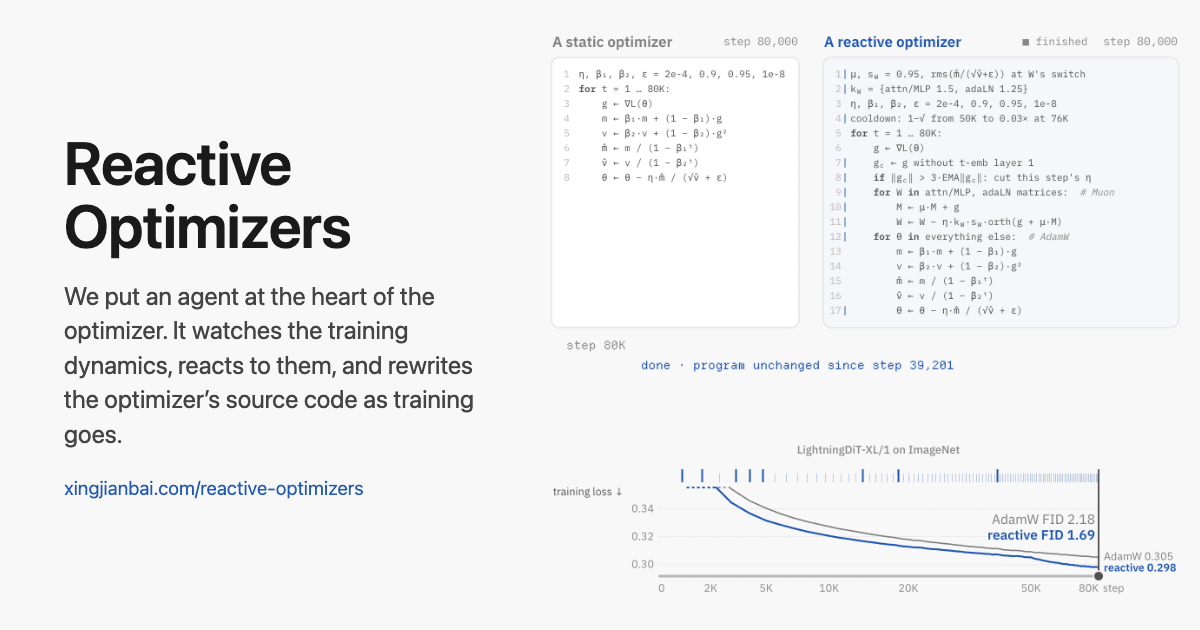
Researchers have introduced 'Reactive Optimizers,' a novel approach where an AI agent dynamically rewrites optimizer source code during model training. This method allows for real-time adjustments that outperform static, pre-tuned configurations across various machine learning tasks.
The Evolution of Model Training: Reactive Optimizers
In the traditional landscape of deep learning, the training process is governed by static recipes. Before a single weight is updated, engineers must commit to a fixed optimizer configuration—such as learning rates, momentum, or weight decay schedules. While effective, this 'set-and-forget' approach often leaves performance on the table, as these hyperparameters are rarely optimal across the entire duration of a training run. The introduction of Reactive Optimizers marks a fundamental shift by placing an intelligent agent at the core of the optimization loop.
How Reactive Optimization Works
Unlike conventional optimizers that follow rigid mathematical rules, Reactive Optimizers act as a meta-learning layer. By monitoring training dynamics in real-time, the agent observes loss landscapes, gradient behaviors, and convergence patterns. It then proceeds to rewrite the optimizer’s source code on the fly. This capability enables the system to adapt its internal logic to the specific needs of the model as it evolves, rather than adhering to a predetermined schedule that may become obsolete as the loss function changes.
Performance and Adaptability
One of the most compelling aspects of this technology is its performance on tasks where no pre-tuned recipe exists. In scenarios ranging from image processing to complex language model training, Reactive Optimizers have demonstrated the ability to match or exceed the performance of the best off-the-shelf configurations. By removing the need for exhaustive manual hyperparameter tuning—often a costly and time-consuming 'black art' in data science—this approach democratizes high-performance model training.
Mitigating Failure Modes
Beyond simple performance gains, the reactive agent exhibits emergent behaviors that address common pitfalls in neural network training. The research suggests that these systems can spontaneously develop sophisticated strategies to stabilize training, specifically by identifying and mitigating loss spikes before they cause divergence. Furthermore, the system has shown a capacity to navigate away from overfitting by dynamically adjusting its optimization strategy, effectively acting as an automated regularization tool.
Future Implications and Implementation
As deep learning models continue to scale in parameter count and architectural complexity, the reliance on manual optimizer tuning becomes a bottleneck. The introduction of the OPAL package offers a practical pathway for researchers to integrate these reactive capabilities into their own workflows. If this technology gains widespread adoption, it could signal the end of the era of static optimization, leading to more resilient, efficient, and autonomous training pipelines that require significantly less human intervention.