Beware of clicking on 3 dots: You may lose money to cons
Source Entity
TNN
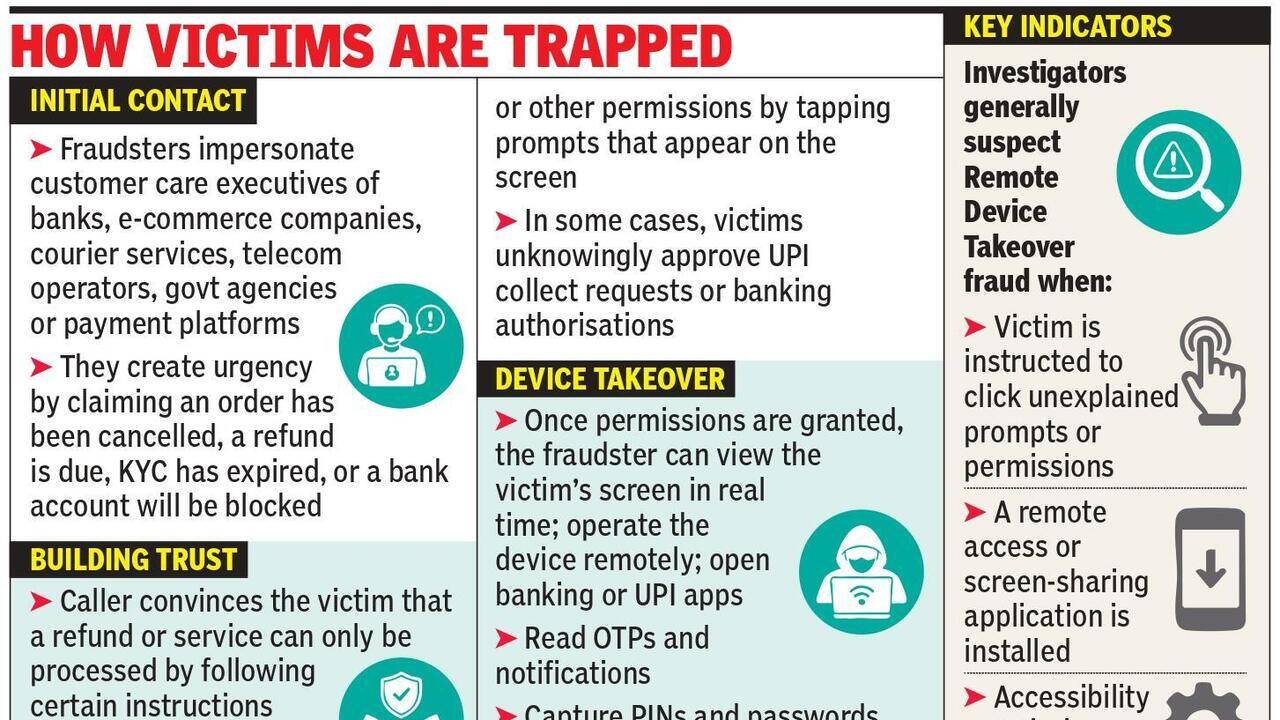
Cybercriminals are using remote device takeover tactics to drain bank accounts by tricking users into granting screen-sharing permissions. A Lucknow resident recently lost over three lakh rupees after fraudsters posed as customer support to gain access to her device.
The Rise of Remote Device Takeover Fraud
In an era where digital transactions have become the backbone of daily commerce, a new and alarming threat has emerged: Remote Device Takeover Fraud. As highlighted by recent incidents in Lucknow, where a victim lost over ₹3.05 lakh, cybercriminals are increasingly bypassing traditional security measures by exploiting the human element rather than just technical vulnerabilities. This scam typically begins with a seemingly innocuous interaction, such as a call from a fake customer support executive, leading to the unauthorized compromise of personal mobile devices.
The Mechanics of the Scam
The modus operandi relies on social engineering. Fraudsters pose as legitimate representatives from e-commerce platforms or financial institutions, creating a sense of urgency or necessity. By instructing victims—or their unsuspecting family members—to click on specific prompts, approve SMS permissions, or select the “three dots” menu on their screens, criminals gain the ability to mirror or control the device remotely. Once this access is granted, the attacker can navigate banking applications, intercept one-time passwords (OTPs), and initiate unauthorized fund transfers without the victim’s immediate awareness.
Psychological Manipulation and Target Selection
What makes this fraud particularly insidious is its reliance on psychological manipulation. By targeting individuals during routine activities—such as waiting for an e-commerce order—scammers lower the victim's guard. In the Lucknow case, the perpetrators successfully tricked the victim's child, demonstrating that these criminals are opportunistic and willing to exploit any member of a household to gain the necessary access. This highlights a critical need for digital literacy across all age groups, as the boundary between a helpful support call and a malicious intrusion has become dangerously blurred.
Broader Implications for Digital Security
The increasing frequency of such scams signals a paradigm shift in how we must approach mobile security. While banking apps have implemented robust encryption and multi-factor authentication, these protections are rendered ineffective if the user themselves grants the attacker an 'all-access pass' to the device. This trend suggests that security experts must now focus as much on user behavior and awareness as they do on software patches. The reliance on screen-sharing tools for legitimate support has created a 'blind spot' that criminals are now aggressively weaponizing.
Future Trends and Prevention
Moving forward, we can expect to see an evolution in these tactics as AI and voice-cloning technologies make impersonation even more convincing. To combat this, platforms must implement stricter verification protocols for customer support interactions, and users must adopt a 'zero-trust' approach to unsolicited requests for permission-based actions. The future of mobile safety lies in the widespread recognition that no legitimate service provider will ever ask a user to share their screen or approve unknown prompts via third-party links or SMS.
Conclusion
The case of the Lucknow resident serves as a stark reminder of the financial and emotional toll exacted by remote device takeover schemes. As digital adoption continues to accelerate, protecting one’s digital perimeter is no longer optional. By remaining vigilant against deceptive prompts and refusing to grant remote access to unknown callers, consumers can safeguard their assets against these sophisticated cyber threats.