'Apologise for 1962 humiliation': Rijiju counters Rahul's 'compromised PM' swipe
Source Entity
SUBHADRA SRIVASTAVA
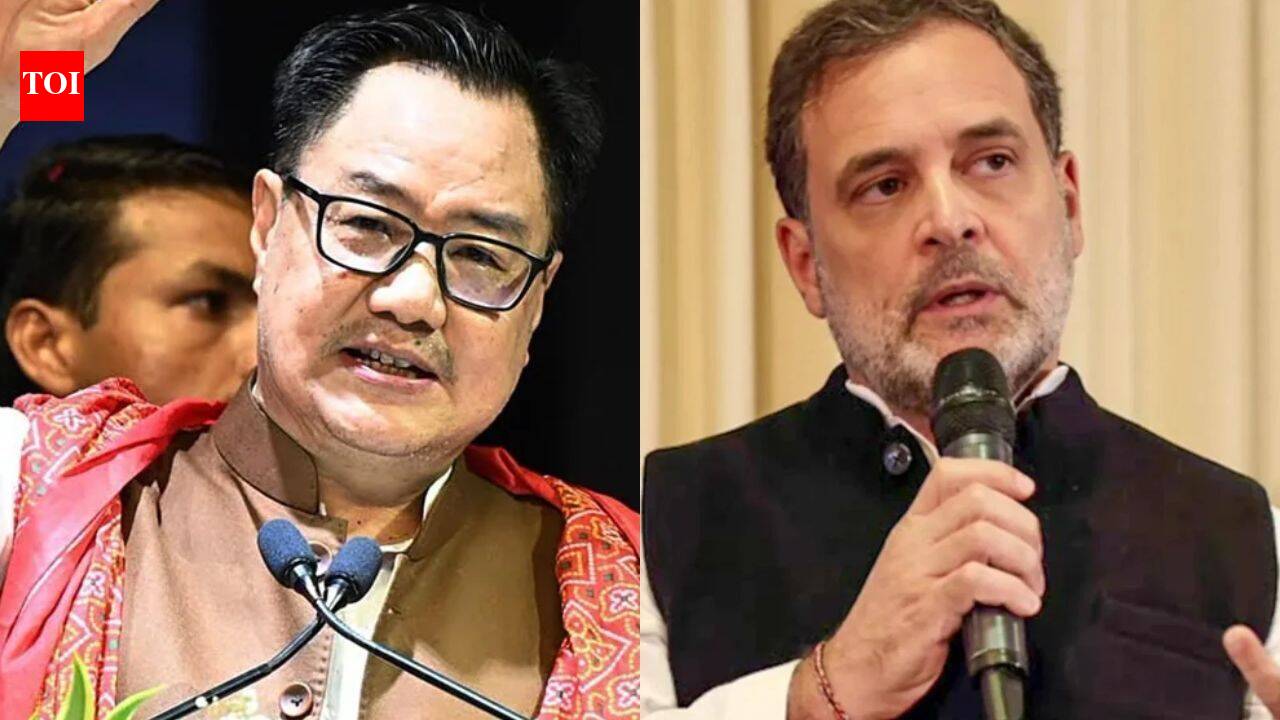
Union Minister Kiren Rijiju has challenged Rahul Gandhi following the latter's 'compromised PM' criticism of Narendra Modi. Rijiju demanded an apology for the 1962 China conflict and questioned the Congress party's historical governance record.
The Political Fallout: Rijiju vs. Gandhi
The Indian political landscape witnessed a sharp intensification of rhetoric on November 21, 2026, as Parliamentary Affairs Minister Kiren Rijiju launched a scathing rebuttal against Congress leader Rahul Gandhi. This confrontation stems from Gandhi's recent characterization of Prime Minister Narendra Modi as a 'compromised PM,' a remark that has triggered a broader ideological struggle between the Bharatiya Janata Party (BJP) and the opposition. By pivoting the discourse toward historical grievances, Rijiju has effectively shifted the narrative from current policy critique to a debate on the Congress party's historical legacy.
The 1962 Conflict as a Political Pivot
At the core of Rijiju’s argument is the 1962 Sino-Indian War, an event that remains a sensitive point in Indian political memory. Rijiju, citing his own personal experience, noted that his village was occupied by China during the conflict. By demanding an apology for the '1962 humiliation,' the Minister is attempting to frame the current opposition's critique as hypocritical, given the territorial losses incurred under previous Congress administrations. This strategy seeks to undermine the credibility of the opposition’s national security narrative by forcing them to defend past geopolitical failures.
Economic Critiques and Historical Narratives
Beyond territorial disputes, Rijiju’s four-pronged inquiry targets the economic history of India under Congress rule. By questioning why India was kept as a 'poor nation,' why it was stereotyped as the 'land of snake charmers,' and why the economy was historically labeled the 'Hindu rate of growth,' the Minister is challenging the economic developmental model championed by the Congress party for decades. These points are designed to resonate with a voter base that prioritizes economic growth and national pride, positioning the BJP as the architect of India’s modern economic ascent.
Geopolitical Implications and Party Positioning
The BJP’s response, articulated through leaders like Rijiju, characterizes Rahul Gandhi as 'clueless' regarding global geopolitics. This framing is crucial for the party's strategy to delegitimize opposition critiques of the current government's foreign policy. By focusing on historical baggage, the BJP aims to insulate the current administration from claims of being 'compromised' by highlighting that the party currently in opposition oversaw significant setbacks during the mid-20th century.
Future Trends in Political Discourse
This exchange signals a trend where historical narratives are increasingly weaponized to define contemporary political legitimacy. As the two major political forces continue to clash, it is likely that future parliamentary sessions will see further focus on the historical records of each party. The reliance on legacy-based arguments suggests that both the BJP and the Congress are doubling down on their respective voter bases, utilizing emotional and historical triggers to maintain ideological cohesion in an increasingly polarized landscape.
Conclusion
In summary, the exchange between Kiren Rijiju and Rahul Gandhi illustrates the deep-seated friction between India's ruling coalition and the opposition. By demanding accountability for 1962 and past economic performance, Rijiju has successfully forced the Congress into a defensive posture regarding its historical governance. As this rhetoric continues, the focus remains on whether such historical debates will influence the electorate's perception of current governance or if the public will demand a shift toward future-oriented policy discussions.