Rio Witnesses Spectacular ‘Blood Moon’ As Earth’s Shadow Covers 96% Of Moon
Source Entity
Latest News: Todays Latest News Headlines from India & World | Hindustan Times | Hindustan Times
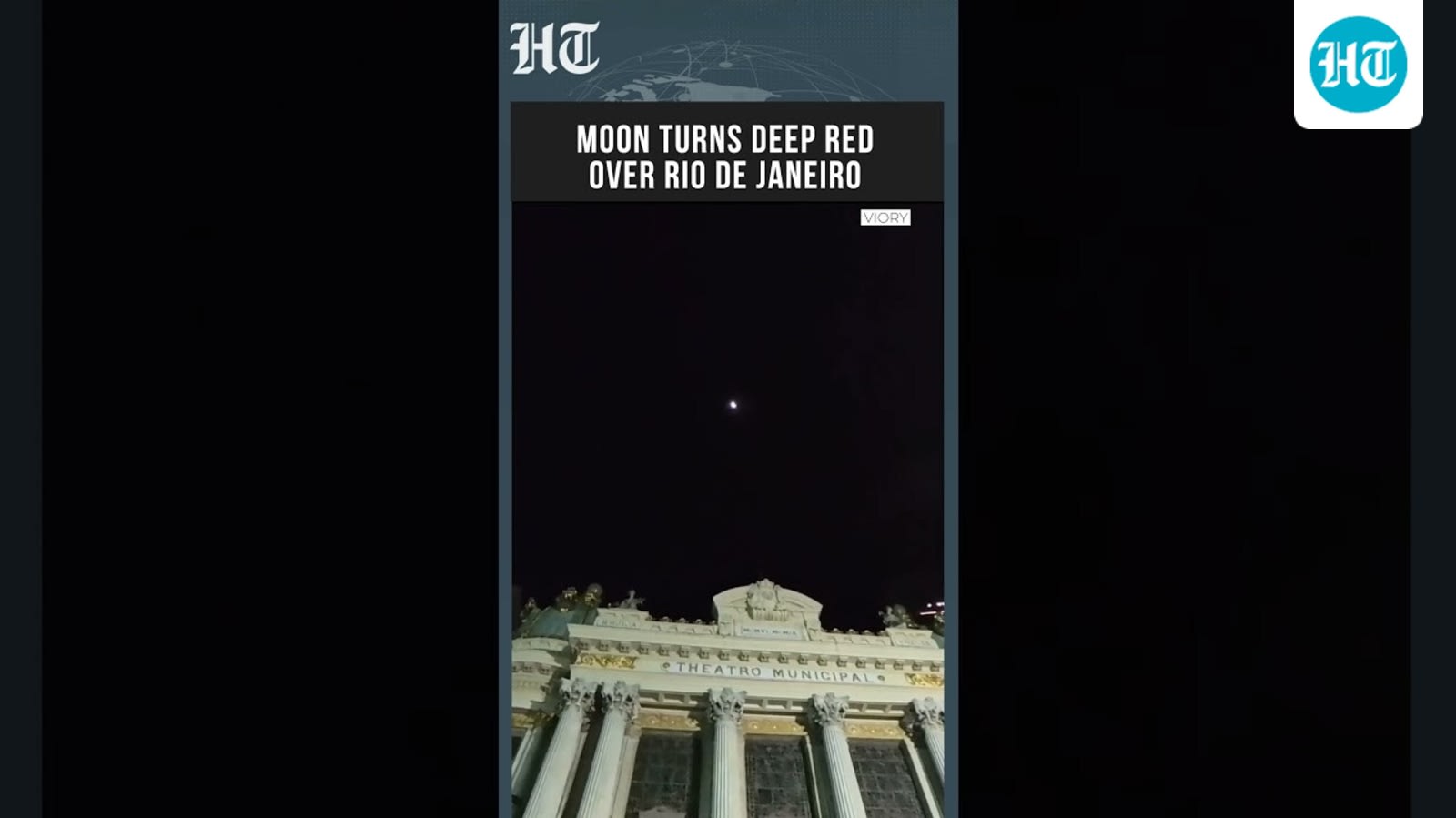
Rio de Janeiro experienced a rare near-total lunar eclipse that turned the Moon a deep copper-red. The event occurred as Earth's shadow covered 96.2% of the lunar surface.
A Celestial Spectacle Over Rio
Early on Friday, the skies above Rio de Janeiro played host to a rare and visually arresting astronomical event: a near-total lunar eclipse. As the Earth moved directly between the Sun and the Moon, it cast its shadow across the lunar surface, resulting in a phenomenon colloquially known as a 'Blood Moon.' At the height of the event, an impressive 96.2 percent of the Moon was obscured, leaving only a sliver of the lunar disk untouched by the umbra.
The Mechanics of the Copper-Red Glow
The striking copper-red coloration observed by residents in Rio is a result of Rayleigh scattering. As sunlight passes through Earth's atmosphere, shorter blue wavelengths are filtered out, while longer red wavelengths are bent, or refracted, around the curvature of the Earth toward the Moon. This process illuminates the lunar surface with a dim, reddish hue, creating the dramatic contrast that distinguishes a lunar eclipse from a standard full moon.
Astronomical Significance
While lunar eclipses occur periodically, a near-total eclipse reaching over 96 percent coverage is a significant event for observers. Unlike solar eclipses, which require specialized protective eyewear and are limited to narrow geographic paths, this lunar event was visible to anyone on the night side of the Earth, provided clear skies. For the residents of Rio, the event offered a unique opportunity to engage with celestial mechanics without the need for sophisticated equipment.
Historical and Cultural Context
Throughout history, such astronomical events have often been viewed with a mix of awe and trepidation. In many ancient cultures, the sudden change in the Moon's appearance was interpreted as an omen. Today, however, the event serves as a testament to our advanced understanding of orbital dynamics. The precision with which scientists can predict the exact timing and percentage of lunar coverage highlights the rigor of modern celestial mechanics.
Future Trends in Lunar Observation
As public interest in astronomy continues to grow, events like the Rio 'Blood Moon' serve as vital entry points for science education. These phenomena encourage amateur stargazing and foster a deeper public appreciation for our solar system. As we look ahead, the continued tracking of these eclipses remains a cornerstone of observational astronomy, providing researchers with data on the state of the Earth's atmosphere and the Moon's orbital path.
Conclusion
The near-total lunar eclipse in Rio was more than just a beautiful night sky display; it was a powerful reminder of our planet's place within the solar system. By witnessing the Earth's shadow projected onto the Moon, observers were able to visualize the complex interplay of celestial bodies that governs our day-to-day existence.
Verification Required?