RSS chief Mohan Bhagwat cautions against disruptive agitations, alleges foreign conspiracy: Key takeaways
Source Entity
Vikas Pathak
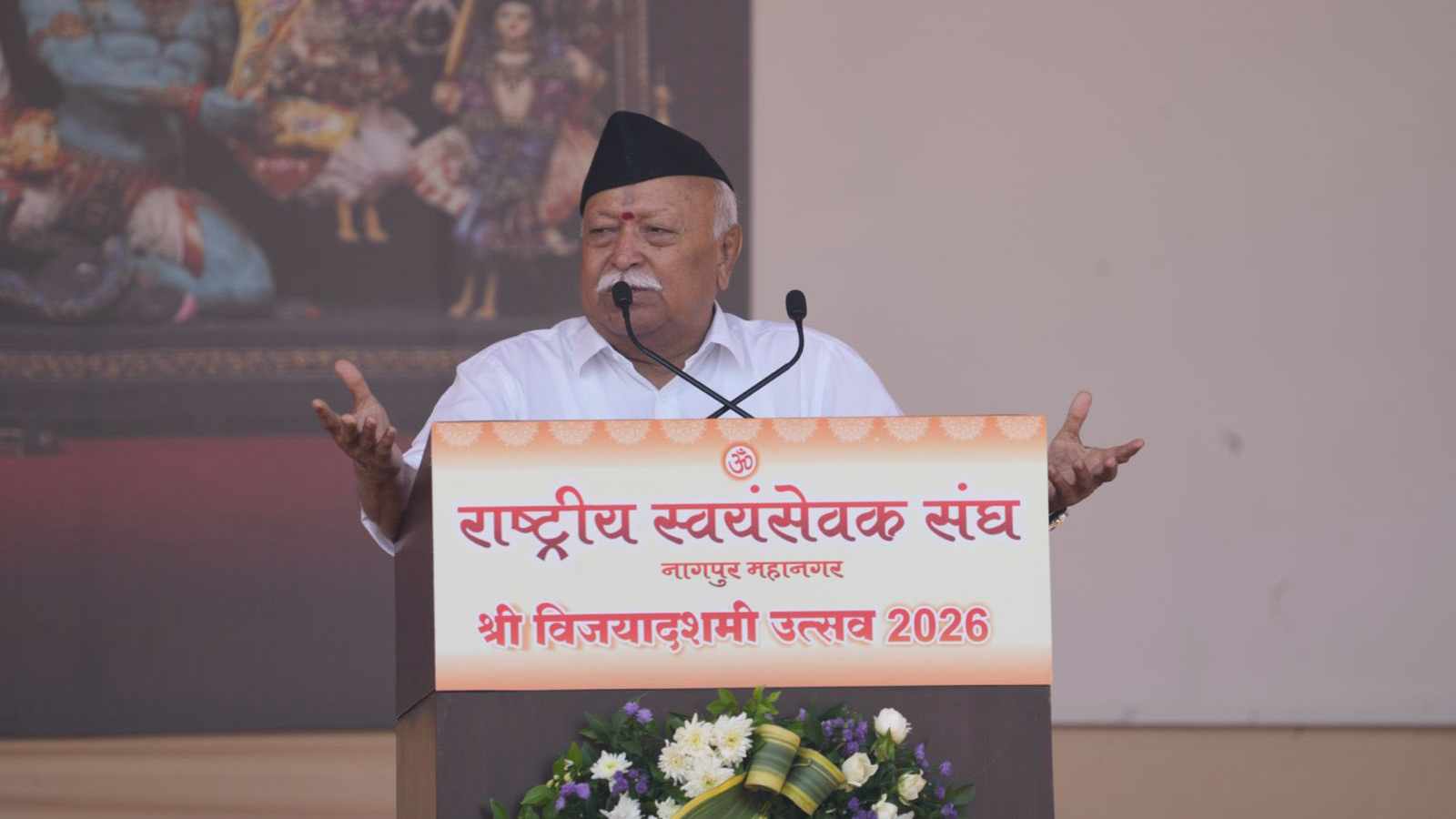
RSS Chief Mohan Bhagwat emphasized national unity and social harmony while cautioning against the belief that regime changes solve systemic societal problems. Speaking at the 101st anniversary of the RSS, he urged citizens to focus on internal solutions rather than divisive protests.
RSS Centenary and the Vision of 'Sva'
At the recent Vijayadashami celebrations marking the 101st anniversary of the Rashtriya Swayamsevak Sangh (RSS) in Nagpur, Sarsanghchalak Mohan Bhagwat delivered a wide-ranging address that touched upon national identity, the historical significance of social reformers like Sant Ravidas, and the organization's stance on contemporary political discourse. The event, attended by Vice President Jagdeep Dhankhar, served as a platform for the RSS to reiterate its core mission of 'awakening the sva'—a concept Bhagwat describes as the inner ethos of Indian civilization that has guided the organization's work for the past century.
The Historical Context of 'Svadharma'
Bhagwat drew deep historical parallels by invoking the life and teachings of the 15th-century saint Ravidas. By framing Ravidas as a figure who comforted society during periods of foreign invasion and terror, Bhagwat aimed to project the RSS’s current efforts as a continuation of a long-standing tradition of 'svadharma nishtha' (devotion to one's own duty). This narrative is designed to root the modern RSS project in the cultural and spiritual soil of India, emphasizing that true national unity is achieved by embracing the country's inherent diversity while upholding shared values.
Skepticism Toward Regime Change
One of the most significant aspects of the address was Bhagwat’s explicit rejection of the idea that a change in government is a panacea for national challenges. Referencing recent geopolitical upheavals in countries like Bangladesh, Nepal, Albania, and France, he argued that regime change often fails to deliver the promised improvements in societal conditions. This assertion suggests that the RSS leadership views stability and internal societal reform as more critical to India's progress than the cyclical shifts in political power that characterize democratic systems.
Addressing Global and Internal Tensions
Bhagwat also addressed what he termed the efforts of 'evil forces' to dismantle India, linking these attempts to the nation's recent economic and policy successes. He posited that global powers, driven by narrow interests, are attempting to weaken India’s trajectory. By framing these external pressures as an inevitable response to India’s growth, the RSS chief reinforced a narrative of national resilience, suggesting that the country’s decisive policies have made it a target for those who wish to disrupt its momentum.
The Role of Social Agitation
In light of current protests and public agitations, Bhagwat cautioned that mere protests do not bring about structural change. He urged society to look inward, suggesting that the solutions to systemic problems must emerge from within the community itself rather than through external agitation. This perspective is consistent with the RSS's long-standing belief in 'Samajik Samrasta' (social harmony), where the organization positions itself as a mediator and guide for societal cohesion rather than a participant in standard electoral politics.
Conclusive Summary
Mohan Bhagwat’s address at the 101st anniversary of the RSS underscores a strategic pivot toward emphasizing ideological continuity over political expediency. By linking the 'awakening of sva' to national stability and cautioning against the efficacy of regime change, the RSS is setting a long-term agenda that prioritizes cultural unity and internal social reform. As India continues to navigate complex geopolitical and internal challenges, the RSS’s focus on these themes suggests a continued effort to shape the national discourse around the preservation of traditional values and the rejection of foreign-influenced political agitation.
Multiple Citing Sources