Europe makes deal with Ukraine, Putin unleashes 135 drones; 'Coalition of the Willing' in danger?
Source Entity
Latest News: Today's Latest News Headlines from India & World | Hindustan Times | Hindustan Times
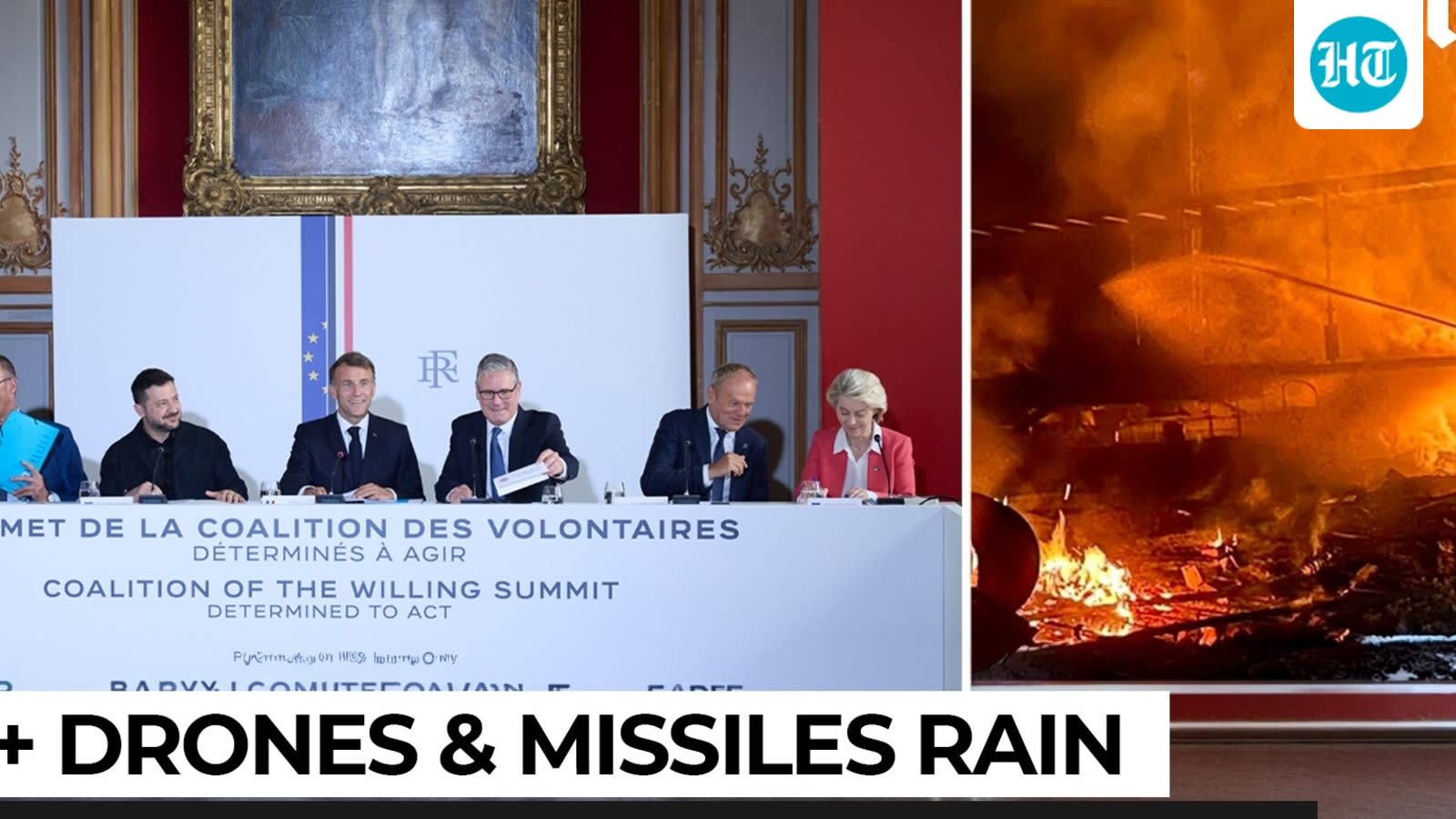
Russia launched a massive wave of 135 drones and missiles targeting major Ukrainian cities, including Kyiv and Odesa, coinciding with a critical meeting of European leaders in Paris aimed at strengthening military support for Ukraine.
Escalation Amidst Diplomacy: Russia's Drone Offensive and the Paris Summit
The recent launch of 135 drones and missiles by Russian forces across Ukraine represents a calculated synchronization of kinetic warfare and psychological pressure. By targeting critical urban centers such as Kyiv, Kharkiv, Odesa, and Zaporizhzhia, the Kremlin is not merely attempting to degrade Ukrainian military infrastructure but is sending a visceral message to the international community. This massive wave of strikes occurs at a pivotal moment as European leaders convene in Paris, highlighting a stark contrast between the diplomatic efforts to secure Ukraine's future and the brutal reality of the ongoing aerial campaign.
Tactical Objectives and Urban Targeting
The selection of targets—spanning the north, east, south, and center of the country—suggests a strategy of saturation. By striking Kyiv, the political heart; Kharkiv, a vital industrial hub; Odesa, the primary maritime gateway; and Zaporizhzhia, a frontline strategic point, Russia aims to overstretch Ukraine's air defense systems. This "saturation attack" is designed to identify gaps in the Ukrainian shield and exhaust the supply of interceptor missiles. From a strategic standpoint, these strikes serve to demoralize the civilian population and disrupt the logistics necessary for Ukraine to maintain its defensive lines, effectively attempting to create a state of perpetual instability.
The 'Coalition of the Willing' and the Paris Dialogue
Simultaneous to these attacks, the gathering of European leaders in Paris underscores the urgency of the "Coalition of the Willing." This term refers to the subset of allied nations prepared to move beyond cautious support toward more aggressive military provisioning. The discussions in Paris are likely centered on the procurement of advanced long-range weaponry and more robust integrated air defense systems (IADS) to counter the very drone swarms currently plaguing Ukrainian cities. However, the phrase "in danger" suggests a growing friction within the alliance, where diverging national interests and "war fatigue" may be hindering the speed and scale of military commitments.
Zelensky's Strategic Plea for Sanctions and Weaponry
President Volodymyr Zelensky's renewed calls for tougher sanctions and increased weaponry are not merely reactions to the latest strikes, but a broader strategic demand for a shift in the West's approach. Zelensky recognizes that while military hardware provides tactical advantages, only comprehensive economic strangulation of the Russian war machine can ensure long-term sustainability. By tying the current drone onslaught to the need for tougher sanctions, the Ukrainian leadership is arguing that the current international restrictions are insufficient to deter Putin's aggression, thereby urging the Paris summit to move from rhetoric to enforceable policy.
Geopolitical Messaging and the Timing of the Attack
The timing of Putin's offensive is unlikely to be coincidental. Launching a massive strike while European leaders meet in Paris is a classic example of "coercive diplomacy." Russia is attempting to signal that any increase in European military support will be met with an immediate and proportional escalation in violence. This is intended to sow doubt among European leaders, suggesting that providing more advanced weapons might inadvertently provoke a wider conflict or increase the intensity of strikes on Ukrainian soil. It is a high-stakes game of brinkmanship designed to fracture the unity of the European coalition.
Future Trends: The Evolution of Aerial Warfare
Looking forward, this event signals a transition toward more frequent and larger-scale drone deployments. The use of 135 drones in a single wave indicates an industrialization of drone warfare that will force a paradigm shift in how air defense is managed. We can expect a trend where Ukraine becomes increasingly dependent on AI-driven counter-drone technology and a decentralized air defense network. Furthermore, the outcome of the Paris summit will determine whether the "Coalition of the Willing" evolves into a formalized military procurement bloc or remains a loose assembly of nations with varying levels of commitment.
Conclusion
The juxtaposition of the Paris summit and the massive Russian drone strikes illustrates the precarious balance between diplomatic hope and military desperation. While European leaders seek to forge a stronger alliance to support Kyiv, the Kremlin continues to use overwhelming force to test the limits of that resolve. The ability of the "Coalition of the Willing" to translate their discussions into tangible, rapid military and economic action will be the deciding factor in whether Ukraine can withstand this intensified phase of the conflict.
Verification Required?