Space tech VC funding tops 2025 in just six months
Source Entity
Yahoo Finance
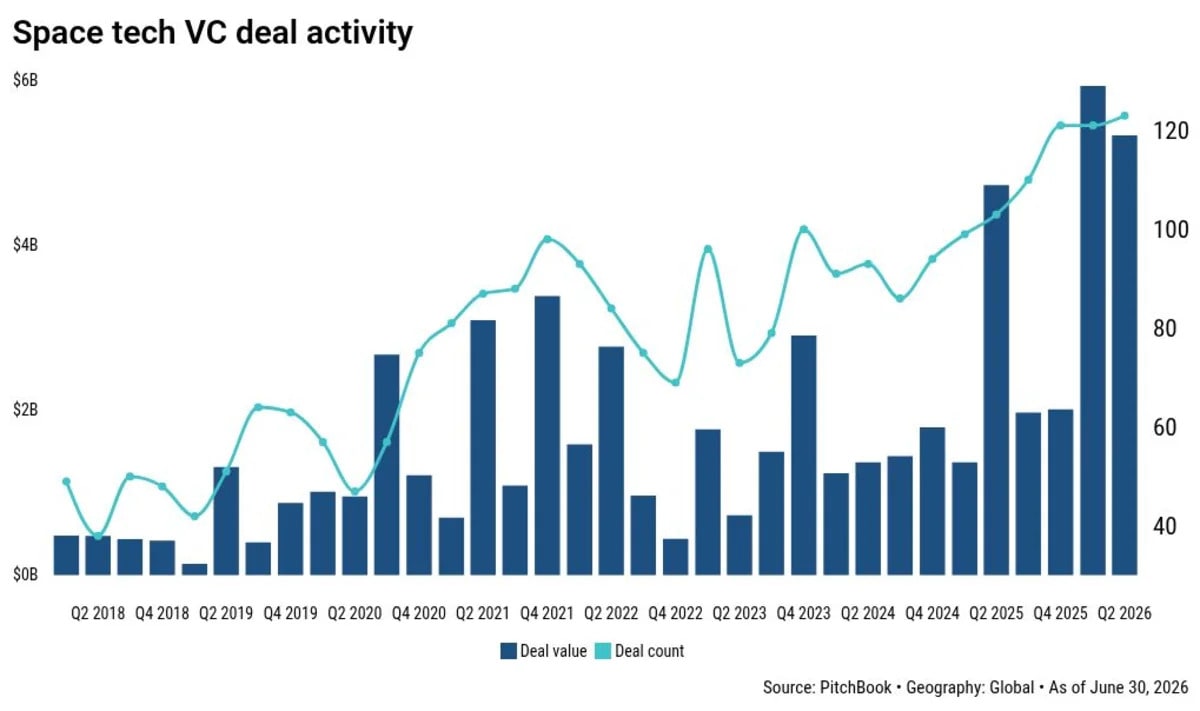
Space tech startups have already outperformed 2025's total venture capital funding by securing $11.3 billion in the first half of 2026. This growth is driven by larger late-stage investments as companies transition from technical development to mass production.
The Surge in Space Tech Capital: A New Era for Commercial Spaceflight
Recent data from PitchBook reveals a dramatic shift in the space technology investment landscape. As reported by senior research analyst Ali Javaheri, space startups have secured $11.3 billion in venture capital within the first six months of 2026. This figure is particularly striking as it exceeds the $10.1 billion total raised throughout the entirety of 2025, signaling a rapid maturation of the sector.
From Innovation to Industrialization
The fundamental shift driving this capital influx is a transition in the industry's lifecycle. Investors are increasingly moving away from high-risk, early-stage technical validation and toward established entities capable of manufacturing and mass production. By focusing capital on companies that have proven their core technologies, venture firms are betting on the scalability of space infrastructure rather than speculative R&D.
The Rise of Mega-Rounds
Unlike previous years where funding was characterized by a high volume of smaller deals, 2026 has been defined by a concentration of larger checks. The median funding round has more than doubled, jumping from $7 million in 2025 to $14.5 million in 2026. This trend suggests that the space industry is entering a phase of consolidation and growth, where the firms that survived the initial "hype cycle" are now receiving the heavy capital infusion required to build physical assets at scale.
Late-Stage Dominance and the Seed Gap
The data indicates a significant skew toward maturity, with venture-growth and late-stage deals capturing a staggering 87.4% of all investment. This concentration of wealth at the top end of the market reflects a risk-averse environment where investors prefer companies with proven revenue models or hardware-ready production lines. Consequently, seed funding has plummeted to roughly 1.5% of total investment, indicating that new entrants may face a significantly higher barrier to entry compared to their predecessors.
Broader Implications and Future Trends
This trend suggests that the space economy is evolving into a capital-intensive utility sector. As space companies pivot to production, we can expect to see an increase in satellite constellations, orbital logistics, and manufacturing services. However, the decline in seed funding presents a challenge for the next generation of space innovators. Moving forward, the industry will likely see fewer new startups, but those that do emerge will be expected to demonstrate a clear path to production far earlier than in previous years.
Conclusion
The first half of 2026 has established a new benchmark for the space tech sector. By prioritizing manufacturing capability and late-stage growth, the venture capital community is signaling that the space economy is ready for the transition from experimental projects to essential global infrastructure. While the barrier to entry for startups has risen, the scale of investment ensures that the companies currently in the pipeline have the resources necessary to fundamentally reshape the orbital landscape.