The Tesla Roadster flew, drove upside down, and hit 60mph in under a second
Source Entity
Andrew J. Hawkins
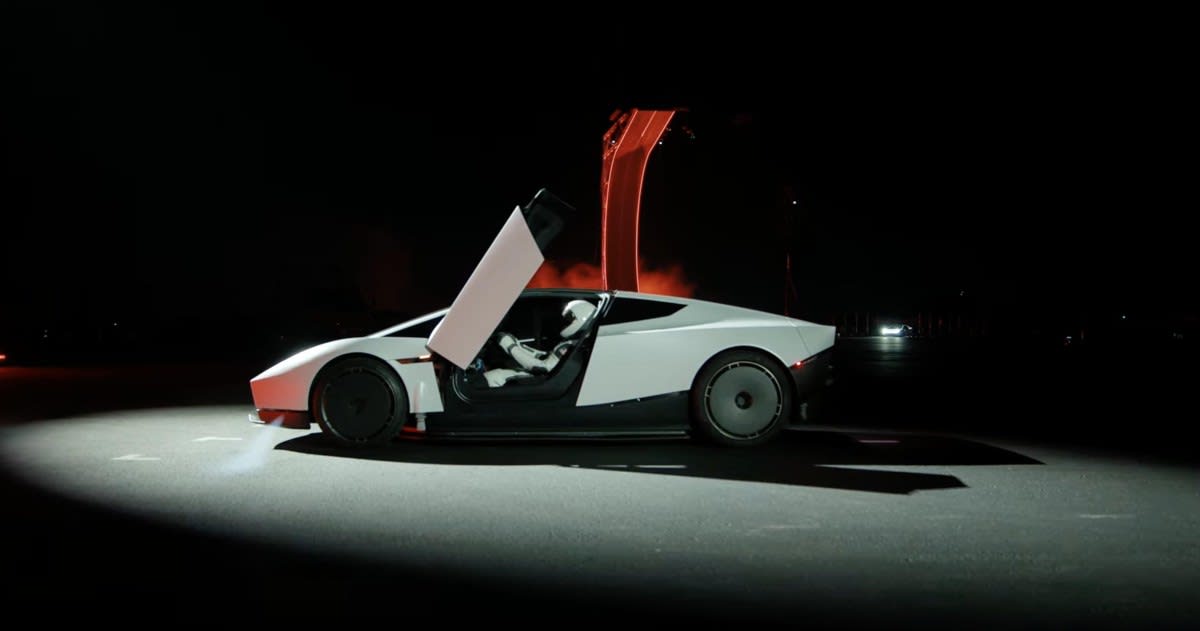
Tesla has unveiled its long-awaited next-generation Roadster, featuring a dramatic demonstration of flight and sub-one-second acceleration. The vehicle, showcased at a SpaceX facility, aims to redefine electric vehicle performance despite ongoing questions regarding production timelines.
The Return of the Tesla Roadster: Engineering or Spectacle?
After nearly a decade of anticipation and missed delivery targets, Tesla has finally staged a demonstration of its next-generation Roadster. The event, held at a SpaceX test site in McGregor, Texas, served as a high-stakes reveal for a project that has tested the patience of investors and enthusiasts since its initial concept introduction in 2017. By utilizing a SpaceX test site, Tesla underscored the integration of aerospace technology into its automotive lineup, specifically targeting the use of thrusters to achieve unprecedented performance metrics.
Breaking the Laws of Conventional Physics
The demonstration was nothing short of cinematic, showcasing the Roadster’s ability to accelerate to 60 mph in under one second. Perhaps more surprisingly, the vehicle was shown driving upside down and briefly achieving flight. These feats represent a significant departure from standard automotive engineering, moving the Roadster into the realm of experimental aerospace hardware. By leveraging technology often associated with SpaceX, Elon Musk appears to be fulfilling his long-standing promise of creating a 'flying car,' though the practical implications remain to be seen.
A Decade of Anticipation
To understand the significance of this reveal, one must look back at the original Tesla Roadster, which first debuted in 2008. Designed on a Lotus Elise chassis, that vehicle helped establish Tesla as a legitimate player in the electric vehicle market. The new iteration, however, represents a radical pivot from a luxury sports car to a high-performance stunt vehicle. The path to this moment has been paved with constant delays, transforming the Roadster into a symbol of Tesla’s 'vaporware' challenges—a narrative the company is clearly attempting to shed.
The Stunt Show vs. The Production Line
The brevity of the 30-minute event, which lacked concrete details regarding pricing, trim levels, or mass-production timelines, suggests that this reveal was designed more for brand positioning than for immediate consumer availability. While the performance metrics are record-breaking, the transition from a controlled SpaceX test environment to a road-legal consumer vehicle involves immense regulatory and safety hurdles. The 'heavy caveats' mentioned by industry observers highlight the stark divide between a functional prototype and a vehicle that can be safely sold to the public.
Future Trends and Market Implications
Looking forward, the Tesla Roadster serves as a halo product intended to push the boundaries of what is possible with electric battery and propulsion technology. If Tesla successfully manages to bring even a fraction of these capabilities to market, it could force a paradigm shift in the hypercar industry, where acceleration and maneuverability are the primary metrics of success. However, the company must now pivot from the spectacle of the Texas event to the grueling reality of manufacturing, logistics, and safety compliance to prove that the Roadster is a viable product rather than a singular engineering stunt.