TikTok is going after Yelp and Google Maps with an in-app restaurant guide
Source Entity
Mia Sato
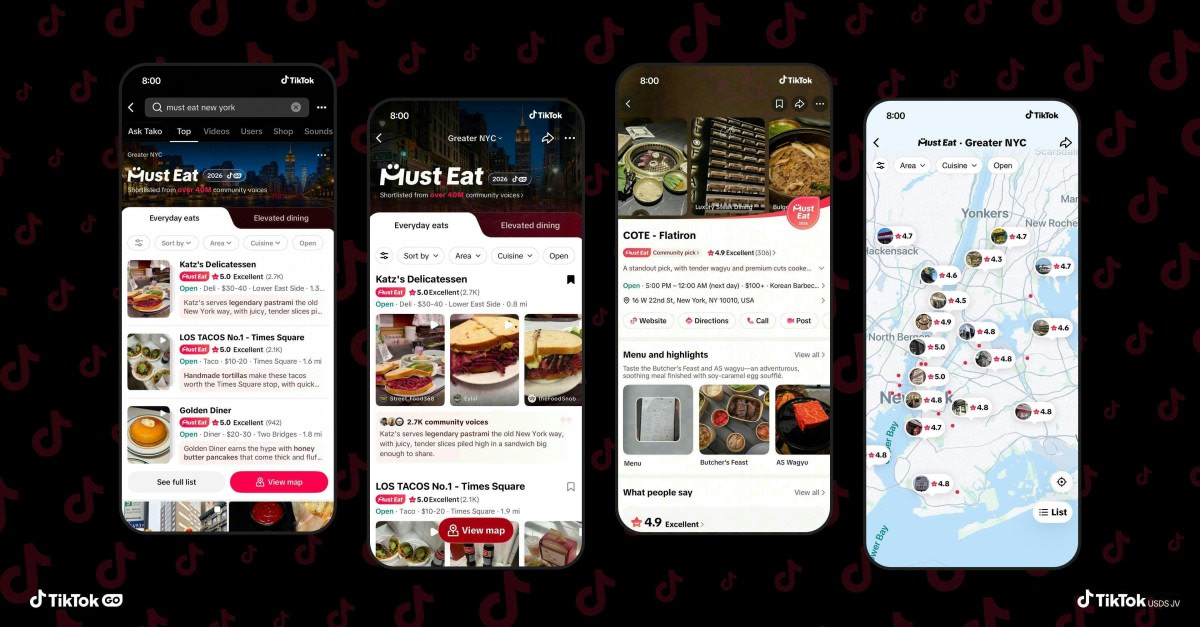
TikTok has launched 'Must Eat,' an in-app restaurant guide leveraging over 40 million user posts and videos. The feature directly challenges incumbents like Yelp and Google Maps by integrating discovery, reservations, and location-based search.
TikTok Challenges Search Incumbents with 'Must Eat'
TikTok has officially entered the local discovery market with the launch of "Must Eat," an in-app restaurant guide that aggregates the platform's vast library of dining-related content. By leveraging over 40 million existing posts, reviews, and comments, TikTok is pivoting from a passive discovery engine to a functional utility tool. This move signals a significant shift in the platform's strategy, moving beyond viral entertainment into the high-intent domain of local search.
A New Paradigm for Local Discovery
Historically, users have turned to Yelp and Google Maps for reliable business information and static reviews. However, TikTok's "Must Eat" feature capitalizes on the "social proof" model. Rather than relying on text-heavy, potentially outdated reviews, the new interface utilizes the video-first nature of the app to provide a more visceral and authentic preview of dining experiences. This community-driven approach transforms how users interact with local businesses, prioritizing the "vibe" and visual appeal that TikTok excels at showcasing.
Direct Competition with Yelp and Google
By integrating features such as in-app reservations, direct calling, and map-based search, TikTok is encroaching on the core business models of Yelp and Google. CEO Adam Presser described "Must Eat" as a "compilation of all the conversation" occurring on the platform. This aggregation of user-generated content creates a closed-loop ecosystem where users can discover, research, and act on a recommendation without ever leaving the app, effectively increasing time-on-site and user retention.
The Power of 40 Million Data Points
The foundation of "Must Eat" rests upon the massive volume of food-related discourse already present on the platform. While competitors rely on structured business listings, TikTok’s advantage lies in the unstructured, organic data of millions of videos. By structuring this data into a searchable, location-aware guide, TikTok is effectively weaponizing its existing creator economy to provide a more dynamic and trend-focused alternative to traditional search engines.
Future Implications for Local Commerce
Looking ahead, this expansion suggests that TikTok is positioning itself as an essential tool for local commerce. If the integration of reservation systems and maps proves successful, we may see further expansion into other service-based sectors. This could force incumbents like Google to rethink their reliance on static data, potentially leading to a market-wide shift toward video-integrated local discovery tools.
Conclusion
The introduction of "Must Eat" marks a pivotal moment in the evolution of social media platforms into multi-functional utility hubs. By bridging the gap between social discovery and transactional utility, TikTok is not just changing how users find restaurants—it is challenging the established dominance of traditional search engines in the local discovery space.