Watch: Masked men carry TVs, printer out of Kolkata TMC office after vandalism claim
Source Entity
SHREEDHAR RATHI
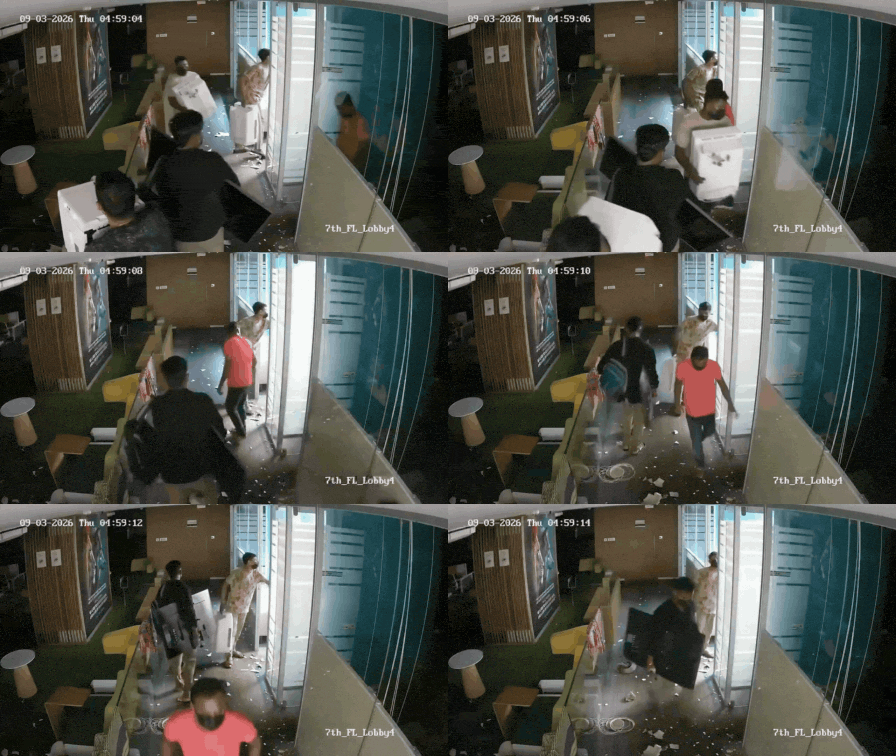
TMC leader Abhishek Banerjee's Kolkata office was ransacked by masked intruders, prompting him to blame BJP workers and demand federal intervention. CCTV footage shows the theft of electronic equipment, escalating political tensions in West Bengal.
Political Unrest in West Bengal: The Camac Street Incident
On the morning of September 3, 2026, the political climate in West Bengal faced a fresh surge of volatility following an early-morning attack on a Trinamool Congress (TMC) party office located on Camac Street in Kolkata. According to reports and visual evidence shared by TMC MP Abhishek Banerjee, the incident occurred at approximately 4:30 a.m., involving a group of masked individuals who breached the premises, engaged in vandalism, and absconded with electronic equipment, including television sets.
Allegations and Political Accusations
Abhishek Banerjee, a prominent leader within the TMC, has directly accused workers associated with the Bharatiya Janata Party (BJP) of orchestrating the attack. By releasing CCTV footage showing the intruders in action, Banerjee has sought to frame the event not as a simple burglary, but as a calculated act of political intimidation. He has characterized the incident as part of a broader pattern of 'violence, vandalism, and intimidation' aimed at weakening the Opposition in the state.
The Demand for Accountability
In the aftermath of the breach, Banerjee has publicly challenged the silence of constitutional and federal authorities. He has explicitly called upon the West Bengal Governor, the Union Home Minister, and the Prime Minister’s Office to intervene and investigate the matter. By questioning whether these high-ranking offices will 'continue to look the other way,' Banerjee is leveraging the incident to highlight the ongoing friction between the state’s ruling party and the central government.
Broader Implications for Democracy
Banerjee’s rhetoric has extended beyond the immediate crime, touching upon the fundamental health of democracy in West Bengal. He has asserted that such acts of 'political thuggery' undermine the moral authority of those in power and has even suggested that failure to address such violence questions the legitimacy of the administration. By invoking the judiciary, specifically the Calcutta High Court, the TMC is signaling that it intends to pursue legal and institutional avenues to hold the perpetrators accountable.
Contextualizing the Conflict
This incident is symptomatic of the deep-seated political polarization that has characterized West Bengal for years. The transition from political disagreement to physical vandalism of party offices is a recurring concern for observers of the region's political landscape. As both major parties—the TMC and the BJP—continue to vie for dominance, such events serve as flashpoints that further entrench partisan divides and heighten public anxiety regarding safety and political stability.
Future Trends and Outlook
Looking ahead, the response of the state administration and the central government will be critical in determining whether this incident leads to a cooling of tensions or further escalation. If the investigation remains stalled or contested, it is likely that the TMC will continue to use this narrative to rally support and criticize the BJP’s tactics. The reliance on digital evidence, such as the shared CCTV clips, suggests that the battle for public opinion in West Bengal will increasingly be fought through the rapid dissemination of multimedia evidence, forcing authorities to respond under the glare of public and social media scrutiny.
Multiple Citing Sources