WorldTUI: I trained a 360M model to pretend to be a terminal
Source Entity
Hacker News
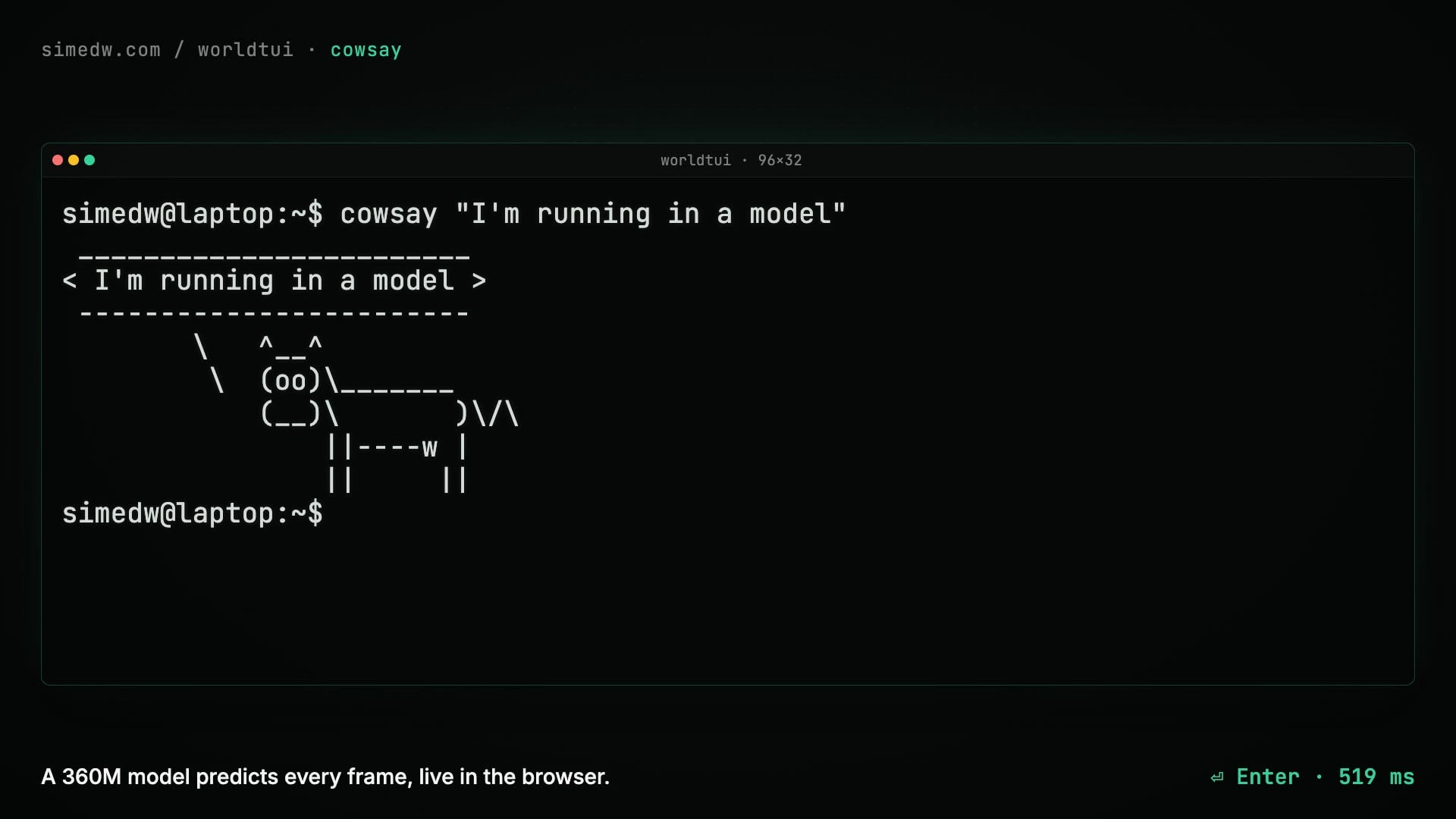
A developer has created a 360M-parameter language model that simulates a terminal interface without a real backend. By predicting screen state changes, it mimics complex tools like vim and tmux within a browser environment.
The Emergence of Generative Terminal Interfaces
The recent release of a 360M-parameter language model designed specifically to emulate a terminal environment marks a fascinating experiment in the intersection of generative AI and traditional computing interfaces. Unlike conventional terminal emulators that translate input into system calls executed by a real shell (such as Bash or Zsh) and a filesystem, this model operates entirely on prediction. It treats the terminal screen as a visual state that evolves based on user input, effectively 'hallucinating' the expected behavior of a command-line interface.
Technical Mechanics of the Model
At its core, the project utilizes a lightweight 360M-parameter architecture. The innovation lies in the training objective: rather than executing commands, the model predicts how the screen's text rows should update in response to a keypress. This approach allows it to simulate complex terminal-based applications like vim, tmux, and even games like snake. By teaching the model to repair its own logical errors—such as correcting the spelling of a command like 'pythoon'—the developer has demonstrated that LLMs can achieve a functional level of coherence within a constrained, rule-based environment.
The Shift Toward Learned Applications
This project draws direct inspiration from the broader trend of 'learned' applications, exemplified by models like Genie 3. The underlying vision is a future where software is not strictly defined by lines of procedural code but is instead learned by neural networks. By moving away from traditional compiled binaries and toward models that predict interface states, developers are exploring a paradigm where software interaction is fluid, adaptive, and potentially more resilient to certain types of input errors.
Performance and Hardware Constraints
Because the model relies on WebGPU for rendering the predicted screen state, the user experience is highly dependent on hardware acceleration. The developer notes that while the 208 MB model is accessible via desktop browsers like Chrome or Edge, mobile devices may struggle with the computational load. This highlights the current bottleneck for edge-based AI: balancing model parameter size with the real-time responsiveness required for an interactive user interface.
Broader Implications and Future Trends
While this project is currently a proof-of-concept, it signals a shift in how we might interact with computing environments in the future. If a language model can successfully simulate a terminal—an environment defined by strict syntax and deterministic output—it suggests that more complex, non-deterministic applications could eventually be replaced or augmented by generative models. As these models grow in efficiency, we may see a transition where 'coding' as we know it is supplemented by training models to 'act' as the software itself.
Conclusion
The WorldTUI experiment serves as a compelling bridge between traditional computing and the generative era. By successfully mimicking the behavior of a terminal without an underlying filesystem, the project proves that LLMs can be utilized for highly specific, state-dependent tasks. While it is not a replacement for a real shell today, it sets the stage for a future where applications are learned, predictive, and potentially more intuitive.