Yuva Morcha protest march to Kerala CM’s official residence over PSC exam ‘anomalies’ turns violent
Source Entity
India Latest News: Top National Headlines Today & Breaking News | The Hindu
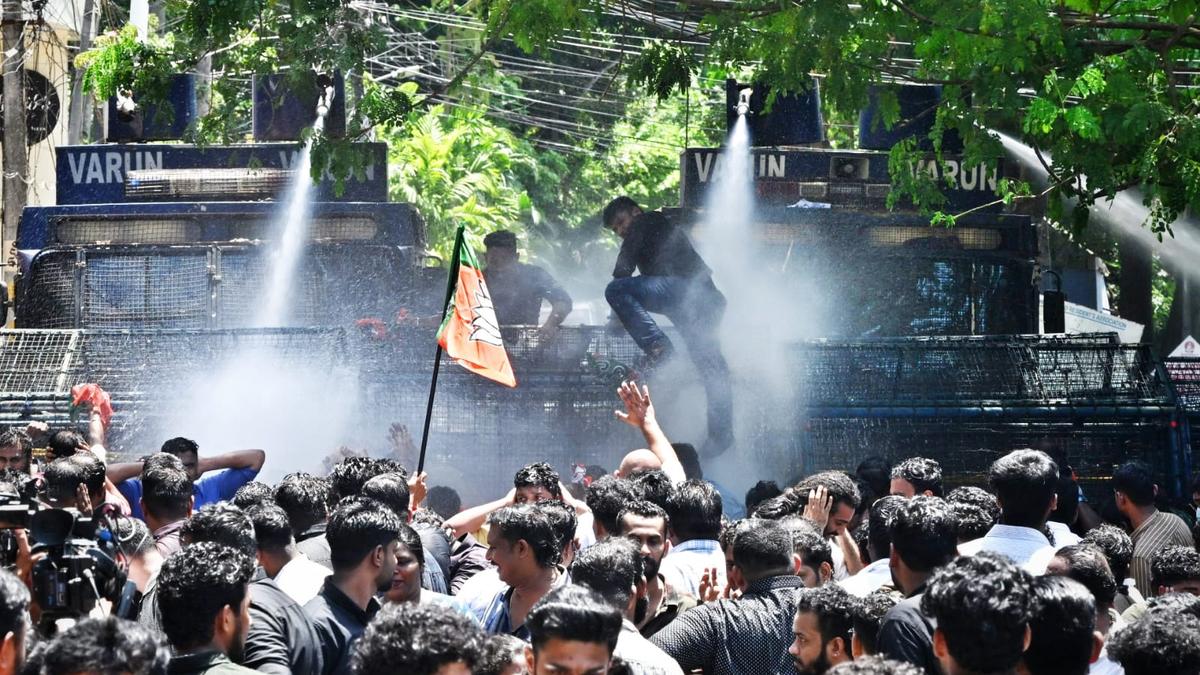
The Bharatiya Janata Yuva Morcha held a violent protest march toward the Kerala Chief Minister's residence, alleging examination irregularities. The group accused the CM of hypocrisy regarding his stance on national versus state-level exam integrity.
Tensions Escalate in Kerala Over PSC Exam Integrity
On Friday, July 24, 2026, the political climate in Kerala reached a boiling point as the Bharatiya Janata Yuva Morcha (BJYM) organized a protest march toward the Cliff House, the official residence of Chief Minister V.D. Satheesan. The demonstration, which aimed to highlight alleged anomalies within the State Public Service Commission (PSC) examination processes, quickly descended into chaos at the Devaswom Board junction in the state capital. The intensity of the confrontation underscores the growing public frustration regarding the transparency and fairness of state-level recruitment examinations.
The Allegation of Political Hypocrisy
At the core of the BJYM’s protest is a pointed accusation of double standards directed at Chief Minister V.D. Satheesan. The youth wing of the BJP contends that the state leadership is applying inconsistent moral benchmarks to examination irregularities. Specifically, the protesters drew a direct comparison between the CM’s silence on PSC issues and his active participation in a high-profile protest led by Congress leader Rahul Gandhi in New Delhi. That national-level demonstration targeted Prime Minister Narendra Modi’s government, demanding accountability for reported paper leaks in the NEET examination.
Analyzing the Political Friction
This clash represents a broader trend in Indian politics where state and national examination integrity issues are leveraged to undermine political opponents. By framing the CM’s involvement in the Delhi protest as hypocritical, the BJYM is attempting to shift the narrative from national-level concerns to regional governance failures. The juxtaposition of the NEET controversy—a massive, nationwide issue—with the specific, localized grievances regarding the Kerala PSC serves to localize the discourse on exam integrity, making it a potent tool for mobilizing the youth vote in the state.
The Mechanics of the Confrontation
When the march reached the security perimeter near the Cliff House, the situation escalated into violent scenes. Such events are often symptomatic of deep-seated political polarization, where traditional protest channels are bypassed in favor of direct confrontation. The use of the Devaswom Board junction as a site for this protest is strategically significant, as it is a high-traffic area that ensures maximum visibility for the demonstrators' demands, forcing the administration to acknowledge the unrest.
Broader Implications for PSC Governance
Beyond the immediate political theater, the protest highlights a systemic challenge for the Kerala government: maintaining the credibility of its public recruitment agencies. The PSC is a cornerstone of employment in the state, and any perception of 'anomalies' directly threatens the trust of thousands of job seekers. If the government fails to address these concerns with transparency, it risks further erosion of its support base among the youth, who are increasingly vocal about the lack of meritocratic processes in government hiring.
Future Trends and Outlook
Looking ahead, it is likely that the issue of examination security will remain a central pillar of political debate in Kerala. As the BJYM continues to exert pressure, the state government will be forced to either initiate a formal inquiry into the alleged PSC anomalies or face sustained civil unrest. The outcome of this standoff will not only impact the current administration's stability but will also set a precedent for how future examination-related grievances are handled by the state leadership.
Verification Required?