Tasklet (YC P26) Is Hiring a Customer Success Engineer
Source Entity
Hacker News
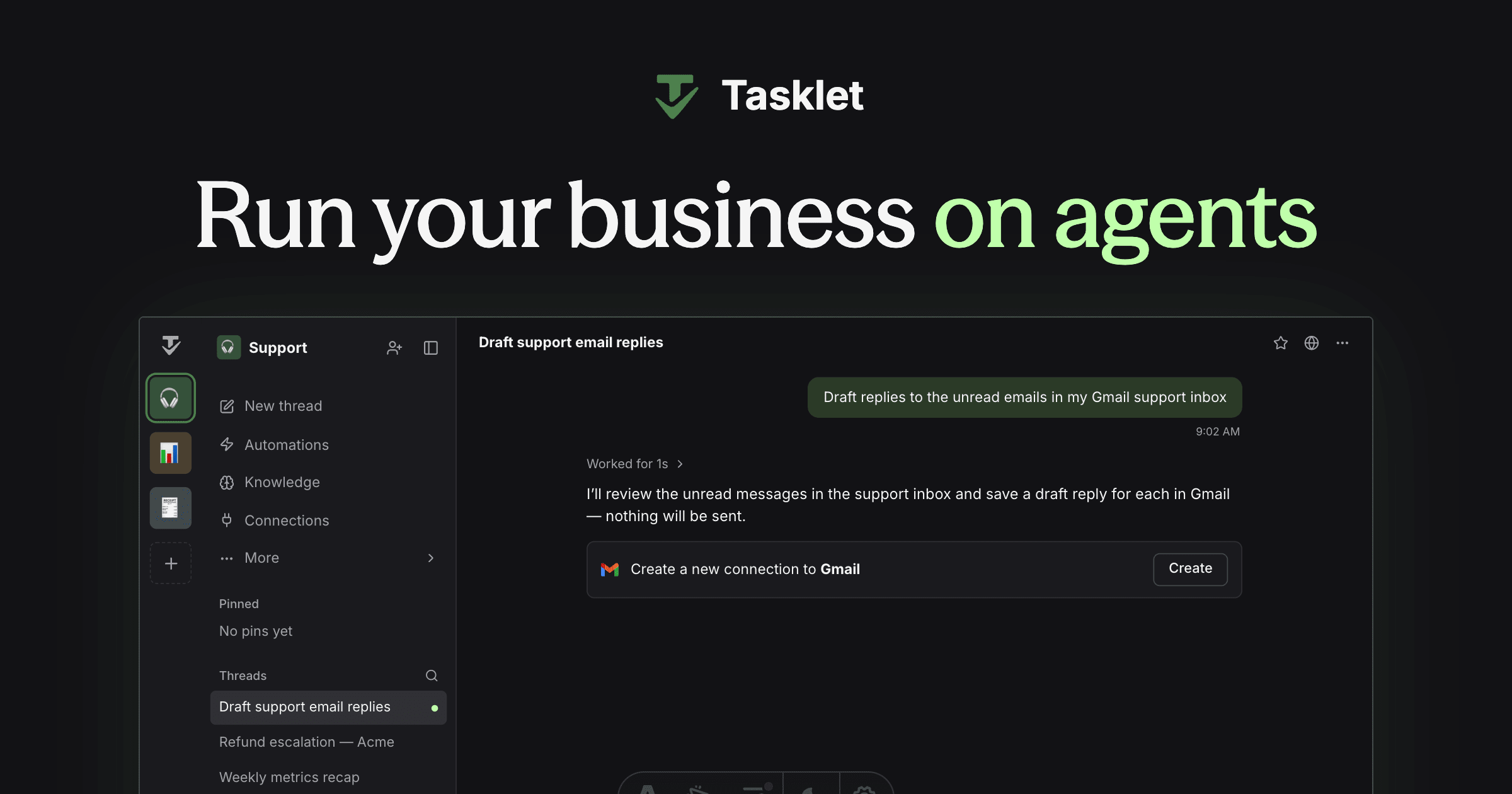
Startups Tasklet and Gooseworks are recruiting specialized engineering roles to advance the development and deployment of autonomous AI agents. Both companies are focused on replacing manual workflows with agent-driven systems for business operations and marketing growth.
The Rise of the Autonomous Agent Economy
Recent recruitment drives from YC-backed startups Tasklet and Gooseworks signal a significant shift in the enterprise software landscape. As companies move beyond simple chatbots, the focus is transitioning toward "agentic" workflows where AI systems are tasked with executing complex, multi-step business processes independently. This shift reflects a broader industry trend where the bottleneck is no longer the availability of AI models, but the engineering required to integrate these models into the foundational systems of a business.
Tasklet: Redefining Business Process Automation
Tasklet’s approach to business operations centers on the concept of intent-based automation. By allowing users to describe outcomes in plain English, the company aims to bridge the gap between high-level business goals and the technical execution required across various software tools. The hiring of a Customer Success Engineer is strategic; the company recognizes that when users entrust critical workflows to an AI agent, the reliability and transparency of those systems become paramount. Their goal is not merely ticket resolution, but the creation of self-serve resources and internal tools that improve the product itself.
Gooseworks: Automating the Growth Funnel
Meanwhile, Gooseworks is targeting the inefficiencies of modern marketing, which they identify as a "linear headcount" problem. By building self-improving AI agents to handle creative production, ad testing, and organic distribution, Gooseworks is attempting to solve the scalability issue inherent in consumer brand growth. Their mission highlights a future where marketing departments rely on a "fleet" of agents rather than large teams of humans performing repetitive tasks, fundamentally changing the cost structure of customer acquisition.
The Shift Toward Agentic Workflows
Both companies are operating on the assumption that the next decade of billion-dollar enterprises will be defined by their ability to decouple growth and operations from human labor. By utilizing AI agents to manage complex workflows—whether in back-office operations or front-end growth distribution—these startups are moving toward a model of continuous, 24/7 autonomous productivity. This represents an evolution from passive AI assistants to active, task-oriented agents.
Challenges in Reliability and Adoption
Despite the promise of these technologies, the core engineering challenge lies in reliability. As noted by Tasklet, user trust is fragile. When an AI agent manages critical business systems, any error has immediate, tangible consequences. Consequently, the roles being recruited emphasize a deep understanding of technical systems, workflow design, and the ability to build internal tooling that makes the AI environment more predictable and easier to debug for the end-user.
Future Implications for the Workforce
Looking ahead, the success of these agent-based platforms suggests a transformation in the role of the knowledge worker. If Tasklet and Gooseworks succeed in their mandates, the demand will shift toward "Creative Engineers" and "Success Engineers" who act as architects of these agent fleets rather than executors of the tasks themselves. This evolution will likely continue to reshape how companies structure their teams, prioritizing technical oversight of automated systems over manual operational labor.