With 86% of the words, you might understand only 38% of an anime's lines
Source Entity
Hacker News
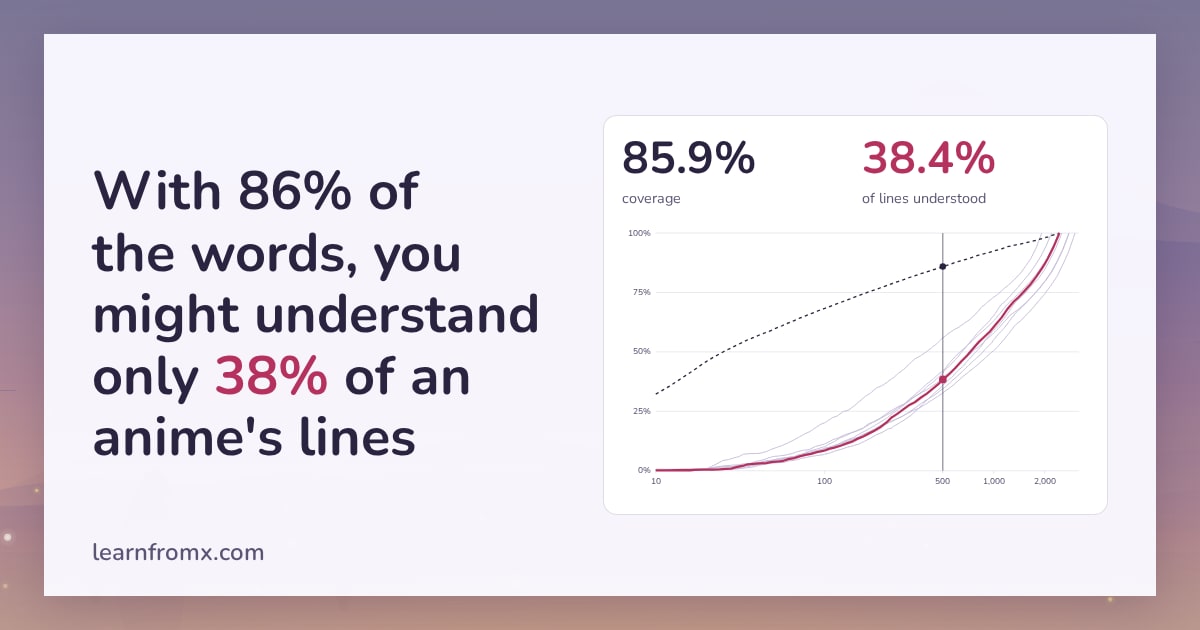
A new analysis reveals that high word-coverage percentages in anime do not equate to actual comprehension. Learning the most common 500 words only allows viewers to fully understand roughly 38% of lines, highlighting the limitations of vocabulary-based learning.
The Illusion of Language Coverage
Recent data analysis has highlighted a critical disconnect between quantitative language metrics and qualitative comprehension in the context of anime consumption. While language learners often rely on 'coverage'—the percentage of total words spoken that a learner recognizes—this study demonstrates that knowing 86% of the words in a show like Frieren does not translate to understanding the narrative. In fact, such a statistic is misleading, as it fails to account for the distribution of unknown words across individual sentences.
The 500-Word Threshold Paradox
For a dedicated learner, mastering the top 500 most frequent words in a specific anime series might seem like a robust foundation. However, the data reveals that this level of preparation only results in full comprehension of approximately 38.4% of the dialogue. The remaining 61.6% of lines contain at least one unfamiliar word, which acts as a barrier to understanding. This suggests that language proficiency is not merely a game of aggregate word counts but a requirement for syntactic and contextual fluency.
Why Coverage Metrics Fail
The core issue lies in the nature of language distribution. In any given dialogue, the presence of just one or two unknown terms can render an entire line unintelligible to a beginner. Even if a learner recognizes the vast majority of vocabulary in a show, the 'gaps' are strategically placed in the most essential parts of the sentence. This phenomenon turns the viewing experience into a laborious process, where constant pauses to look up definitions—as exemplified by the metaphor of tea going cold—undermine the immersion required for media consumption.
Implications for Language Learning Technology
This analysis serves as a cautionary tale for developers of language learning tools and software. Relying on simple word-coverage percentages to estimate learner readiness is insufficient. Instead, tools should focus on 'line coverage' or 'sentence comprehension' metrics, which provide a more realistic expectation of what a learner will actually encounter. By shifting the focus from global vocabulary counts to the granular reality of sentence structures, technology can better serve those attempting to bridge the gap between study and entertainment.
Future Trends in Media-Assisted Learning
As AI-driven tools become more prevalent, the ability to analyze media through the lens of personalized comprehension will likely improve. Future platforms could potentially identify the exact 'missing' vocabulary that prevents a learner from understanding a specific scene, offering targeted practice before the viewer hits play. This shift marks a transition from passive, broad-spectrum learning to precise, content-specific preparation, potentially making the dream of learning a language through anime a more achievable, albeit more complex, reality.