Explained in graphics: From bottle to vial, how drugs took hold in a dry Bihar
Source Entity
Himanshu Harsh
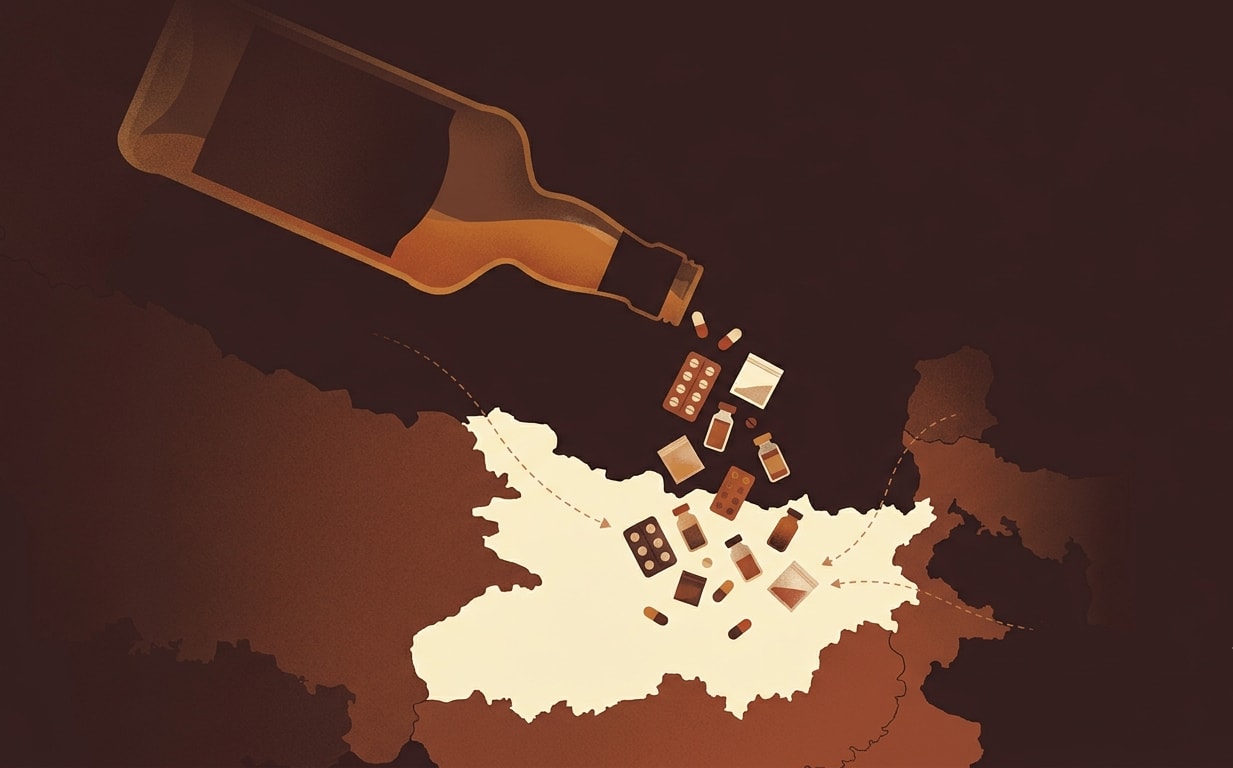
Ten years after Bihar's liquor prohibition, law enforcement faces a shifting challenge as illicit drug trade replaces alcohol. Police report a surge in hard narcotics, while instances of corruption among officers underscore the ongoing struggles with enforcement.
A Decade of Prohibition: Bihar’s Shifting Substance Crisis
Since the implementation of total liquor prohibition in Bihar in April 2016, the state’s law enforcement apparatus has been locked in a massive, daily operational cycle. Over the past decade, official data indicates that police have seized approximately 3.16 crore litres of liquor, resulting in 7.15 lakh arrests. This equates to a staggering average of 8,650 litres seized and 196 arrests recorded every single day. While these figures highlight the intensity of the state's crackdown on alcohol, they also reveal a system stretched to its limits.
The Rise of a Parallel Narcotic Market
While the state focused its resources on hunting for smuggled liquor in trains, tankers, and horse-borne consignments, a more insidious trend has emerged: the rapid expansion of an illegal narcotics market. Investigative reports have identified that the vacuum created by alcohol prohibition is being filled by highly potent and easily concealable substances. These include heroin, brown sugar, various pills, injection vials, and a localized variant known as 'kota'.
The Challenge of Detection
Unlike bulky liquor consignments, these new narcotics pose a unique tactical challenge for police. Because substances like heroin and synthetic tablets are pocket-sized, they can be hidden in soap boxes, small packets, or even the folds of a petticoat. This high degree of portability makes traditional detection methods, which were optimized for large-scale alcohol smuggling, increasingly ineffective. The police force, having spent ten years training for liquor interdiction, is now forced to recalibrate its strategy to combat this smaller, more lethal contraband.
Corruption and Institutional Integrity
The strain of enforcement is further complicated by internal issues within the police force itself. Recent incidents, such as the arrest of a GRP havildar and a woman home guard at Hajipur Junction, highlight the risks of corruption. In this instance, the officers were caught on video seizing 36 bottles of liquor from a passenger but failing to report the haul. The subsequent verification through CCTV footage confirms that the pressure of the prohibition regime can sometimes lead to individual misconduct rather than successful enforcement.
Broader Implications for Public Health
As the state grapples with this transition from alcohol to harder drugs, the public health implications are significant. Social workers and medical professionals are increasingly concerned about the shift in consumption patterns. The move toward injectable and synthetic drugs represents a transition from a widespread social vice to a more dangerous addiction crisis that requires a different set of intervention strategies, including harm reduction and specialized rehabilitation services.
Future Trends and Policy Outlook
Moving forward, the Bihar administration faces a critical juncture. The persistence of the illegal market—whether it be alcohol or narcotics—suggests that demand remains high despite restrictive laws. As police continue to tune into the alarm bells set off by the rise of narcotics, the state will likely need to shift its focus from purely punitive measures to a more comprehensive approach that addresses the root causes of substance abuse. Without a significant shift in strategy, the 'parallel market' of narcotics is poised to become the primary challenge for Bihar's law enforcement in the coming decade.
Multiple Citing Sources