Brain implant helps paralysed man to feed himself and drink from cup
Source Entity
Ian Sample Science editor
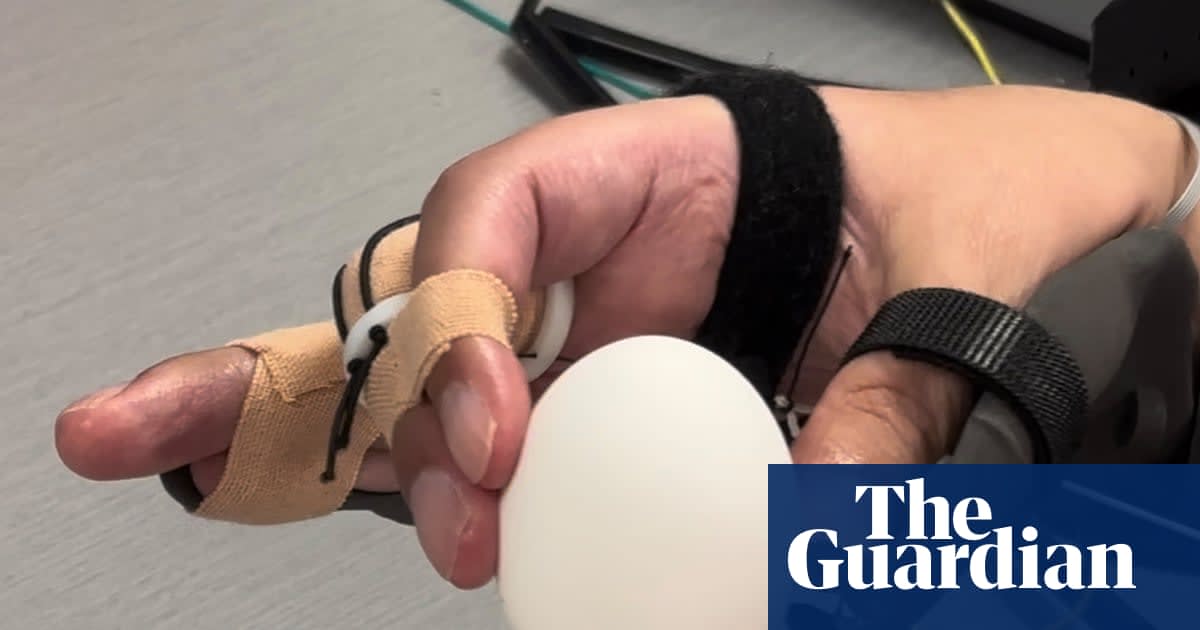
Keith Thomas, who was paralyzed from the chest down following a swimming accident, has regained the ability to feed himself and drink from a cup thanks to a 'double neural bypass' brain implant and extensive training.
A Breakthrough in Neural Restoration: The Case of Keith Thomas
In a landmark achievement for medical science and neurotechnology, Keith Thomas, a resident of Massapequa, New York, has regained significant motor function and sensory perception after being paralyzed from the chest down. Six years prior to this breakthrough, a swimming accident resulted in a severe spinal cord injury, leaving Thomas unable to lift his arms or interact with his environment independently. The restoration of his ability to feed himself and drink from a cup marks a pivotal moment in the application of Brain-Computer Interfaces (BCIs), demonstrating that the gap created by spinal cord severance can be bridged through advanced technological intervention.
Understanding the 'Double Neural Bypass'
The core of this achievement lies in the implementation of a "double neural bypass." Unlike traditional assistive technologies that may rely on external robotics or simple switches, this system utilizes electrodes implanted directly into the brain. These electrodes detect the neural intentions of the user—essentially "reading" the thought of wanting to move a limb—and bypass the damaged section of the spinal cord entirely. By transmitting these signals to stimulators in the muscles or other neural pathways, the system effectively creates a synthetic bridge. The "double" nature of the bypass likely refers to the bidirectional flow of information: not only is the brain sending commands to the limbs (motor output), but the system also allows for the sensation of touch to be transmitted back to the brain (sensory input), which is critical for the precise coordination required to handle a cup or utensil.
The Critical Role of Neuroplasticity and Training
One of the most significant aspects of Keith Thomas's journey is that the surgical implantation was only the beginning. The reports highlight "many months of training," which underscores a fundamental principle of neurology: neuroplasticity. The brain does not instinctively know how to operate a synthetic bypass; it must be trained to modulate its signals to trigger the specific responses of the implant. This period of rehabilitation is where the actual "learning" occurs, as Thomas's brain reorganized itself to utilize the new artificial pathway. This suggests that the success of BCI technology is as much about psychological and physical therapy as it is about the hardware itself.
Broader Implications for Spinal Cord Injury (SCI)
This case provides a profound blueprint for the future of treating spinal cord injuries. For millions of individuals worldwide living with paralysis, the primary challenge is the loss of autonomy. The ability to perform basic activities of daily living (ADLs), such as eating and drinking, drastically reduces the burden on caregivers and significantly improves the patient's mental health and quality of life. By proving that both motor control and tactile sensation can be restored, this trial moves the goalpost from simply "managing" paralysis to actively "reversing" its functional effects.
Historical Context and the Evolution of BCI
For decades, the goal of neural interfaces was primarily focused on communication—allowing paralyzed patients to type on a screen or move a cursor using their thoughts. While those milestones were essential, the transition to physical limb movement represents a massive leap in complexity. Previous iterations of BCI often struggled with the "latency" of movement or the lack of sensory feedback, which often led to clumsy or imprecise motions. The success seen with Keith Thomas indicates that we have entered an era of "closed-loop" systems, where the brain receives real-time feedback from the limb, allowing for the fine motor skills necessary to drink from a cup without spilling.
Predicting Future Trends in Neuroprosthetics
Looking forward, the trajectory of this technology suggests a move toward less invasive implantation methods and more seamless integration. We can expect future iterations of the neural bypass to be wireless, reducing the risk of infection associated with percutaneous leads. Furthermore, as machine learning algorithms improve, the "training" period for patients may be shortened, as the AI becomes better at interpreting noisy neural signals and translating them into smooth physical movements. We may soon see these systems expanded to facilitate walking or complex grasping tasks, potentially integrating with exoskeletons for full-body mobility.
Conclusion: A New Horizon for Recovery
Keith Thomas's recovery is more than a medical curiosity; it is a validation of the hypothesis that the human brain remains capable of controlling the body even when the biological wiring is destroyed. Through the synergy of surgical precision, electrode technology, and relentless patient training, the "double neural bypass" has restored a level of independence that was previously thought impossible. This case stands as a beacon of hope, signaling a future where paralysis is no longer a permanent state, but a condition that can be bypassed through the ingenuity of science.