Revanth creating drought by not lifting Godavari waters: Harish
Source Entity
India Latest News: Top National Headlines Today & Breaking News | The Hindu
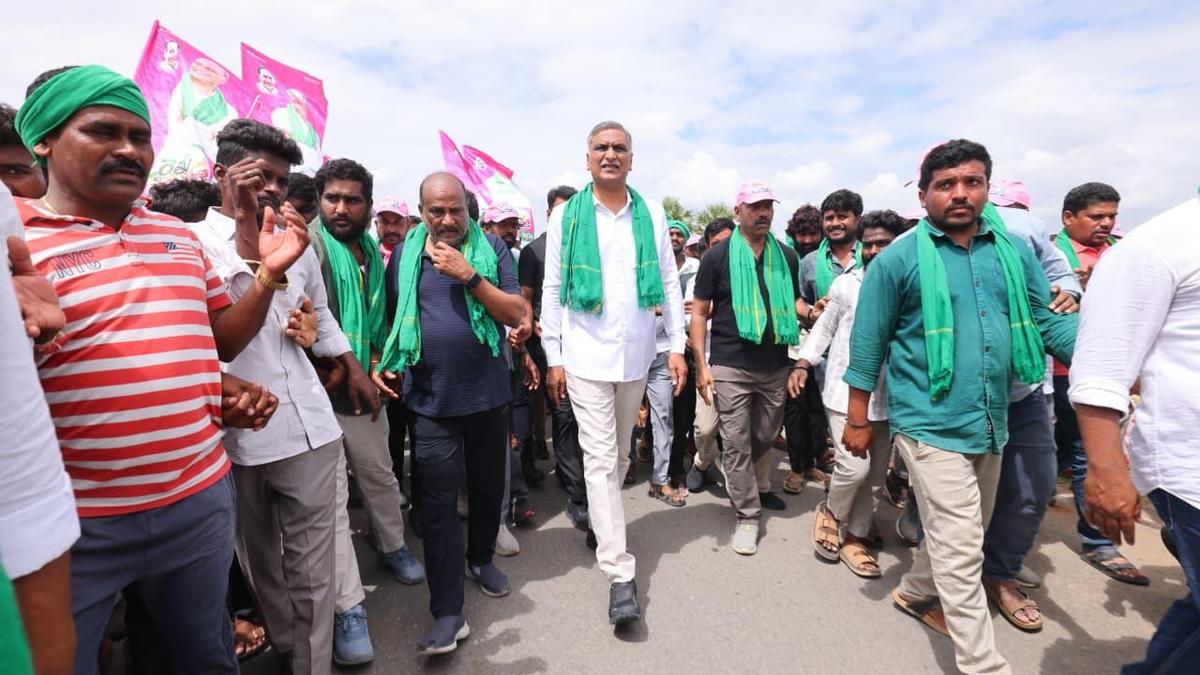
BRS leader T. Harish Rao has accused Telangana CM Revanth Reddy of inducing an 'artificial drought' by neglecting the Kaleshwaram project. The allegations emerged during a farmers' Maha Padayatra demanding the filling of the Ranganayaka Sagar Reservoir.
Political Warfare Over Water Management in Telangana
The state of Telangana is currently witnessing a sharp political escalation regarding its water management strategies. BRS Deputy Floor Leader T. Harish Rao has launched a scathing attack on the current Congress-led administration, specifically targeting Chief Minister A. Revanth Reddy. The core of the dispute centers on the allegation that the present water scarcity is not a result of natural climatic failures or insufficient rainfall, but is instead an "artificial drought" engineered by the government's refusal to utilize existing irrigation infrastructure.
The Kaleshwaram Project and the 'Artificial Drought' Claim
At the heart of this controversy is the Kaleshwaram project, a massive irrigation undertaking initiated by the previous BRS government. According to T. Harish Rao, the project was envisioned as a strategic safeguard to decouple Telangana's agricultural success from the volatility of the monsoon season. By lifting Godavari waters into various reservoirs across the state, the BRS claims they provided a six-year window of water security for farmers. The current allegation suggests that the Congress government is intentionally ignoring this infrastructure, which Rao characterizes as a "political vendetta" against the legacy of the BRS administration, thereby depriving farmers of essential water resources.
Ground Realities: The Maha Padayatra
The political rhetoric is backed by visible unrest among the farming community. This was highlighted by a 15-km Maha Padayatra organized by the farmers of Chinnakodur mandal. The primary objective of this protest march was to demand the filling of the Ranganayaka Sagar Reservoir. The participation of Harish Rao in this march underscores the BRS's strategy to align itself with the agrarian crisis, framing the water shortage as a direct consequence of administrative negligence rather than an act of nature.
Infrastructure vs. Administration
This clash highlights a recurring theme in regional politics: the transition of power and the subsequent treatment of predecessor-led infrastructure projects. The BRS argues that the technical capacity to mitigate drought exists through the lifting of Godavari waters, but the political will to operate these systems is absent. By framing the issue as a failure to "utilize" rather than a lack of "resource," the BRS is positioning the current drought as a choice made by the Congress government rather than an inevitable disaster.
Broader Implications for Telangana's Agriculture
If the allegations of an artificial drought are accurate, the implications for Telangana's agricultural sector are severe. Dependency on uncertain monsoons, which the Kaleshwaram project sought to eliminate, puts thousands of farmers at risk of crop failure and financial ruin. The tension between the two political parties over the operation of irrigation systems may lead to a stalemate where technical requirements are sidelined by political optics, potentially exacerbating the water crisis in key mandals like Chinnakodur.
Future Trends and Political Trajectory
Looking forward, this issue is likely to become a central pillar of the BRS's opposition strategy. As the farming community grows more desperate for water, the narrative of "political vendetta" will likely be amplified to mobilize rural voters. The Congress government will face increasing pressure to either justify its management of the Kaleshwaram project or resume the lifting of Godavari waters to stabilize the reservoirs. The resolution of this crisis will depend on whether the state can move past political friction to ensure the functional utility of its irrigation assets.
Summary
In essence, the conflict is a struggle over the narrative of Telangana's water security. While the BRS points to the Kaleshwaram project as the solution to water scarcity, they accuse the current leadership of sabotaging that solution for political gains. With farmers taking to the streets via the Maha Padayatra, the demand for filling the Ranganayaka Sagar Reservoir has become a critical flashpoint in the state's political and agricultural landscape.
Verification Required?