Solution to Feynman's reverse sprinkler puzzle also applies to "silly sprinklers"
Source Entity
Jennifer Ouellette
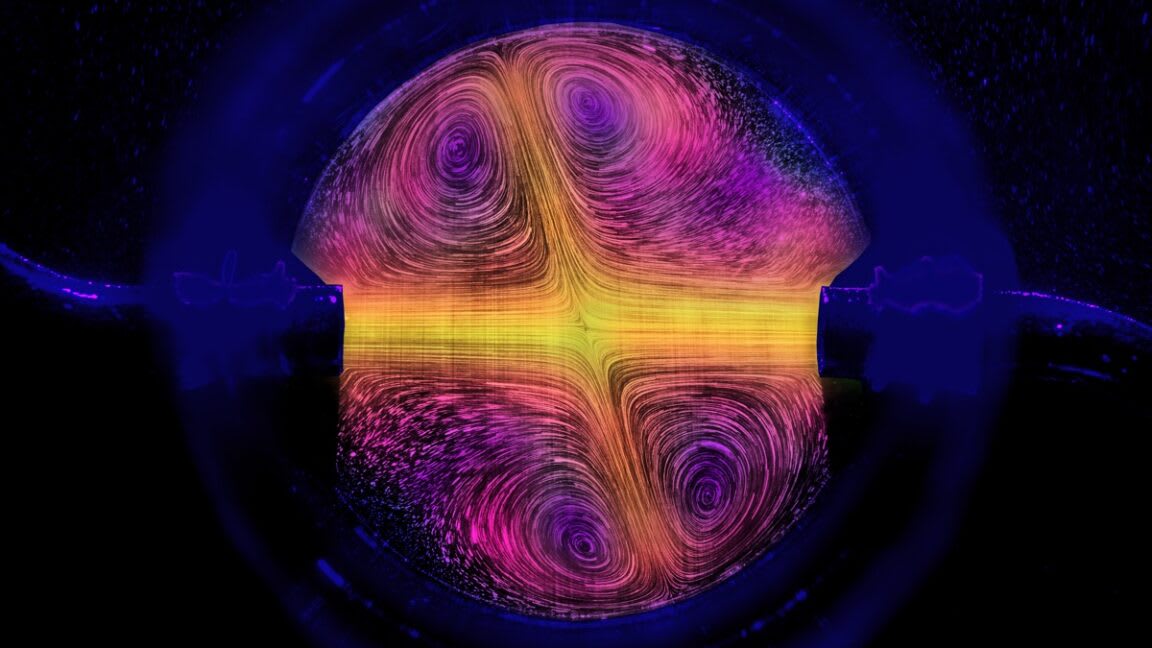
New study confirms 2024 "momentum flux theory" on how angular momentum of water flows drives rotation.
Solving a Physics Legend: The Feynman Reverse Sprinkler
For decades, the physics community has been captivated by a deceptively simple problem posed by the legendary physicist Richard Feynman: the reverse sprinkler. While a standard lawn sprinkler rotates due to the reaction force of water being ejected—a clear application of Newton's Third Law—the reverse sprinkler, which sucks water inward, presents a counter-intuitive challenge. For years, theorists and experimentalists disagreed on whether such a device would rotate, and if so, in which direction. The recent confirmation of the 2024 "momentum flux theory" marks a pivotal moment in fluid dynamics, providing a rigorous mathematical framework that finally resolves this paradox.
Understanding the Momentum Flux Theory
At the heart of this breakthrough is the momentum flux theory, which shifts the focus from simple action-reaction pairs to the net flow of momentum across the system's boundaries. In a standard sprinkler, the momentum is clearly carried away by the exiting water. However, in a reverse sprinkler, the water is drawn from the surrounding environment. The new study demonstrates that the rotation is driven by the specific way angular momentum is transported by the fluid as it enters the nozzles. By analyzing the "flux"—the rate of flow of momentum—researchers have been able to prove that the internal flow patterns and the boundary layer interactions create a net torque, driving the rotation in a predictable direction.
The Case of the "Silly Sprinklers"
One of the most significant aspects of this new research is its applicability to "silly sprinklers." These are variations of the reverse sprinkler setup that often feature irregular nozzle shapes or unconventional suction patterns, which previously produced results that seemed to defy standard physics. By applying the momentum flux theory, scientists have found that these "silly" behaviors are not anomalies but are instead consistent with the same laws governing the Feynman puzzle. Whether the nozzle is curved, angled, or modified, the rotation is always a product of the total momentum flux, effectively unifying these disparate experimental observations under a single theoretical umbrella.
Historical Context and Feynman's Legacy
Richard Feynman was known for his ability to identify "simple" problems that revealed deep, misunderstood principles of nature. The reverse sprinkler puzzle served as a cautionary tale against relying solely on intuition in fluid mechanics. For a long time, the debate was split between those who believed the device should not rotate and those who observed it doing so in experiments. This tension highlighted a gap in how physicists conceptualized the interaction between a device and the surrounding fluid medium. The 2024 validation of the momentum flux theory is not just a solution to a puzzle, but a victory for the rigorous application of conservation laws over intuitive guesswork.
Broader Implications for Fluid Dynamics
Beyond the academic curiosity of sprinklers, this discovery has profound implications for the broader field of fluid dynamics. Understanding how momentum flux drives rotation in suction-based systems can inform the design of more efficient pumps, turbines, and microfluidic devices. In industries where fluid transport is critical—such as aerospace or chemical engineering—the ability to precisely calculate torque generated by fluid intake can lead to significant optimizations in machinery. This research reinforces the importance of considering the entire system, including the ambient fluid, rather than treating the device as an isolated entity.
Future Trends in Theoretical Physics
Looking forward, the success of the momentum flux theory suggests a trend toward using more holistic, system-wide boundary analyses to solve classical mechanics problems. We can expect to see this approach applied to other "paradoxical" flow problems, potentially revisiting other unsolved puzzles from the 20th century. As computational fluid dynamics (CFD) become more powerful, the integration of this theory into simulation software will allow engineers to predict the behavior of complex suction systems with unprecedented accuracy, moving away from trial-and-error experimentation.
Conclusion
The resolution of Feynman's reverse sprinkler puzzle via the 2024 momentum flux theory represents a triumph of modern physics. By proving that the rotation of both standard reverse sprinklers and "silly sprinklers" is governed by the same fundamental principles of angular momentum transport, the scientific community has closed a long-standing chapter of debate. This discovery not only honors Feynman's spirit of inquiry but also provides essential tools for the future of fluid engineering and theoretical mechanics.