Why Nobel physicist Francis Halzen built a giant ice cube to catch 'ghost particles'
Source Entity
PRANJAL PANDEY
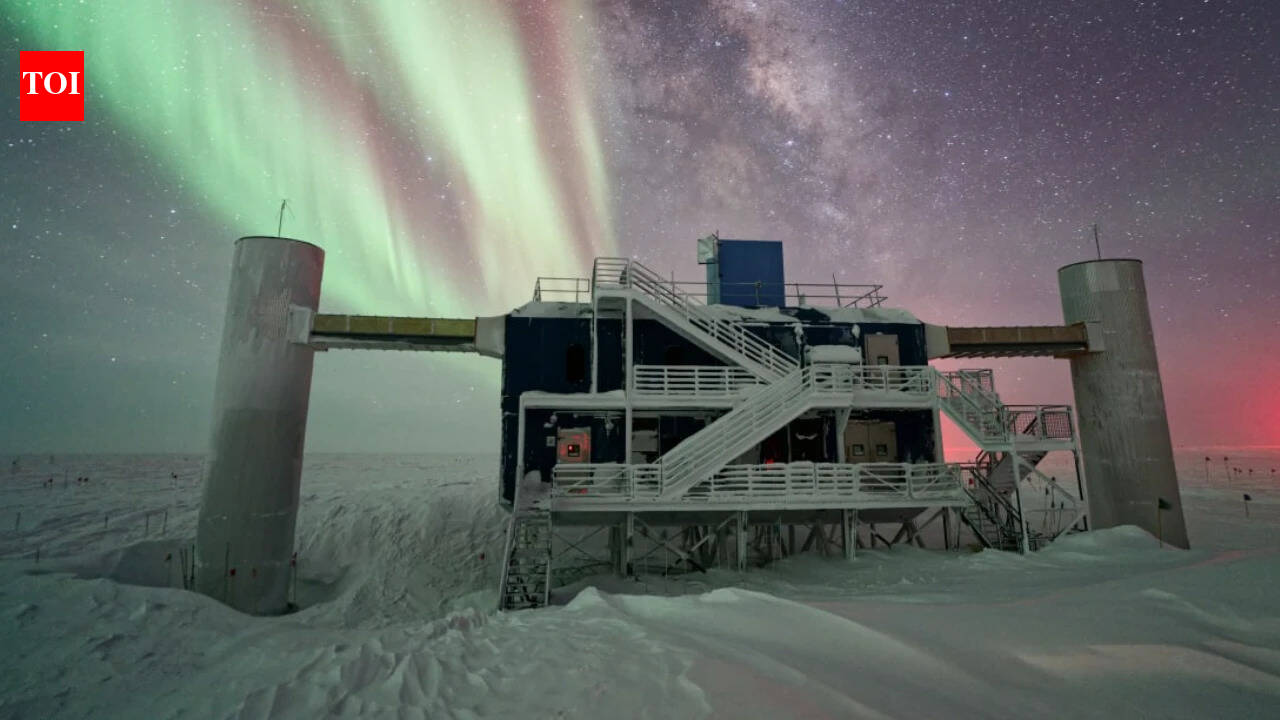
Belgian physicist Francis Halzen has been awarded the Nobel Prize in Physics for his leadership in developing the IceCube Neutrino Observatory. This Antarctic-based instrument detects elusive 'ghost particles' to reveal high-energy cosmic processes.
The Neutrino Pioneer: Francis Halzen and the IceCube Legacy
Belgian physicist Professor Francis Halzen has been awarded the Nobel Prize in Physics, a recognition of his decades-long dedication to the field of neutrino astronomy. Halzen’s seminal contribution centers on his visionary leadership in the development of the IceCube Neutrino Observatory, a massive scientific instrument located deep beneath the ice at the South Pole. By utilizing a cubic kilometer of Antarctic ice equipped with advanced light sensors, the observatory has fundamentally changed how humanity perceives the high-energy cosmos.
The Science of 'Ghost Particles'
Neutrinos, often referred to as 'ghost particles' due to their nearly massless nature and ability to pass through matter almost unimpeded, have long been a subject of intense scientific curiosity. Halzen’s work has enabled researchers to harness these particles as messengers from the distant universe. Because they are not deflected by magnetic fields or obscured by dust, neutrinos carry untainted information about the most violent and energetic processes occurring in deep space, effectively serving as a new lens through which we can observe the heavens.
A Vision Decades in the Making
The path to this Nobel recognition began long before the observatory's completion. Halzen first presented his ambitious vision for detecting neutrinos at the South Pole in 1988. Over the subsequent decades, he spearheaded an international collaboration of researchers and engineers who transformed this conceptual framework into a functioning, world-class instrument. The Royal Swedish Academy of Sciences specifically highlighted his scientific leadership as the fundamental catalyst that allowed such a complex project to succeed in one of the most inhospitable environments on Earth.
Global Collaboration and Scientific Leadership
The successful operation of IceCube is a testament to international scientific cooperation. As noted by colleagues in the field, Halzen’s ability to lead diverse teams was critical in providing the global scientific community with this 'fantastic instrument.' The project demonstrates how high-stakes physics research requires not only theoretical brilliance but also the logistical and collaborative prowess to manage large-scale engineering feats in extreme conditions.
Future Implications for Astrophysics
With the Nobel recognition, the importance of neutrino astronomy is set to grow significantly. The ability to detect these particles provides a unique window into high-energy astrophysical events, such as black hole mergers or supermassive star explosions, which remain invisible to traditional optical telescopes. By securing the $1.2 million (12 million Swedish kronor) prize, Halzen’s achievement solidifies the role of the South Pole as a vital hub for modern particle astrophysics and sets a precedent for future experiments in deep-ice detection technology.
Conclusion
In summary, Francis Halzen’s Nobel Prize is a fitting tribute to a scientist who turned a theoretical curiosity into a revolutionary observational tool. His work at IceCube has not only expanded our understanding of the universe's most violent phenomena but has also provided a blueprint for how future collaborative science can push the boundaries of what is detectable in the vast expanse of space.
Multiple Citing Sources