Why MU, AMD, Intel and SNDK stocks suddenly slumped — experts explain what’s behind the sell-off
Source Entity
Latest News: Todays Latest News Headlines from India & World | Hindustan Times | Hindustan Times
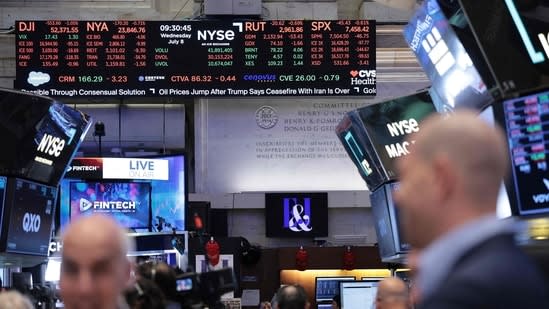
Global stock markets are facing significant volatility as a massive sell-off in semiconductor stocks hits Asian and U.S. exchanges. Investors are growing increasingly concerned over AI-related financing models and heightened competition in the chip sector.
The Global Semiconductor Sell-Off: A Deep Dive
Market Turbulence and the AI Correction
Global financial markets are currently navigating a period of intense volatility, characterized by a sharp retreat in technology stocks. On Tuesday, futures for the Nasdaq-100 fell 0.9%, while the S&P 500 slipped 0.2%, reflecting a broader loss of confidence in the tech-heavy indices. This downturn is primarily fueled by a dramatic sell-off in the semiconductor sector, which has long been the primary engine of the recent AI-driven bull market. The rapid decline in investor sentiment is now overshadowing positive developments in other areas, such as the recent drop in global oil prices.
The Asian Chip Rout and Its Global Impact
The epicenter of this market correction is in South Korea and Japan, where major chip manufacturers have experienced historic losses. South Korea’s KOSPI benchmark plummeted over 10%, a decline so severe it triggered a circuit breaker and has pushed the index to a three-month low. This drop is particularly significant given that the index had tripled in value over the preceding 12 months. Major industry titans, including SK Hynix and Samsung Electronics, saw shares fall by over 13% and 12% respectively, reflecting a massive repricing of risk for the world’s largest suppliers of high-bandwidth memory (HBM) chips.
Unpacking the AI Financing Concerns
A central driver of this panic is growing skepticism regarding the sustainability of the AI boom, specifically concerning 'circular financing' models. Reports suggesting that Nvidia might be exploring a $250 billion funding backstop for OpenAI have raised alarms among institutional investors. Markets are beginning to question the underlying economics of the AI infrastructure race, fearing that the massive capital expenditures by U.S. hyperscalers may not yield returns fast enough to justify current valuations. This anxiety is exacerbated by reports of rising Chinese competition, which threatens the long-term market dominance of established players.
Regional Contagion and Sector Sensitivity
The sell-off has spread rapidly beyond the Korean peninsula. In Japan, Tokyo Electron dropped nearly 11%, Advantest fell over 10%, and SoftBank Group—a critical proxy for AI investment through its stake in Arm—slid 6.3%. Even Kioxia, a prominent memory manufacturer, saw shares crater by more than 18%. This synchronized decline highlights the deep interdependency within the global supply chain. Because companies like Samsung and SK Hynix are foundational to AI server architecture, any shift in U.S. spending expectations creates an immediate, cascading effect across global tech ecosystems.
Macroeconomic Headwinds
Beyond the specific issues within the semiconductor industry, broader macroeconomic factors are compounding the market's distress. The prospect of a U.S. interest rate hike as early as this week has further drained risk appetite. As liquidity tightens, the high-growth, high-valuation stocks that dominated the market throughout the past year are the first to face liquidation. The combination of interest rate uncertainty and the re-evaluation of AI profitability marks a potential turning point for global equity markets, as investors pivot from growth-at-any-cost to a more cautious, value-oriented strategy.
Conclusion: A New Era of Market Caution
The current market environment represents a significant cooling period for the AI trade. The record-breaking declines in the KOSPI index and the sharp retreat of U.S. tech futures suggest that the market is entering a phase of profound reassessment. Moving forward, the industry will likely face increased scrutiny regarding capital allocation and the tangible ROI of AI infrastructure. While the semiconductor sector remains vital to future technological growth, the era of unbridled optimism appears to have been replaced by a sober recognition of systemic risks.
Multiple Citing Sources
Verification Required?