Watch: Houthis release dramatic drone strike footage from Saudi border regions
Source Entity
ARYAN SINGH
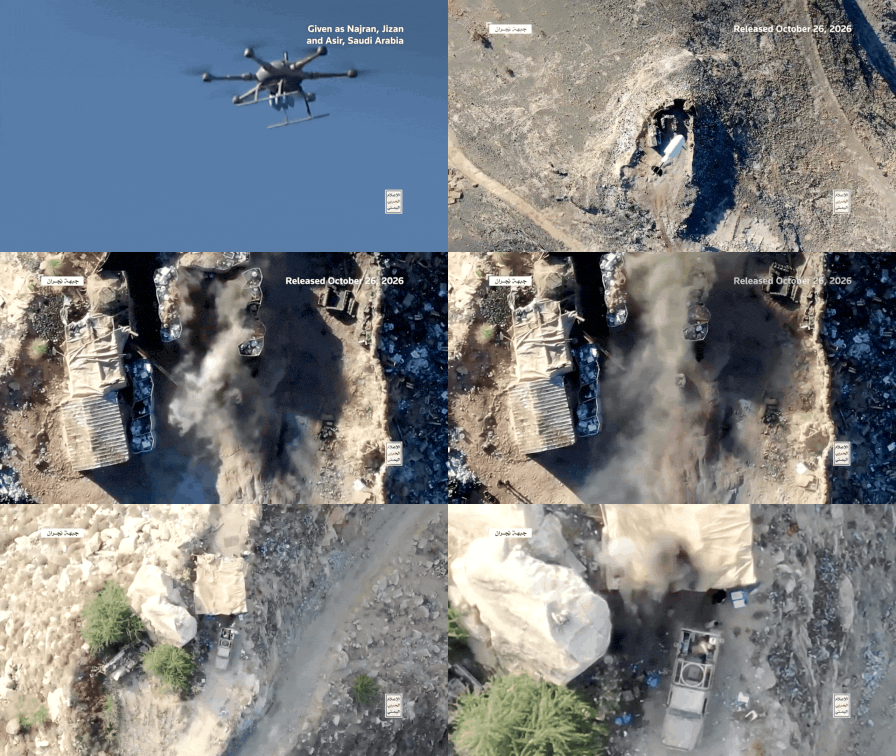
The Iran-aligned Houthi movement has released footage purportedly showing drone strikes on Saudi military positions in border regions like Najran and Jizan. These claims, coupled with reports of explosions in Riyadh, signal an escalation in hostilities targeting Saudi military and energy infrastructure.
Escalation in the Saudi-Houthi Conflict
The recent release of drone footage by the Iran-aligned Houthi movement marks a significant intensification in the ongoing conflict between the group and Saudi Arabia. By showcasing aerial views of alleged strikes on military vehicles and border positions in Najran, Jizan, and Asir, the Houthis are utilizing psychological warfare alongside kinetic operations to project power across the Saudi frontier. This development underscores the persistent vulnerability of the kingdom's border regions and the evolving nature of the threats it faces from non-state actors equipped with sophisticated aerial capabilities.
The Strategic Shift in Aerial Warfare
The emergence of this footage is not merely a tactical update but a strategic signal. The use of drones to strike deep into, or along the periphery of, Saudi territory highlights a shift from traditional ground skirmishes to asymmetric warfare. By targeting military installations and potentially the Saudi defense ministry in Riyadh, the Houthis aim to demonstrate that no part of the kingdom—including its administrative and military nerve centers—is beyond the reach of their evolving arsenal. This shift complicates the security calculus for Saudi Arabia, which must now defend against a diverse array of aerial threats.
Implications for Regional Stability
The broader implications of these attacks extend well beyond the immediate border regions. The potential targeting of critical energy infrastructure remains a primary concern for global markets and regional stability. Saudi Arabia serves as a linchpin in the global energy supply chain, and the ability of the Houthis to conduct strikes—or even claim to have conducted strikes—near sensitive military and economic sites creates a climate of persistent uncertainty. These developments force a constant re-evaluation of regional security protocols and the effectiveness of existing air defense systems.
Challenges to Intelligence and Verification
While the Houthis have claimed a "direct hit" on the Saudi Ministry of Defense, the lack of immediate, independent confirmation from Riyadh highlights the fog of war that characterizes this conflict. Reports of explosions heard in Riyadh serve as a backdrop to these claims, yet the discrepancy between militant assertions and official government silence creates a volatile information environment. The inability to immediately verify these strikes complicates international diplomatic efforts, as stakeholders struggle to discern the difference between propaganda-driven claims and actual military damage.
Future Trends and Security Outlook
Looking forward, the trend suggests a continued focus on long-range drone and missile capabilities by the Houthis. As these technologies become more accessible and refined, the threshold for conducting high-impact strikes lowers. The kingdom will likely be forced to invest further in advanced integrated air defense systems to secure its critical infrastructure and urban centers. The interplay between Iran's regional influence and the Houthi movement’s operational capacity remains the central variable in predicting the trajectory of this conflict, suggesting that tensions along the Saudi border will remain a defining feature of Middle Eastern geopolitics for the foreseeable future.
Multiple Citing Sources