India smartphone shipments tumble by 10% as affordable phones become more expensive
Source Entity
Latest News: Today's Latest News Headlines from India & World | Hindustan Times | Hindustan Times
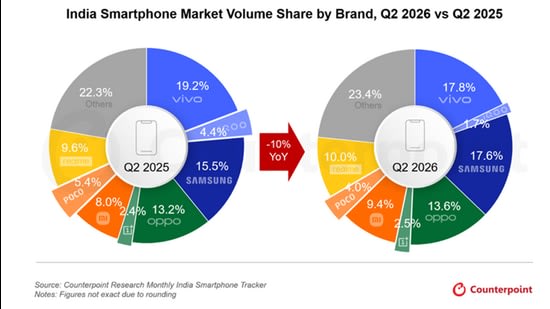
India's smartphone shipments plunged 10% YoY in Q2 2026, marking the sharpest June quarter decline in six years. The slump is primarily driven by a four-fold increase in memory prices and rising component costs that have dampened consumer demand.
India's Smartphone Market Faces Steepest Decline in Six Years
India, one of the world's largest consumers of mobile technology, is currently witnessing a significant contraction in its smartphone market. According to the latest data from Counterpoint Research, smartphone shipments in Q2 2026 tumbled by 10% year-on-year. This decline is particularly alarming as it represents the steepest drop for a June quarter in six years, signaling a deep-seated volatility in the consumer electronics sector. This downturn follows a precarious start to the year, with Q1 already recording a 3% decline, which was noted as the weakest first quarter in the same six-year window.
The Catalyst: Memory and Component Inflation
The primary driver behind this market contraction is a sharp increase in production costs, specifically regarding essential hardware components. The most striking data point is the cost of smartphone memory, which has surged nearly four-fold since September 2025. Because memory is a fundamental component across all device tiers—from entry-level budget phones to high-end flagships—this price hike has a cascading effect on the final retail price of devices. When the cost of raw materials spikes so aggressively, manufacturers are forced to either absorb the costs and see their margins vanish or pass the expense onto the consumer, the latter of which has been the prevailing trend.
Impact on the 'Affordable' Segment and Consumer Behavior
Historically, the Indian market has been driven by the "affordable" segment, where price sensitivity is extremely high. The current trend of affordable phones becoming more expensive has created a significant barrier to entry for millions of consumers. This price escalation has coincided with a broader weakening of consumer demand and a reduction in discretionary spending. As the cost of living rises and the perceived value of upgrading a device diminishes due to higher price tags, consumers are holding onto their old devices longer, leading to the shipment slump observed in the Q2 2026 data.
Shifting Market Dynamics: Vivo and Apple
The market volatility is reflected in the shifting shares of major industry players. Vivo, which holds a leading position, saw its market share slide to 17.8% in Q2 2026, down from a more robust 19.2% in Q2 2025. This suggests that even the market leaders are unable to insulate themselves from the overarching trend of declining demand. Similarly, Apple is not immune to these headwinds; the premium brand saw its shipments decline by 3% YoY, leaving it with a 7% market share. The fact that both a volume-driven brand like Vivo and a premium-focused brand like Apple are experiencing declines indicates that the crisis is systemic across all price segments.
Future Outlook: A Market Under Pressure
Looking ahead, the horizon for the Indian smartphone market remains bleak. Analysts expect the market to remain under significant pressure throughout the remainder of the year. The core issue—elevated memory and component costs—shows no immediate sign of reversal, meaning device prices are likely to remain high. For the market to recover, there would need to be a stabilization in the global semiconductor and memory supply chain or a significant uptick in consumer discretionary income, neither of which is currently forecasted in the short term.
Summary of Market Contraction
In conclusion, the 10% decline in Q2 2026 is a culmination of supply-side shocks and demand-side fatigue. The four-fold increase in memory prices since late 2025 has effectively priced out a portion of the budget-conscious Indian consumer base, while premium segments are seeing a slight cooling of interest. With the weakest performance in six years now established, the industry faces a challenging road to recovery as it grapples with the reality of more expensive hardware in a price-sensitive economy.
Verification Required?