James Webb telescope finds ice older than the star it orbits
Source Entity
Jacek Krywko
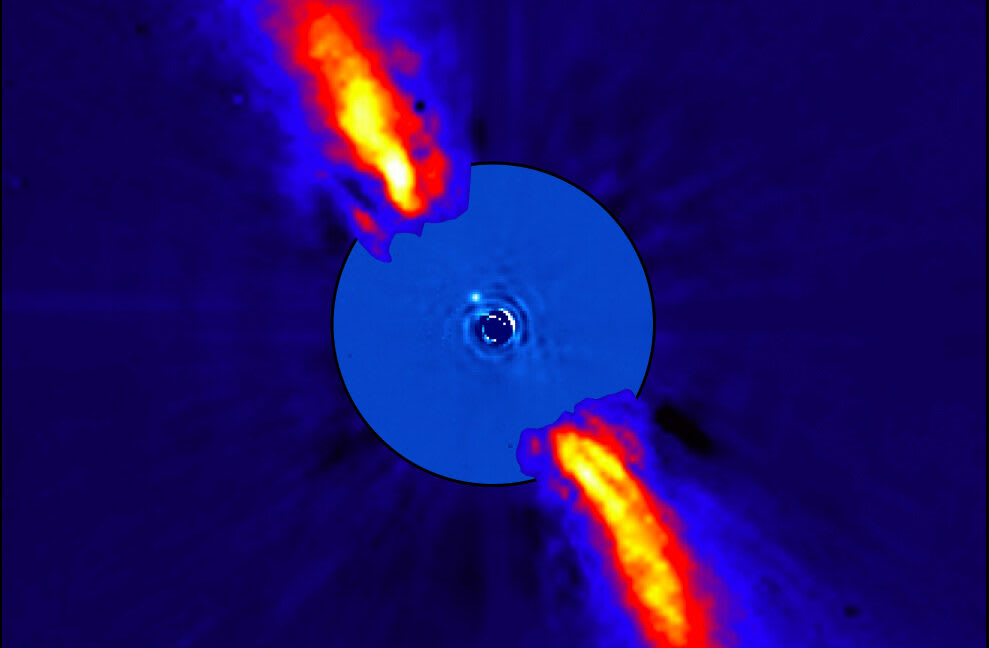
The James Webb Space Telescope has discovered ancient water and carbon dioxide ice surrounding the young star Beta Pictoris. This discovery suggests that the building blocks for life-sustaining, water-rich worlds may be common throughout the universe.
Unveiling the Origins of Planetary Systems
Recent observations from the James Webb Space Telescope (JWST) have provided a groundbreaking look at Beta Pictoris, a young star system located approximately 64 light-years from Earth. At only 20 million years old, this system serves as a pristine laboratory for astronomers studying the chaotic and formative stages of planetary evolution. By analyzing the vast disk of dust and debris surrounding the star, researchers have successfully identified the presence of both water and carbon dioxide ice, offering a rare glimpse into the primordial materials that eventually coalesce into planets.
The Chemistry of Cosmic Building Blocks
The research, led by astronomer Sarah Betti at the Space Telescope Science Institute, highlights a significant discovery regarding the state of these ices. Unlike the crystalline structures often found in more stable environments, the water ice observed around Beta Pictoris is glassy. This indicates that these materials have been subjected to intense radiation and high-velocity collisions—the very processes that characterize a young, active solar system. The fact that these ices are mixed with carbon dioxide in proportions mirroring those found in our own Solar System's comets is a pivotal finding.
Implications for Habitable Worlds
This discovery carries profound implications for our understanding of how life-bearing planets are formed. By confirming that the chemical signatures of Beta Pictoris mirror those of our own neighborhood, scientists are strengthening the hypothesis that the ingredients necessary for water-rich, potentially habitable worlds are not unique to the Sun. Instead, these essential components appear to be a common feature of planetary formation, suggesting that the universe may be far more hospitable to the development of complex chemistry than previously understood.
The Role of Advanced Instrumentation
The JWST’s ability to peer through the thick, obscuring dust of the Beta Pictoris disk has been critical to this research. While previous telescopes struggled to resolve the specific chemical composition of these distant debris fields, the JWST provides the infrared sensitivity required to map these icy deposits with unprecedented precision. This capability allows astronomers to bridge the gap between theoretical models of planet formation and the empirical data captured from stars in their infancy.
Future Trajectories in Exoplanetary Science
As we continue to observe systems like Beta Pictoris, the focus will shift toward understanding how these icy reservoirs are delivered to developing planets. The three planets already identified within this system provide a roadmap for future study. By mapping the distribution of these ices, scientists hope to determine how planetary migration and gravitational interactions might facilitate the delivery of water to rocky worlds. This study marks a significant step forward in the quest to map the chemical evolution of solar systems across the galaxy, reinforcing the role of the JWST as the primary instrument for deciphering our cosmic origins.