LFM2.5-Encoders for Fast Long-Context Inference on CPU
Source Entity
Hugging Face - Blog
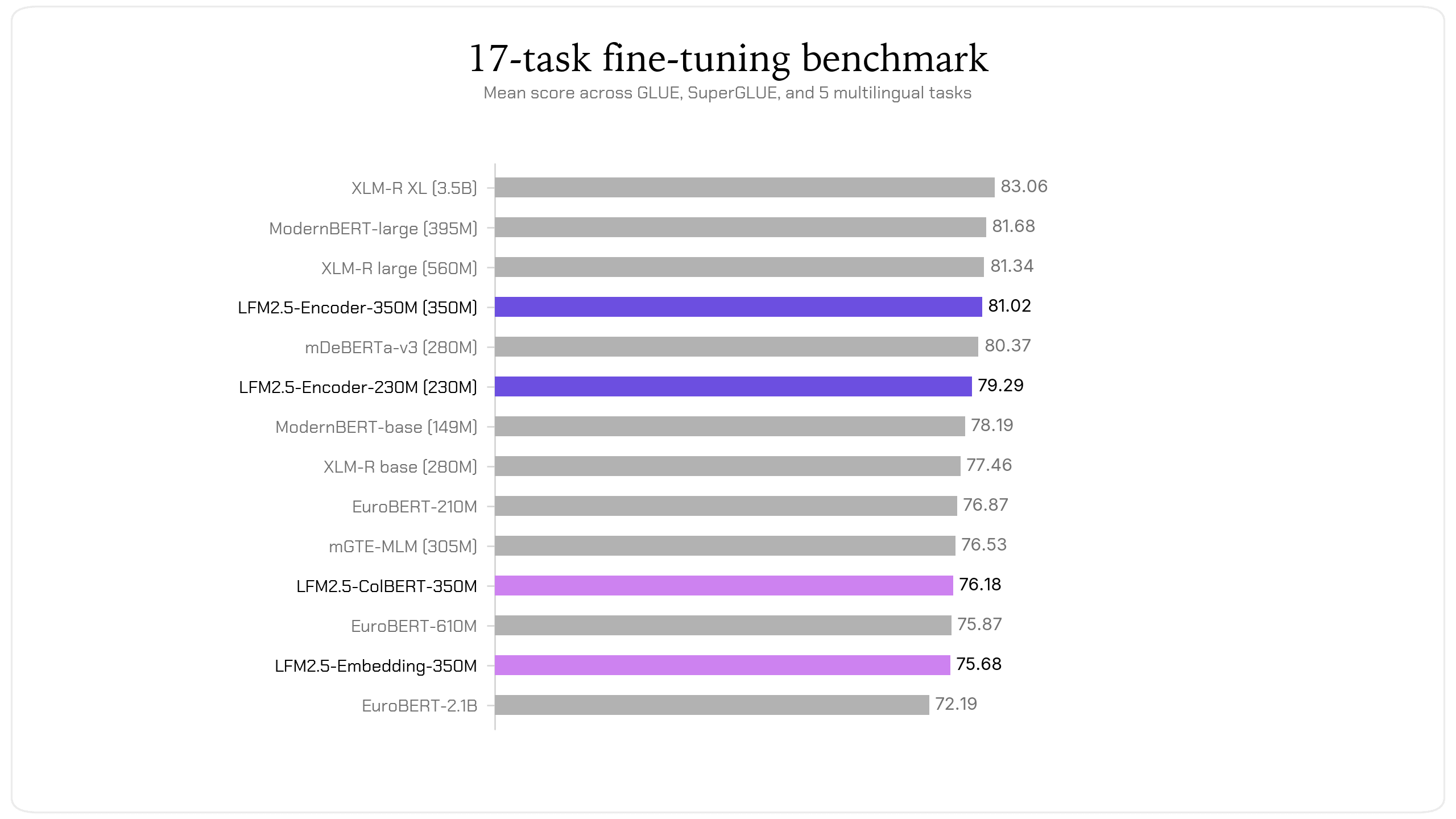
The newly released LFM2.5-Encoder models provide high-performance, long-context inference optimized for CPU environments. These models offer significant speed improvements over existing architectures like ModernBERT, enabling document-scale processing on standard hardware.
Advancing Efficient AI: The LFM2.5-Encoder Release
On July 28, 2026, the artificial intelligence community saw the release of two new encoder models: the LFM2.5-Encoder-230M and the LFM2.5-Encoder-350M. Published on Hugging Face, these models are specifically engineered to address the persistent bottleneck of computational intensity in long-context natural language processing, particularly when deployed on consumer-grade or standard CPU hardware.
Bridging the Efficiency Gap
Historically, achieving high-quality inference for long documents has required massive GPU clusters, often excluding developers or organizations without extensive infrastructure. The LFM2.5-Encoders challenge this status quo by delivering performance that matches or exceeds larger, more resource-heavy models. By excelling across standard benchmarks like GLUE, SuperGLUE, and various multilingual tasks, these encoders prove that parameter count is not the sole determinant of model efficacy.
Architectural Innovations in Latency
One of the most critical features of the LFM2.5-Encoder series is its handling of long-context input. With support for an 8,192-token context window, the models are designed to ensure that latency growth remains minimal as sequence lengths increase. This is a significant departure from traditional transformer architectures, which often suffer from quadratic scaling issues that make long-form document processing prohibitively slow.
The CPU Advantage
The practical impact of this release is perhaps best summarized by the performance metrics against established architectures. The LFM2.5-Encoders are reported to be approximately 3.7× faster than ModernBERT-base when handling long contexts on a CPU. This performance leap enables developers to execute document-scale jobs—such as intent routing or complex text analysis—on existing hardware, significantly lowering the barrier to entry for high-performance AI integration.
Future Trends in Edge Inference
The release of the LFM2.5-Encoder series signals a broader industry trend toward 'efficient AI.' As model architectures become more sophisticated, the focus is shifting from simply increasing parameter counts to optimizing inference speed and hardware accessibility. By enabling high-throughput processing on CPUs, these models pave the way for more decentralized AI applications, allowing for sophisticated NLP tasks to be performed at the edge or on local servers rather than relying exclusively on centralized cloud infrastructure.
Conclusion
The introduction of the LFM2.5-Encoder-230M and 350M represents a milestone for developers seeking a balance between model quality and computational economy. By successfully decoupling high-performance inference from the need for specialized GPU hardware, the developers have provided a versatile toolset for building robust, scalable document processing pipelines.