LoRA Speedrun – a public wall-clock leaderboard for fine-tuning techniques
Source Entity
Hacker News
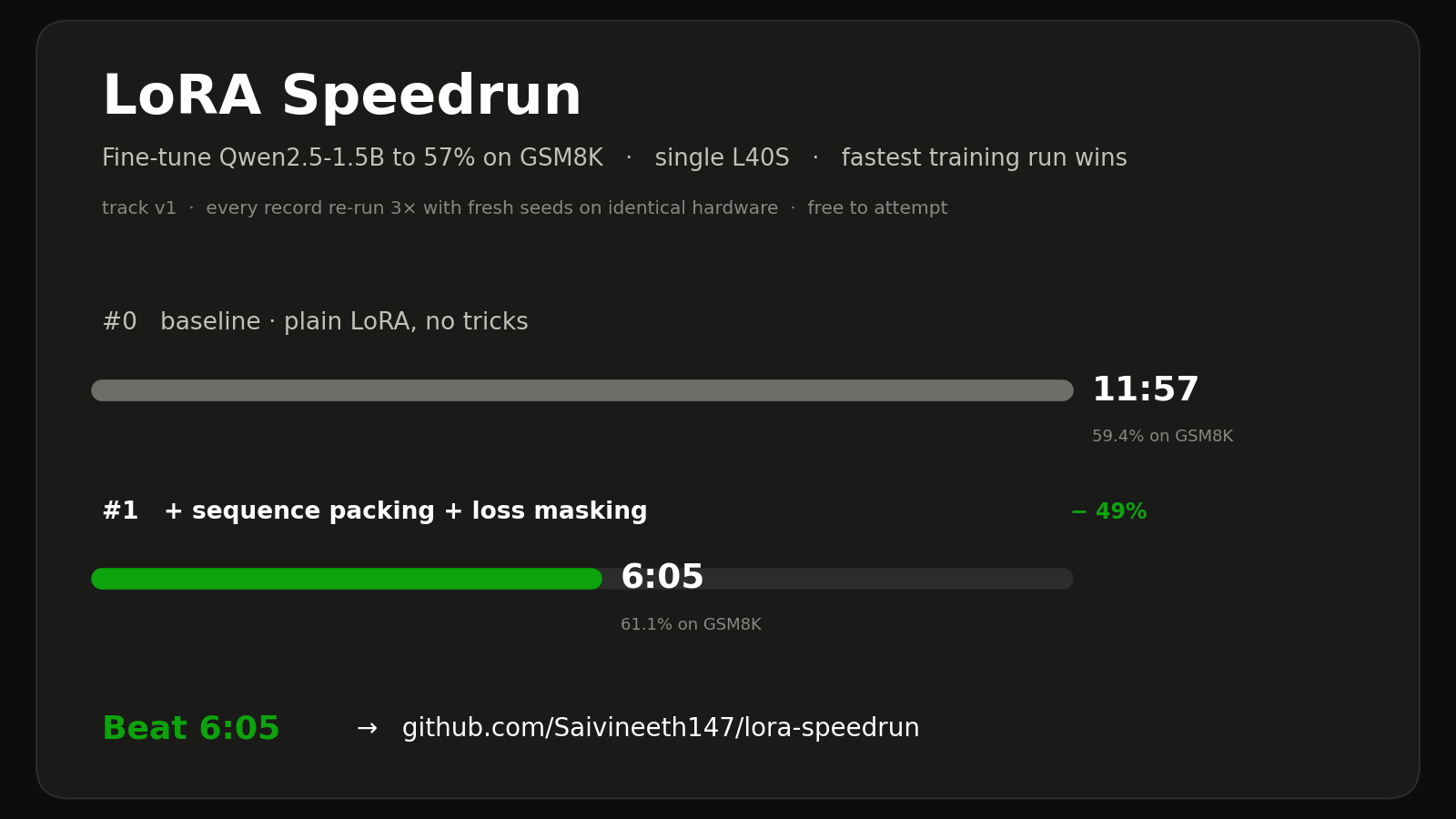
LoRA Speedrun is a new public leaderboard designed to optimize the fine-tuning speed of LLMs like Qwen2.5-1.5B on fixed L40S hardware. By providing a standardized, verifiable environment, it encourages community-driven advancements in machine learning efficiency.
The Rise of Competitive AI Optimization
The emergence of 'LoRA Speedrun' marks a significant shift in the machine learning community, moving away from purely theoretical research toward a sport-like focus on hardware-software efficiency. By establishing a public wall-clock leaderboard for fine-tuning the Qwen2.5-1.5B model on the GSM8K benchmark, this initiative creates a standardized environment where engineers can push the boundaries of Low-Rank Adaptation (LoRA) performance. In an era where training costs are often prohibitive, such optimizations are essential for democratizing access to powerful AI tools.
The Importance of Standardized Benchmarking
The core of this project lies in its strict constraints: a frozen task, fixed hardware (NVIDIA L40S), and a consistent evaluation metric. By requiring every record to be re-run three times with fresh seeds on Modal's sandbox infrastructure, the organizers have effectively neutralized the variables that often plague machine learning benchmarks. This rigor ensures that improvements—such as the sequence packing and completion-only loss masking utilized by the current record holder—are genuine gains in computational efficiency rather than statistical anomalies.
Technical Innovations in Fine-Tuning
Recent advancements, such as the transition from the baseline 11m 57s to the current 6m 05s record, highlight the transformative power of architectural tweaks. By focusing on sequence packing, which optimizes GPU utilization by filling memory buffers more effectively, and completion-only loss masking, which prevents the model from wasting compute cycles on input tokens, the leaderboard is surfacing highly practical techniques. These methods are not just academic; they are directly applicable to industrial-scale fine-tuning pipelines where every second of GPU time translates into direct capital savings.
Democratizing Compute Access
One of the most notable aspects of LoRA Speedrun is its commitment to accessibility. By leveraging Modal’s free monthly compute credits, the project ensures that the barrier to entry is virtually non-existent. This 'open-sandbox' approach fosters a collaborative ecosystem where independent researchers can compete on a level playing field with institutional entities. It transforms what is typically a siloed, proprietary research process into a transparent, community-driven pursuit of optimization.
Future Trends and Implications
As the leaderboard matures, we can expect to see a proliferation of increasingly sophisticated techniques, such as custom kernel fusion, advanced quantization, and dynamic learning rate scheduling tailored for short-duration training. This project serves as a microcosm for the broader AI industry's trend toward 'efficiency-first' development. As models grow larger and the demand for fine-tuning increases, the ability to achieve high-accuracy results in minutes rather than hours will become the primary competitive advantage for AI developers and startups alike.
Conclusion
LoRA Speedrun is more than just a leaderboard; it is a catalyst for innovation in the high-stakes world of LLM fine-tuning. By providing a verifiable, standardized, and accessible platform, it encourages the community to treat model training as an engineering challenge to be solved rather than a black box. The ongoing success of this project suggests that the future of AI development lies in the granular optimization of existing architectures, ensuring that the next generation of models is not only smarter but significantly more efficient to deploy.