M5Stack Launches PaperMono
Source Entity
Hacker News
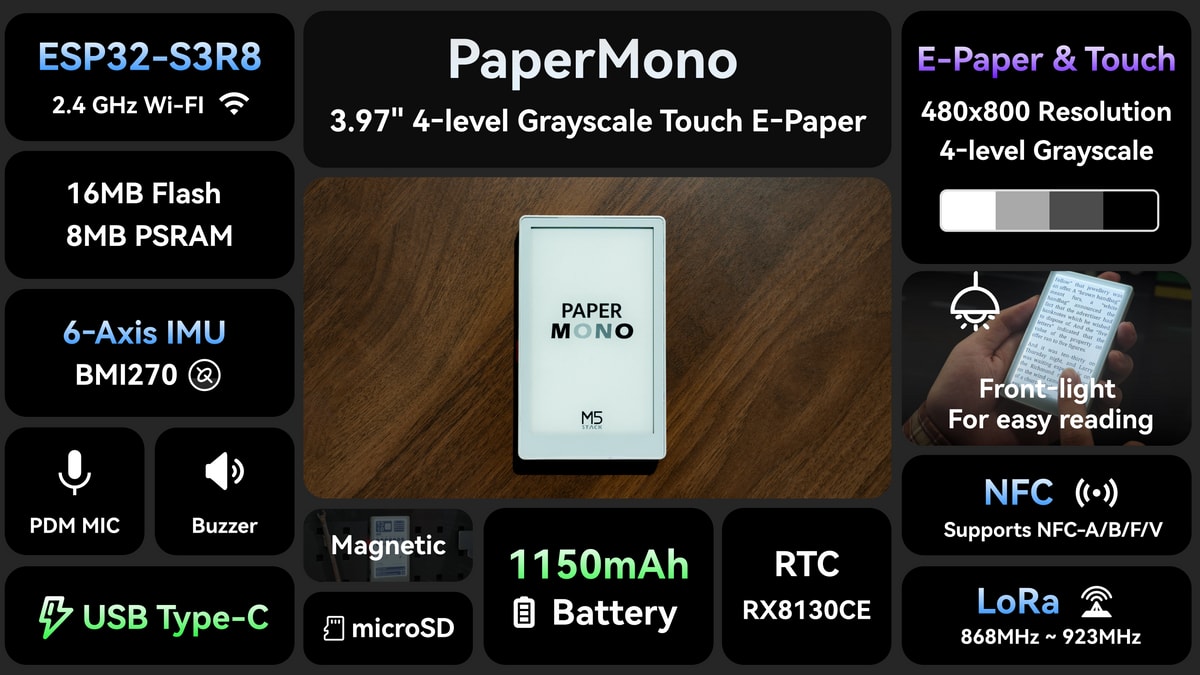
M5Stack has released the PaperMono, a versatile ESP32-S3-powered E-Ink development terminal. Designed for low-power IoT applications, it integrates connectivity, touch interaction, and a battery-backed display into a compact form factor.
Introduction to M5Stack's PaperMono
M5Stack has officially expanded its ecosystem of development hardware with the launch of the PaperMono. This new device, centered around the ESP32-S3 microcontroller, serves as a specialized E-Ink terminal tailored for developers focused on low-power, connected IoT projects. By combining a 3.97-inch grayscale display with robust hardware integration, M5Stack aims to provide a turnkey solution for engineers looking to build interactive, paper-like user interfaces that do not require constant power.
Core Technical Capabilities
The PaperMono distinguishes itself through a high level of hardware integration. The 3.97-inch 4-level grayscale E-Ink display is the centerpiece, offering the characteristic high-contrast, low-power benefits of electronic paper technology. Unlike traditional LCDs, the E-Ink panel maintains its image without drawing power, which is critical for the device’s longevity. Furthermore, the inclusion of an integrated frontlight ensures the display remains functional in low-light conditions, significantly enhancing the terminal's versatility for real-world environmental monitoring or information display tasks.
Connectivity and IoT Integration
Beyond the display, the PaperMono is built for modern connectivity. By incorporating both NFC and LoRa technology, the device addresses two major pillars of the IoT market: short-range data exchange and long-range, low-power communication. These features allow developers to deploy the terminal in diverse scenarios—from smart home automation to industrial sensor nodes—without being tethered to traditional Wi-Fi or Bluetooth limitations, thereby broadening the potential scope for deployment.
Power Management and Usability
Power efficiency is the primary value proposition of the PaperMono. With a built-in 1150mAh battery and an architecture designed for low-power operation, the device is optimized for extended field use. The addition of an RTC (Real-Time Clock) and microSD storage provides the necessary infrastructure for logging data over long durations, effectively turning the PaperMono into a self-contained data acquisition and visualization unit.
Future Trends in Development Hardware
The release of the PaperMono highlights a growing trend in the developer hardware market: the shift toward highly integrated, application-specific terminals. Instead of forcing developers to piece together disparate components—such as separate screens, NFC modules, and battery management systems—M5Stack provides a cohesive platform. This approach reduces the barrier to entry for prototyping complex IoT solutions, allowing developers to focus on software and system architecture rather than hardware assembly.
Conclusion
In summary, the PaperMono represents a strategic addition to the ESP32-based development landscape. By merging touch-enabled E-Ink technology with diverse connectivity options and a compact power supply, M5Stack has created a specialized tool that addresses the specific needs of the low-power IoT sector. As the demand for sustainable and efficient sensor networks grows, devices like the PaperMono are likely to become standard equipment for engineers developing the next generation of connected, intelligent displays.