NSF Inouye Solar Telescope Enables Major Discovery of a Hidden Solar Process
Source Entity
Hacker News
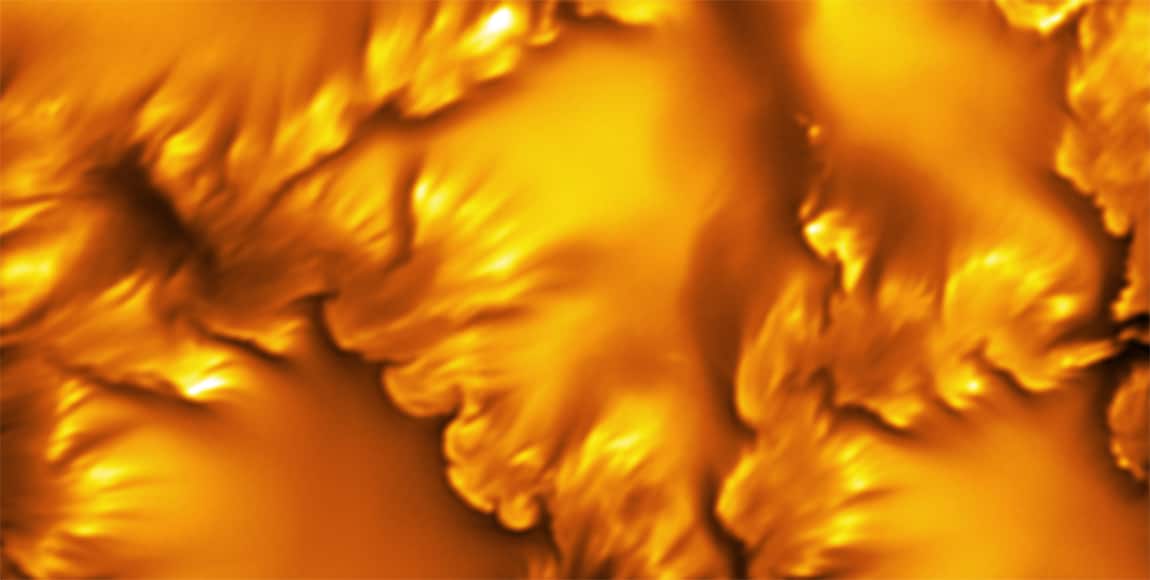
Researchers using the NSF Inouye Solar Telescope have identified Kelvin-Helmholtz instability on the Sun's surface. This discovery provides new insights into the mechanisms driving explosive solar activity and complex atmospheric phenomena.
Unlocking the Sun's Hidden Dynamics
The recent announcement from the National Science Foundation regarding the Daniel K. Inouye Solar Telescope (DKIST) marks a transformative moment in heliophysics. By capturing the elusive signature of Kelvin-Helmholtz instability on the Sun's surface, researchers have identified a fundamental fluid dynamic process that has long been theorized but rarely observed with such clarity. This discovery, made possible by the unprecedented resolution of the telescope located on Maui’s Haleakalā, provides a critical piece of the puzzle in understanding how energy is transferred within the solar atmosphere.
The Mechanism of Kelvin-Helmholtz Instability
Kelvin-Helmholtz instability occurs when there is a velocity shear in a continuous fluid, or when there is a velocity difference across the interface between two fluids. In the context of the Sun, this manifests as turbulent, wave-like patterns created by the interaction of solar plasma layers moving at different speeds. By combining high-resolution observational data with sophisticated computer simulations, scientists from the NSF NSO, NCAR High Altitude Observatory, and the Max Planck Institute have confirmed that these instabilities are not merely theoretical constructs but active drivers of solar surface dynamics.
Bridging Observations and Solar Theory
For decades, solar physicists have struggled to reconcile the observed complexity of the solar corona with the energy input from the surface. The identification of this instability suggests that these turbulent structures play a significant role in mixing solar materials and potentially heating the corona. By mapping these instabilities, the research team is moving closer to explaining the 'coronal heating problem,' one of the most enduring mysteries in space physics that asks why the Sun’s outer atmosphere is significantly hotter than its surface.
Implications for Space Weather Forecasting
Beyond theoretical physics, this finding has profound implications for space weather prediction. Explosive solar phenomena, such as solar flares and coronal mass ejections, are often preceded by complex magnetic and plasma interactions. Understanding how Kelvin-Helmholtz instability contributes to these events could allow scientists to better model the precursors to solar storms. As our society becomes increasingly reliant on satellite infrastructure and power grids, the ability to predict these high-energy events with greater accuracy is of paramount importance.
Future Directions in Heliophysics
The success of this collaborative effort underscores the value of the DKIST as a world-class scientific instrument. As the most powerful solar telescope ever built, its ability to peer into the minute details of the Sun’s magnetic and plasma environments will continue to yield groundbreaking results. Future studies will likely focus on how these instabilities interact with the solar magnetic field over longer time scales, providing a comprehensive view of the Sun's influence on the heliosphere and its impact on Earth's space environment.