Scientists detect signals at the smallest scale ever explored
Source Entity
BBC News
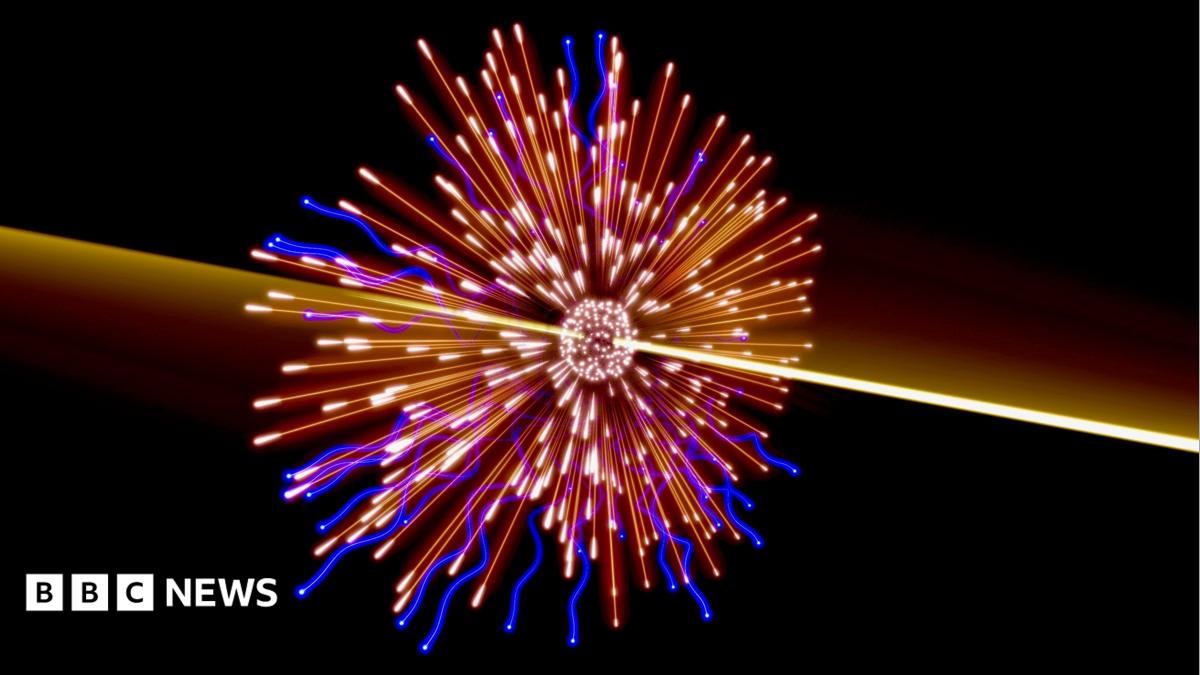
Researchers have achieved a breakthrough by detecting particle interactions at the smallest scale ever recorded. This study of beauty quark decay provides vital insights into the elusive nature of dark matter.
A New Frontier in Sub-Atomic Physics
In a landmark achievement for particle physics, researchers have successfully detected signals from the smallest spatial distances ever probed by human technology. By colliding particles at high energies, scientists examined the resulting 'shrapnel' to observe interactions occurring at the scale of a billion-trillionth of a meter. This feat represents a significant leap forward in our ability to peer into the fundamental building blocks of the universe, setting a new benchmark for experimental precision.
The Elusive Mystery of Dark Matter
At the heart of this research is the ongoing quest to understand dark matter, a substance that constitutes a vast portion of our cosmos yet remains notoriously difficult to observe. While dark matter’s gravitational influence on normal matter confirms its existence, it remains invisible across all other spectrums of interaction. By pushing the boundaries of detection, scientists hope that these high-energy collisions will eventually reveal the hidden signature of dark matter, bridging the gap between theoretical physics and observable reality.
The Role of the Beauty Quark
Central to this experiment is the beauty quark, a sub-atomic particle known for its extreme instability. Existing for only one and a half trillionths of a second before decaying into other forms, the beauty quark serves as a transient but vital probe. Its rapid transformation allows researchers to study the fundamental forces at play during the decay process, providing a high-resolution snapshot of particle behavior at the smallest imaginable scales.
Experimental Methodology and Implications
To capture these fleeting interactions, the team utilized high-energy particle smashers, which force particles together at velocities approaching the speed of light. Analyzing the resulting debris requires sophisticated instrumentation capable of identifying minute variations in sub-atomic behavior. This experimental approach not only validates existing models of particle physics but also challenges researchers to refine their understanding of how matter interacts at the absolute limits of physical space.
Future Trends in Particle Research
As we continue to probe these infinitesimal distances, the data gathered from beauty quark decay will likely inform future theories regarding the composition of the universe. By mapping out how these particles interact at such profound levels, scientists are constructing a more complete picture of the 'invisible' cosmos. This research paves the way for further exploration into whether dark matter interacts with sub-atomic particles in ways that were previously thought impossible, potentially unlocking the next era of cosmological discovery.