Secondaries lifted 2025 foundation returns, but it's mostly paper gains
Source Entity
Yahoo Finance
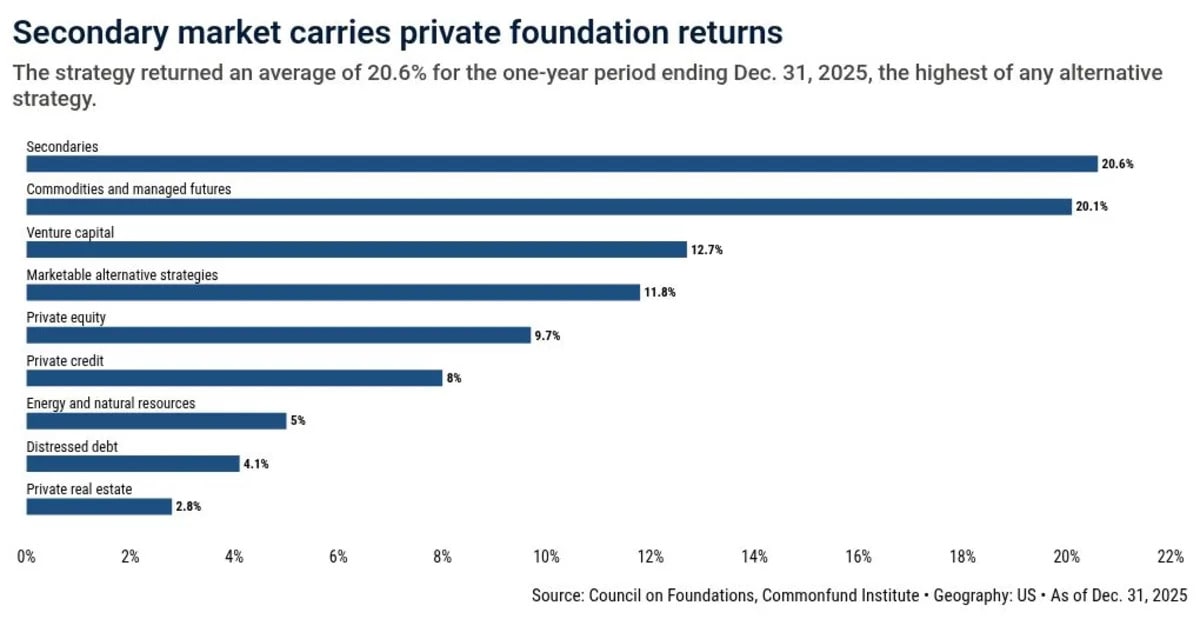
Private foundations saw strong 2025 returns driven by secondary PE investments, though these gains are largely paper-based. Simultaneously, managers are increasingly using collateralized fund obligations to securitize and scale secondary market fundraising.
The Mirage of Secondary Market Gains
Recent research from Commonfund and the Council on Foundations reveals that private foundations achieved an impressive 20.6% average return from secondary market investments in 2025. This performance outpaced all other alternative asset classes within the reporting group. However, analysts are quick to caution that these figures may be a 'mirage,' as they reflect valuation markups rather than actual liquidity events or realized cash flows from mature private equity funds exiting their portfolio companies.
The Mechanics of Paper Gains
The reliance on secondary market activity suggests a shift in how foundations are managing their portfolios. Rather than waiting for traditional exit cycles, these entities are engaging in the acquisition of secondhand fund stakes or backing managers who specialize in such transactions. While these moves boost the net asset value (NAV) on paper, they do not necessarily indicate that the underlying companies are successfully returning capital to investors, highlighting a disconnect between valuation metrics and cash-on-cash returns.
The Rise of Securitization in Private Equity
Parallel to the growth in secondary returns, the market is witnessing a significant evolution in how capital is raised for these strategies. Collateralized Fund Obligations (CFOs) have emerged as a critical tool for large asset managers. By pooling private assets and issuing tranches of rated debt, managers are creating new avenues for institutional capital—including insurance companies and family offices—to participate in the secondary market.
Institutionalizing Secondary Debt
Franklin Templeton’s recent $1.5 billion 'Structured Solutions 2026' CFO exemplifies this trend. By securing debt against the cash flows of diversified private equity stakes and continuation funds managed by Lexington Partners, the firm is effectively financializing the secondary market. This allows for a more structured risk profile, attracting investors who might otherwise avoid the volatility of pure equity exposure in private markets.
Broader Market Implications
This trend toward securitization suggests that secondary markets are moving toward greater integration with traditional credit markets. While this provides liquidity and broadens the investor base, it also introduces layers of complexity regarding debt service and asset performance. As private foundations lean into these structured products, the long-term sustainability of these 'paper gains' will depend on whether the underlying assets can eventually provide the cash flows necessary to support the debt obligations created by these new financial structures.
Future Outlook
Moving forward, the industry will likely see a continued expansion of CFOs as managers seek to scale their secondary platforms. However, investors must remain vigilant. The reliance on valuation-heavy returns, coupled with the increasing complexity of securitized private assets, creates a environment where transparency and accurate underlying asset performance are more critical than ever to ensure that these instruments do not become detached from economic reality.