‘Shortest day of 2026’: How this 'milli-seconds shift' is threatening GPS and satellites
Source Entity
TOI TECH DESK
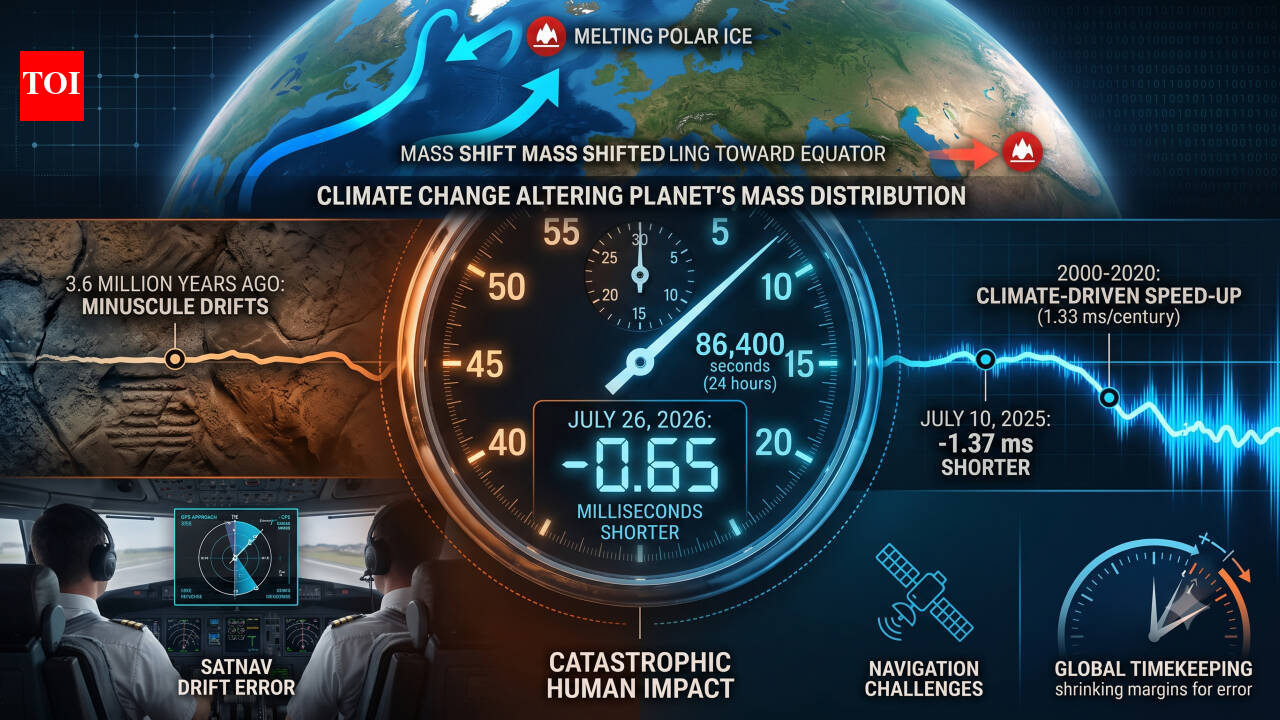
Earth's rotation is accelerating, leading to the shortest day of 2026 on July 26 due to a 0.65-millisecond shift. This phenomenon, driven by climate-induced mass redistribution, poses significant challenges for global navigation and timekeeping systems.
The Accelerating Earth: Understanding the 2026 Rotation Shift
On July 26, 2026, the Earth will experience its shortest day of the year, a phenomenon characterized by a reduction of 0.65 milliseconds. While this duration is imperceptible to human senses—vanishing faster than a camera flash or a human blink—it represents a significant departure from historical norms. Scientists at the International Earth Rotation and Reference Systems Service (IERS) have identified that the Earth's rotation is currently undergoing shifts unmatched in the last 3.6 million years, signaling a profound change in our planet’s geophysics.
The Climate Change Connection
At the heart of this temporal anomaly lies the accelerating impact of climate change. As global temperatures rise, the resulting melting of polar ice caps and glaciers redistributes mass from the poles toward the equator. This shift in mass alters the planet's moment of inertia, effectively acting like a figure skater pulling their arms in to spin faster. This phenomenon is not merely a theoretical concern; it is a measurable, physical change in how our planet navigates its axis, creating a feedback loop that continues to influence the length of our days.
Implications for Global Infrastructure
Modern civilization is built upon the assumption of a constant and predictable Earth rotation. Our global infrastructure, including the Global Positioning System (GPS), high-frequency financial trading platforms, and deep-space communication networks, relies on extreme precision in timekeeping. Even a shift of 1.33 milliseconds per century can accumulate, potentially causing synchronization errors in satellite arrays and navigation systems. As the rotation speed fluctuates in ways previously thought to be stable, the margin for error in these critical systems narrows significantly.
The Challenge of Precise Timekeeping
Historically, humanity has managed these deviations by introducing 'leap seconds' to keep Coordinated Universal Time (UTC) aligned with the Earth's actual rotation. However, as the planet's rotational behavior becomes more volatile and unpredictable due to environmental factors, the traditional methods of time correction are becoming increasingly complex. The scientific community faces the daunting task of recalibrating global clocks to account for these erratic shifts without disrupting the interconnected digital services that define modern life.
Future Trends and Scientific Outlook
Looking toward the future, the trend of accelerating rotation suggests that we may enter an era where negative adjustments to our clocks become necessary—a scenario that current computing systems are largely unprepared for. As climate-induced mass redistribution continues to affect the planet’s physical properties, the scientific community must prioritize the development of more resilient timekeeping protocols. The shift on July 26, 2026, serves as a critical data point in a broader narrative of a changing planet, reminding us that even the most fundamental constants of nature are subject to the influence of human-driven environmental change.