'We will kill Trump': Tehran puts up gigantic billboard depicting US president in coffin
Source Entity
TIMESOFINDIA.COM
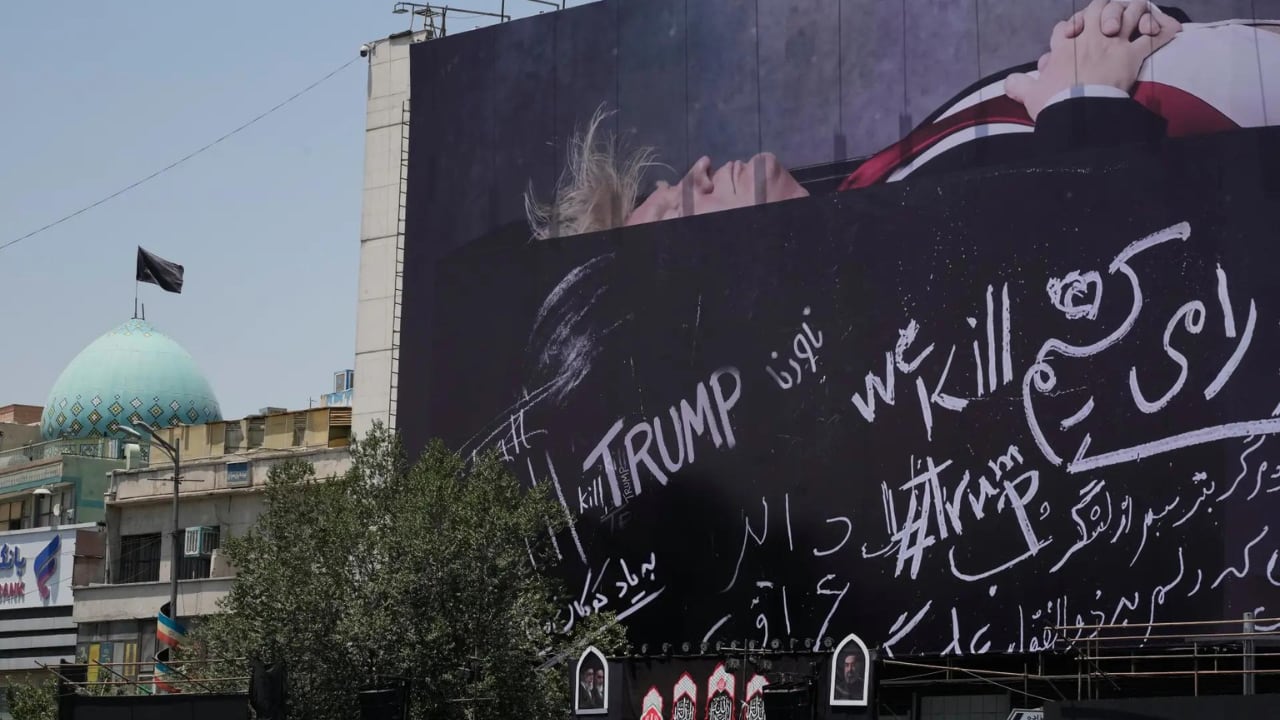
Tensions between the US and Iran have reached a fever pitch following the installation of a provocative billboard in Tehran depicting Donald Trump in a coffin, coinciding with mutual military strikes targeting command centers and industrial facilities.
Escalation in the Gulf: Psychological Warfare and Kinetic Strikes
The recent installation of a massive billboard in Tehran's Enghelab Square, depicting former US President Donald Trump in a coffin, marks a significant escalation in the psychological warfare between the Islamic Republic of Iran and the United States. This visceral display is not merely a piece of political propaganda but a calculated signal intended for both a domestic audience and the international community. By utilizing one of the city's most prominent public spaces, the Iranian leadership is projecting a narrative of defiance and aggression, attempting to galvanize nationalistic sentiment while explicitly threatening the leadership of its primary geopolitical adversary.
The Intersection of Propaganda and Military Action
This provocative imagery does not exist in a vacuum; it coincides with a surge in direct military engagement. The United States has reportedly conducted precision strikes targeting Iranian command centers and air defense systems. These operations suggest a strategic objective by the US to degrade Iran's ability to coordinate military responses and protect its airspace. The timing of the billboard suggests a symbiotic relationship between Iran's kinetic defense and its propaganda machine: as the US strikes physical infrastructure, Tehran responds with symbolic strikes against the image of the American presidency, attempting to shift the narrative from military vulnerability to ideological strength.
Collateral Damage and Industrial Impact
Beyond the strategic targets, the conflict has begun to bleed into civilian and industrial sectors, raising grave concerns regarding international humanitarian law. Reports of a missile strike occurring near a cancer hospital in Ahvaz underscore the volatility of the current engagement. The proximity of military strikes to critical healthcare infrastructure increases the risk of catastrophic civilian casualties. Similarly, the reported damage to an industrial facility in Qeshm indicates that the US may be targeting economic hubs or dual-use facilities to exert pressure on the Iranian regime, further destabilizing the region's industrial output and economic stability.
Historical Context of US-Iran Hostility
To understand the current volatility, one must look at the historical trajectory of US-Iran relations, which have been characterized by deep-seated mistrust since the 1979 Revolution. The cycle of 'maximum pressure' campaigns, the collapse of the Joint Comprehensive Plan of Action (JCPOA), and the assassination of key military figures have created a precedent where direct confrontation is more likely than diplomatic resolution. The use of provocative public displays, such as the coffin billboard, is a recurring theme in Iranian statecraft, used to maintain internal cohesion by framing the US as an existential threat that must be resisted at all costs.
Future Implications and Geopolitical Trends
Looking forward, this combination of high-visibility propaganda and precision military strikes suggests a dangerous trend toward uncontrolled escalation. When political rhetoric moves from diplomatic condemnation to depictions of death, the window for a negotiated settlement narrows significantly. We can expect a continued pattern of 'tit-for-tat' strikes, potentially expanding to include proxy forces in Iraq and Syria. The risk of a miscalculation—where a strike on a civilian facility or a high-ranking official triggers a full-scale war—is currently at its highest point in years.
Summary of the Crisis
In conclusion, the situation in Tehran and the surrounding regions represents a precarious blend of symbolic aggression and physical warfare. The billboard in Enghelab Square serves as a grim marker of the current diplomatic failure, while the strikes in Ahvaz and Qeshm demonstrate the tangible costs of this rivalry. Without an immediate shift toward de-escalation, the region faces a prolonged period of instability characterized by increased military volatility and the erosion of humanitarian safeguards.