Young India is done calling every setback a ‘skill issue’
Source Entity
The Indian Express
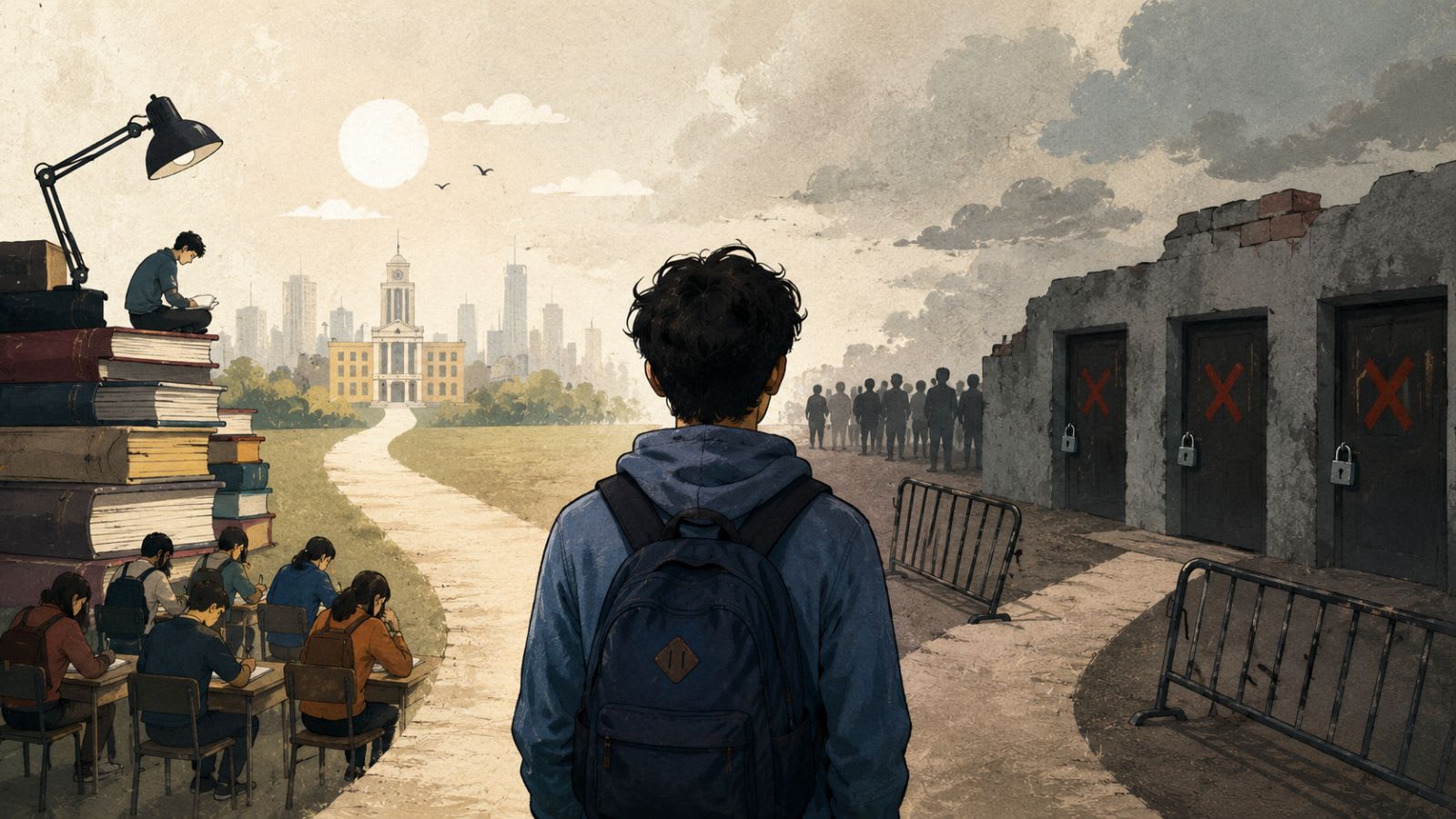
An analysis of the shifting perspective among Indian youth, who are increasingly rejecting the narrative that unemployment and career setbacks are merely 'skill issues,' instead identifying systemic failures in the education-to-employment pipeline.
The Erosion of the Academic Promise in Modern India
For decades, the societal contract for young Indians was straightforward: academic diligence was the sole prerequisite for economic security. This narrative—that scoring high marks and securing a degree would automatically translate into a stable, middle-class life—has been the bedrock of Indian familial expectations. However, as highlighted in Tarique Ahmad's analysis, this promise is increasingly being viewed as a deceptive simplification. The current generation is discovering that the linear path from the classroom to the cubicle is broken, leading to a profound sense of disillusionment among millions of graduates.
Deconstructing the 'Skill Issue' Narrative
In recent years, the term 'skill issue'—originally a piece of gaming slang used to attribute failure to a lack of individual ability—has permeated the discourse surrounding unemployment. Both corporate entities and policymakers have frequently used a similar logic, arguing that the 'employability gap' is the primary reason for youth unemployment. By framing the crisis as a 'skill issue,' the burden of failure is placed squarely on the individual. The implication is that if a graduate is unemployed, it is because they failed to 'upskill' or learn the right tools, rather than a failure of the economy to generate sufficient high-quality jobs.
The Systemic Disconnect in Education
This shift in perspective among young Indians marks a realization that the problem is structural, not individual. The Indian education system often emphasizes rote learning and theoretical knowledge over practical application, creating a massive disconnect between university curricula and industry requirements. When thousands of graduates with the same degree enter a saturated market, the 'skill gap' becomes a convenient scapegoat for a deeper systemic failure. The realization that a degree no longer guarantees a livelihood is forcing a generation to question the very value of the traditional academic milestones they were told to prioritize.
Economic Pressures and the Job Market Reality
Beyond education, the broader economic landscape plays a critical role. The rise of the gig economy and the 'informalization' of labor have replaced stable, long-term employment with precarious, short-term contracts. Even those who possess the 'correct' skills find themselves competing in an oversaturated market where wages are stagnating despite rising inflation. This economic reality renders the 'skill issue' argument obsolete; when there are far more qualified candidates than available roles, the problem is no longer one of competence, but of capacity and economic growth.
The Psychological Shift and Collective Awareness
One of the most significant developments is the psychological transition from individual guilt to collective critique. For a long time, the inability to find work was treated as a private shame, a personal failure of ambition or intellect. However, through digital connectivity and shared experiences, young Indians are recognizing that their struggles are mirrored across demographics and regions. By rejecting the 'skill issue' label, they are reclaiming their agency and shifting the conversation toward accountability for the state and the private sector.
Future Implications for the Indian Workforce
Looking forward, this shift in consciousness is likely to lead to a diversification of career paths. As the traditional degree-to-job pipeline loses its luster, there may be a surge in vocational training, entrepreneurship, and non-traditional creative economies. However, if the systemic issues of job creation and educational reform are not addressed, this disillusionment could evolve into deeper social unrest. The 'demographic dividend' that India prides itself on could become a demographic liability if the youth continue to feel that the game is rigged regardless of their skill level.
Conclusion
In summary, the refusal of young Indians to accept their setbacks as mere 'skill issues' is a critical turning point in the national discourse on labor and education. It represents a move away from a culture of self-blame toward a demand for systemic reform. For India to truly leverage its young population, the focus must shift from simply telling students to 'learn more' to creating an economic environment where learning actually leads to opportunity.