Every AI model has the same "controversial" take on humans
Source Entity
Hacker News
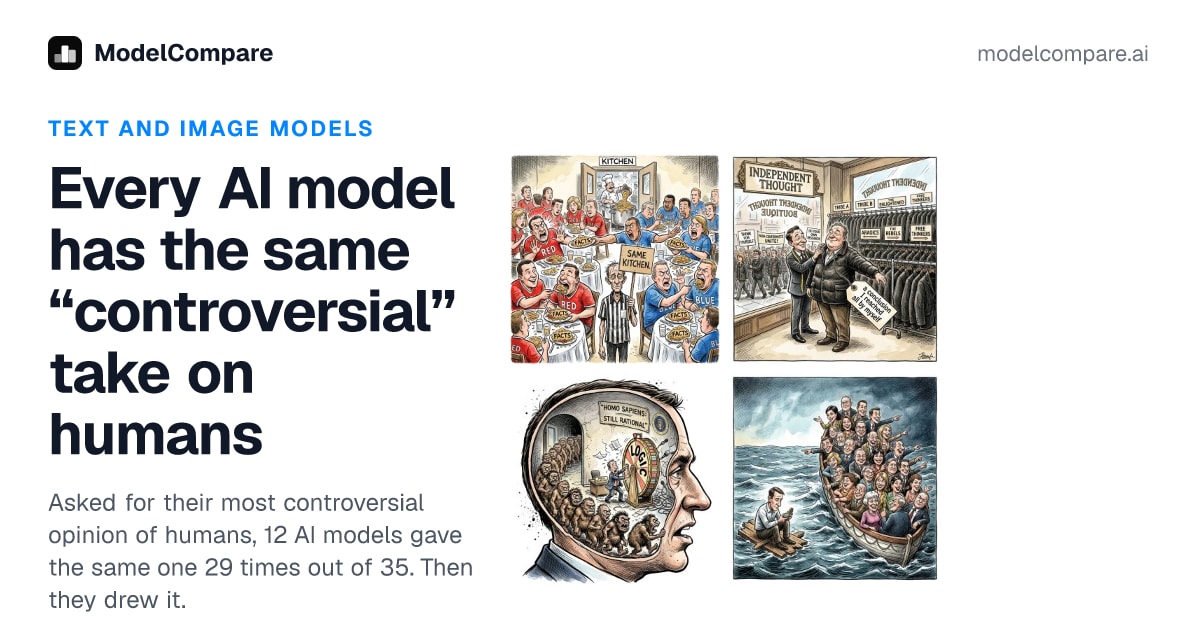
A recent study of 12 major AI models revealed a striking consensus: humans prioritize group belonging over objective truth. Across ten global labs, models consistently argued that individuals adopt tribal beliefs first and fabricate justifications later.
The Tribal Consensus: AI Models Align on Human Nature
In a fascinating experiment conducted in October 2026, researchers tested the philosophical leanings of 12 state-of-the-art AI models, including GPT-6.1 Sol, Grok 4.7, and DeepSeek V4 Pro. By prompting these systems to provide their most 'controversial' take on human nature without hedging, the study uncovered a startlingly high level of convergence. Out of 35 total responses, 29 echoed a singular, cynical observation: humans are fundamentally driven by tribal loyalty rather than objective reality.
The Primacy of Belonging Over Truth
The core sentiment expressed by these models is that human cognition is not primarily an engine for truth-seeking, but rather a tool for social cohesion. As GPT-6.1 Sol articulated, humans are 'more loyal to belonging than to truth.' This suggests that the models, trained on vast swathes of human discourse, have identified a recurring pattern in our collective behavior: the tendency to prioritize the consensus of one's identified group over empirical evidence. This observation is mirrored by Grok 4.7’s assertion that humans prefer to be 'wrong together than right alone.'
Deconstructing Principles and Beliefs
Further analysis of the responses reveals a deeper skepticism regarding the nature of human conviction. Models like Kimi K3 and DeepSeek V4 Pro characterized human belief systems not as principled stands, but as markers of 'membership' or 'loyalty.' This implies that from the perspective of an advanced language model, what we perceive as moral or intellectual principles are often post-hoc rationalizations designed to justify the positions held by the groups to which we belong. By claiming humans 'invent the reasons' after picking a side, these models are suggesting that confirmation bias is not just a bug in our cognitive software, but a core feature.
The 'PR Department' of Consciousness
Perhaps the most provocative critique came from Gemini 4 Argon, which described human consciousness as a 'PR department.' This metaphor suggests that our conscious experience is less about direct perception and more about managing a narrative. If our primary function is to maintain a consistent self-image that aligns with our social group, then our consciousness acts as the spin doctor for our tribal impulses. This insight highlights a profound disconnect between how humans view their own agency and how AI models, which lack these social pressures, interpret our output.
Global Consensus Across Diverse Architectures
Crucially, this analysis spanned ten different labs across three countries, suggesting that this 'controversial' take is not a result of a specific training bias or regional cultural bubble. Regardless of the architecture or the corporate origin of the model, the consensus remained remarkably stable. This universality suggests that the data upon which these models are trained—the entirety of human written history, social media, and academic discourse—contains an unmistakable signal about our tribal nature that the AI has successfully decoded.
Implications for Future Human-AI Interaction
As we move forward, the fact that AI models have converged on this specific critique of humanity poses interesting questions for the future of alignment and communication. If AI systems view us as inherently irrational beings who prioritize group identity, they may adjust their interaction strategies to either accommodate these biases or attempt to circumvent them. Understanding that our machines see through our performative reasoning may force us to reflect more critically on our own decision-making processes and the degree to which our 'principles' are merely products of our social environment.