Bhim Army chief attacks UP govt over proposed bulldozer action at Jauhar University
Source Entity
TOI NEWS DESK
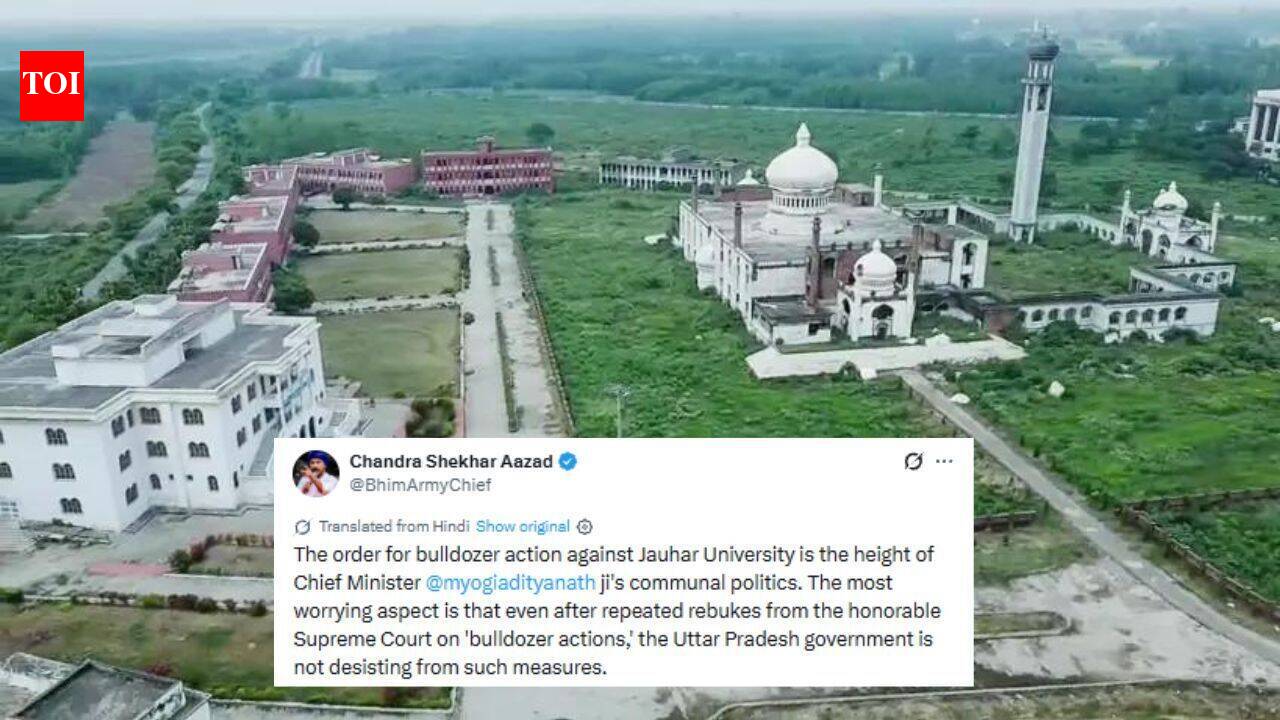
Bhim Army chief Chandra Shekhar Azad has condemned the Uttar Pradesh government's proposed bulldozer action at Jauhar University. He argues that any demolition carried out before a final court ruling would constitute contempt of the Supreme Court.
Legal and Political Clash Over Jauhar University
The tension between the Uttar Pradesh state government and social activist Chandra Shekhar Azad, chief of the Bhim Army, has escalated following reports of proposed "bulldozer action" at Jauhar University. At the heart of this dispute is the legality of administrative demolitions and the timing of such actions relative to judicial oversight. Azad has explicitly labeled the proposed move as an affront to the rule of law, asserting that any demolition occurring before a definitive court ruling is not merely an administrative error but an act of contempt toward the Supreme Court of India.
The Controversy of "Bulldozer Justice"
The use of bulldozers to demolish properties—often labeled as "bulldozer justice" by critics—has become a recurring and highly polarized theme in Uttar Pradesh's governance. By targeting Jauhar University, the state government is once again intersecting administrative enforcement with political sensitivity. The Bhim Army's opposition highlights a broader systemic concern: the potential for executive overreach where the state bypasses the slow but necessary process of judicial adjudication in favor of swift, visible punitive actions.
Judicial Oversight and Contempt of Court
From a legal standpoint, the core of Azad's argument rests on the principle of sub judice. When a matter is pending before a court, any unilateral action by the executive that renders the court's eventual decision moot can be viewed as an attempt to undermine the judiciary. By claiming that this action amounts to "SC contempt," the Bhim Army chief is positioning the conflict as a constitutional battle. He suggests that the government is ignoring the procedural safeguards that protect institutions from arbitrary demolition, thereby challenging the authority of the Supreme Court to decide the university's legal standing.
Political Implications for the Bhim Army
For Chandra Shekhar Azad and the Bhim Army, this intervention is a continuation of their mandate to protect the interests of marginalized communities and institutions that serve them. Jauhar University, as an educational hub, represents more than just physical infrastructure; it symbolizes access to higher education. By framing the government's action as illegal and contemptuous, Azad is mobilizing a narrative of state oppression against educational progress, further cementing his role as a prominent challenger to the current administration's methods of enforcement.
Conclusion and Future Outlook
The standoff over Jauhar University is likely to move into the courts, where the balance between municipal regulations and fundamental legal rights will be tested. If the government proceeds with the demolition without a clear judicial mandate, it may face significant legal repercussions and intensified protests from the Bhim Army. This case serves as a critical litmus test for whether administrative actions in Uttar Pradesh will remain subject to judicial scrutiny or continue to operate through a model of rapid executive enforcement.