BRICS Forum adopts joint declaration; condemns Pahalgam attack, seeks UNSC reforms
Source Entity
India Latest News: Top National Headlines Today & Breaking News | The Hindu
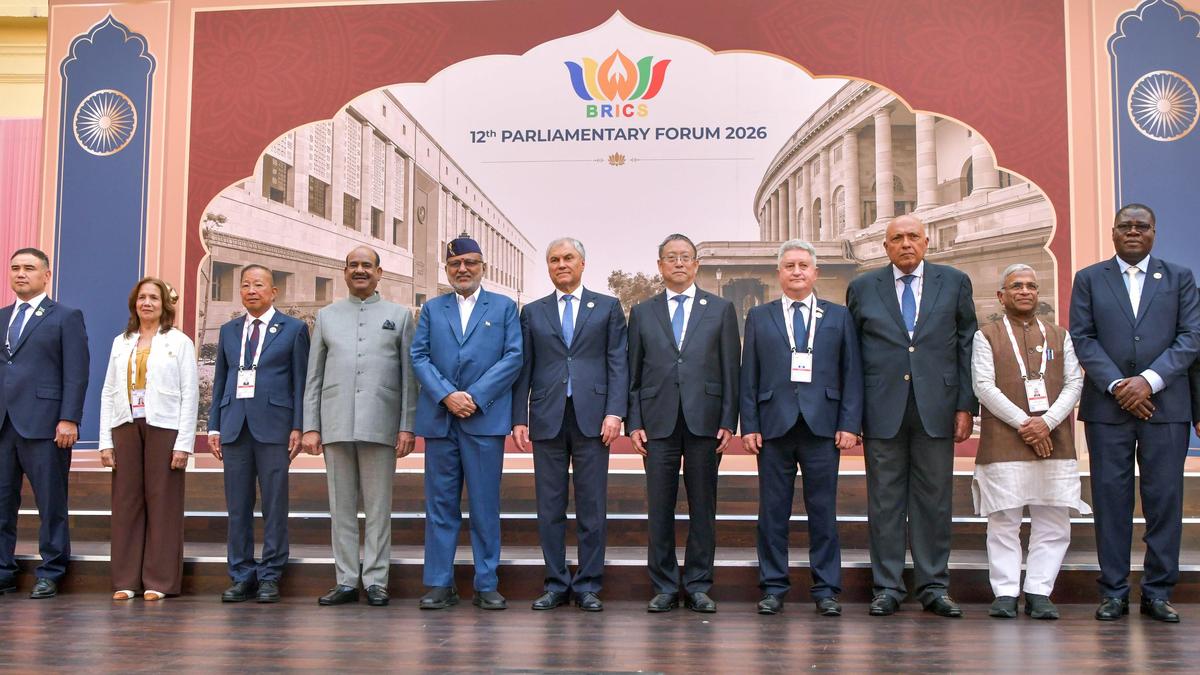
The 12th BRICS Parliamentary Forum, led by Lok Sabha Speaker Om Birla, issued a joint declaration calling for a two-state solution in West Asia and condemning unilateral sanctions. The forum also advocated for comprehensive UN Security Council reforms and pledged unified action against terrorism, citing the 2025 Pahalgam attack.
BRICS Parliamentary Forum Addresses Global Stability and Geopolitical Tensions
The 12th BRICS Parliamentary Forum, held in New Delhi and presided over by Lok Sabha Speaker Om Birla, has concluded with a significant joint declaration that underscores the bloc's growing influence on global diplomatic discourse. The forum focused heavily on the volatile situation in West Asia, expressing 'deep concern' over escalating hostilities and advocating for a path toward regional stability that respects international law.
Advocating for the Two-State Solution
At the core of the forum's resolution regarding the Middle East is a firm commitment to the 'two-state' solution as the primary pathway for resolving the Israel-Palestinian conflict. By asserting the Palestinian people's right to self-determination, freedom, and an independent, sovereign state, the BRICS nations have signaled a unified diplomatic front. The declaration emphasizes the necessity for 'maximum restraint' from all involved parties to prevent further regional destabilization.
Opposition to Unilateral Coercive Measures
A critical component of the forum's output was the explicit condemnation of 'unilateral coercive measures' and 'unilateral economic sanctions.' The participating nations argued that these measures are contrary to international law and impose severe, far-reaching negative consequences on the human rights of civilian populations. Specifically, the forum highlighted how such sanctions impede the fundamental rights to development, healthcare, and food security, suggesting that economic pressure should not be used as a tool that undermines humanitarian stability.
A Call for Global Institutional Reform
Beyond regional conflicts, the forum addressed the structural limitations of current international governance. The joint declaration explicitly supported a comprehensive reform of the United Nations, with a particular focus on the Security Council. The member nations advocated for a more 'just' and 'equitable' UN framework, reflecting a broader BRICS agenda to shift the global power balance toward a more multipolar world order that grants greater representation to the Global South.
Unified Front Against Terrorism
Security cooperation remained a central theme, with the forum taking a strong stance against terrorism. The declaration condemned the 2025 Pahalgam attack and pledged to combat the menace of terrorism in all its forms and manifestations. By linking the rejection of terrorism with the principle of non-intervention in the internal affairs of sovereign nations, the forum articulated a clear standard for inter-state relations within the BRICS framework.
Future Implications and Conclusion
This forum marks a pivotal moment for BRICS as it seeks to harmonize the diverse national positions of its members into a cohesive narrative on international affairs. By prioritizing diplomatic solutions, institutional reform, and a rejection of unilateral economic coercion, the bloc is positioning itself as a significant counter-voice to Western-led global policy. Moving forward, the effectiveness of these resolutions will depend on how successfully these nations can translate their collective parliamentary rhetoric into tangible influence within global bodies like the UN.
Multiple Citing Sources
Verification Required?