Lathi-charge, tear gas at CJP protests: Police can disperse a crowd. Law doesn't say how much force it can use
Source Entity
Latest News: Todays Latest News Headlines from India & World | Hindustan Times | Hindustan Times
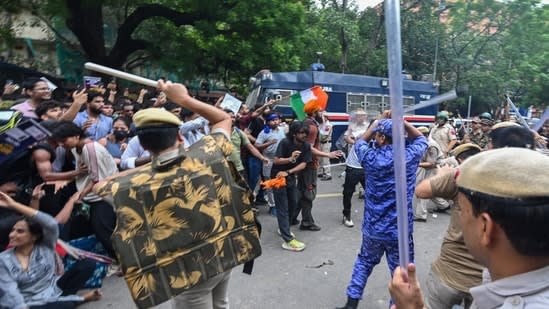
The deployment of plainclothes police during recent Cockroach Janta Party protests has sparked intense debate over identification and the use of force. Legal experts note that while police have authority to manage crowds, the lack of a clear statutory framework regarding proportionality remains a significant concern.
The Controversy of Plainclothes Policing in Delhi
The recent demonstrations by the Cockroach Janta Party (CJP) in New Delhi have ignited a significant public debate regarding the operational tactics employed by law enforcement. Visuals emerging from the protests depicted individuals in civilian attire—specifically shirts, trousers, and chappals—wielding lathis and wearing police helmets. This lack of clear identification, such as uniforms and name tags, has drawn sharp criticism from the public and civil rights observers, raising questions about accountability and the potential for confusion during high-tension crowd control scenarios.
The Intelligence vs. Identification Dilemma
Senior police leadership has defended these deployments, characterizing them as a long-standing necessity for intelligence gathering and undercover operations. The rationale provided suggests that plainclothes officers are better equipped to infiltrate and monitor large crowds effectively. However, this operational necessity creates a palpable ambiguity. When individuals lack standard police identifiers, it becomes difficult for the public to distinguish between law enforcement personnel and potentially hostile actors, which can lead to unnecessary escalation during public demonstrations.
Digital Vigilantism and Privacy Concerns
The fallout from these events has extended into the digital realm, where social media users have taken it upon themselves to identify the officers in question. By circulating personal details, including Instagram handles, phone numbers, and home addresses, critics have engaged in a form of digital vigilantism. In several instances, individuals were wrongly identified, highlighting the dangers of reactionary online behavior. This development underscores the risks associated with blurring the lines between professional law enforcement and the civilian sphere, as it leaves officers vulnerable to doxxing and misinformation.
Legal Frameworks and the Limits of Force
Beyond the issue of attire, the CJP protests have refocused attention on the legal constraints surrounding the use of force in India. While the Bharatiya Nagarik Suraksha Sanhita (BNSS) grants police the authority to disperse unlawful assemblies, there is a notable absence of a cohesive statutory framework governing the specific extent of force that may be applied. Currently, the principles of necessity, proportionality, and the requirement to use minimum force are derived from scattered court judgments rather than a singular, clear legislative code.
Future Implications and Policy Shifts
Recognizing the potential for public distrust, police leadership has begun to discourage the use of plainclothes officers for general law and order duties, reserving them only for situations where the threat level escalates or manpower is critically short. This shift acknowledges that while operational flexibility is required, the optics of unidentified personnel using force can undermine public confidence in the institution of policing. Moving forward, the challenge for authorities will be to balance the strategic benefits of undercover intelligence with the constitutional mandate for transparent and accountable law enforcement.
Verification Required?