Before building higher, Delhi must strengthen the city beneath its buildings
Source Entity
Shailaja Chandra
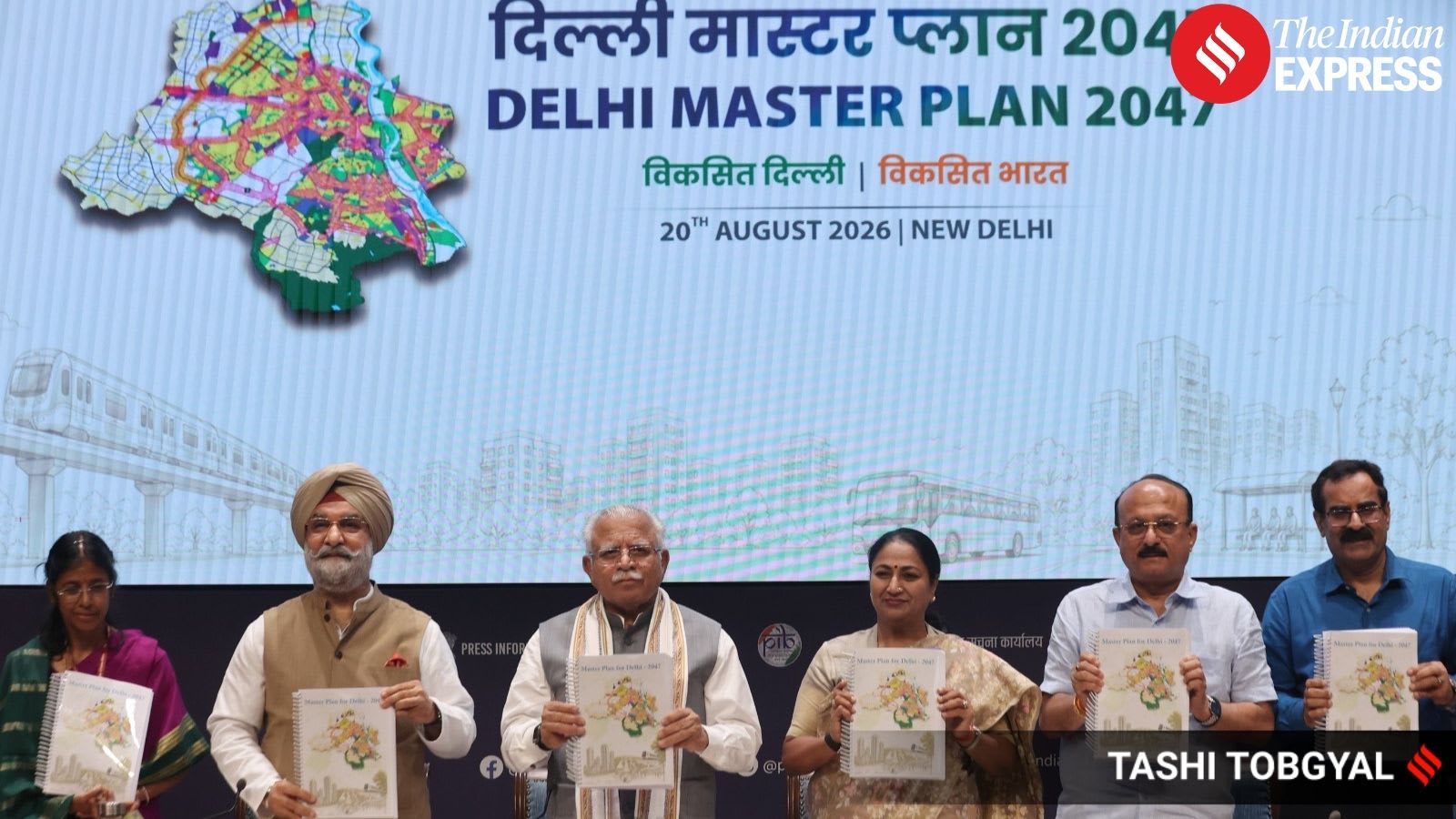
The Delhi Master Plan 2047 aims to address rapid urbanization by facilitating 40 lakh affordable homes through land pooling and small-scale redevelopment. The strategy focuses on densification, infrastructure upgrades, and regularizing unauthorized colonies to support a projected population of 3.2 crore.
Shaping the Capital: An Analysis of Delhi Master Plan 2047
Delhi stands at a critical juncture of urban evolution. With the population projected to reach 3.2 crore, the city faces the dual challenge of accommodating growth while managing the scarcity of developable land. The recently unveiled Delhi Master Plan 2047 (MPD-2047), launched by Union Minister Manohar Lal Khattar and LG Taranjit Singh Sandhu, represents a paradigm shift in how the capital envisions its future. By moving away from rigid, large-scale planning toward more modular, high-density development, the government aims to provide 40 lakh affordable housing units that are better integrated into the city’s transit networks.
The Strategy of Land Pooling and Expansion
At the heart of MPD-2047 is the strategic use of land pooling. This mechanism is designed to unlock undeveloped areas by allowing landowners to participate in the development process, ensuring that infrastructure is laid out before construction begins. By shifting the burden of expansion from haphazard, unplanned growth to a regulated framework, the plan aims to create sustainable residential hubs. This approach is essential for balancing the city's need for space with the necessity of maintaining basic civic amenities, such as water, sewage, and power connectivity.
Decentralizing Redevelopment Thresholds
One of the most significant policy adjustments in the new master plan is the lowering of the minimum area required for redevelopment. By reducing the threshold from 40,000 square meters (approximately 10 acres) to just 3,000 square meters (less than one acre), the policy enables smaller housing societies to undergo regeneration. This change is vital for the city’s aging infrastructure, as it allows smaller apartment complexes to modernize their facilities and increase density without requiring the massive land assembly that previously stifled urban renewal projects.
Integrating Unauthorized Colonies
Delhi’s unauthorized colonies have long been a source of housing for millions, yet they remain outside the formal planning framework. MPD-2047 explicitly seeks to regularize these areas, offering residents greater security of property ownership and access to formal municipal services. By extending a Floor Area Ratio (FAR) of 350 to regeneration schemes within these colonies, the plan incentivizes property owners to upgrade their buildings in accordance with modern safety and structural standards, effectively bringing them into the city’s formal economy.
Transit-Oriented Development and Density
To manage the influx of residents, the plan emphasizes high-density construction along public transport corridors. This "Transit-Oriented Development" (TOD) model is designed to reduce commute times and reliance on private vehicles, which are primary contributors to the city’s pollution and traffic congestion. By placing housing near transit hubs, the plan seeks to create a more efficient, walkable, and environmentally conscious urban environment that can sustain a population of 3.2 crore residents.
Looking Ahead: The Future of Urban Delhi
While the objectives of MPD-2047 are ambitious, the success of the plan will ultimately depend on the seamless implementation of these regulatory changes. The transition toward high-density, small-scale redevelopment necessitates robust oversight to ensure that the city’s underlying infrastructure—its pipes, wires, and road networks—can support the increased load. If executed effectively, this master plan could serve as a blueprint for other rapidly growing Indian metropolises, proving that even a city as complex as Delhi can be reimagined through strategic, modular, and inclusive urban planning.