Researchers build AI camera that reconstructs particle paths using handful of photons
Source Entity
The Indian Express
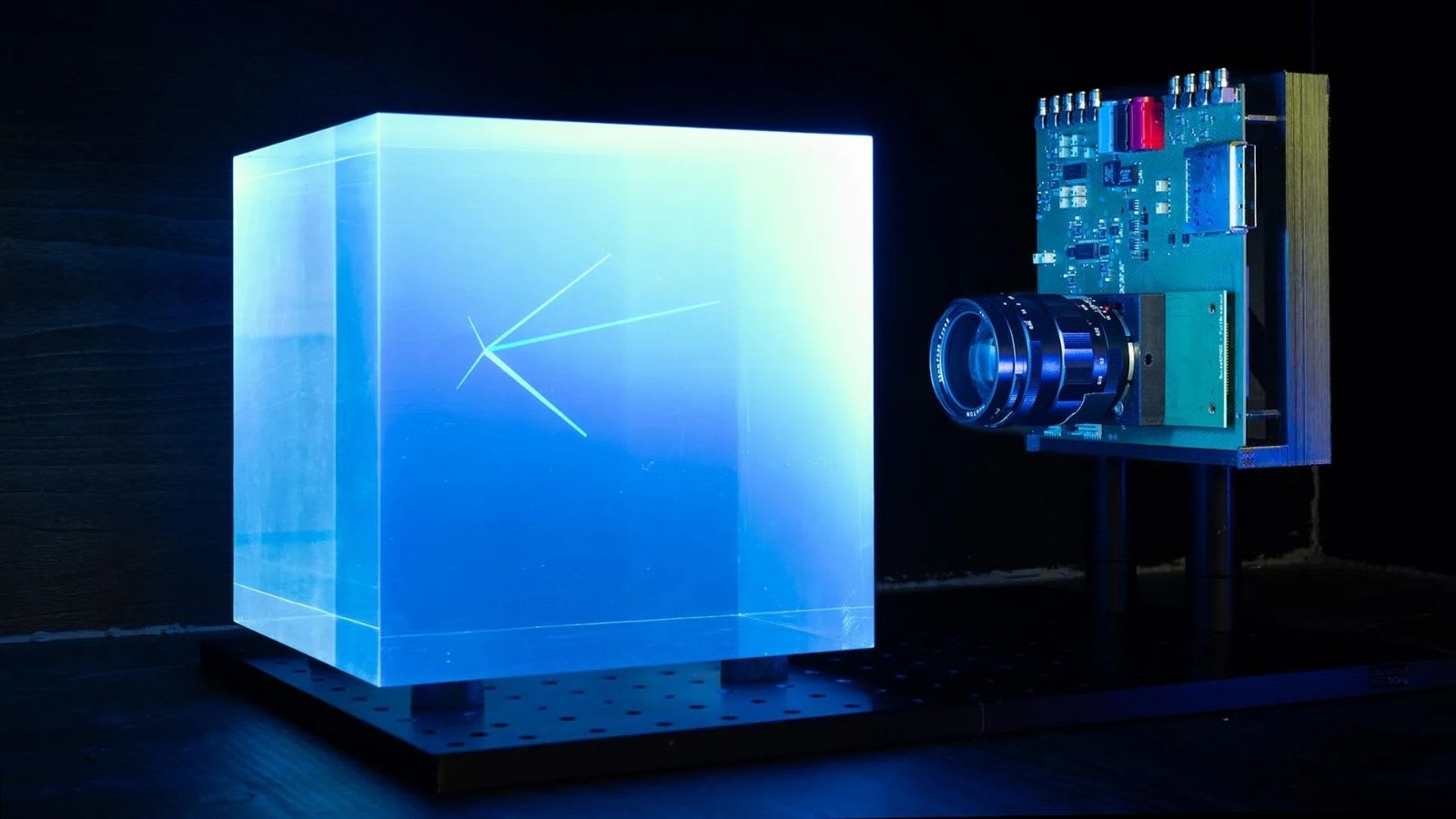
Researchers at ETH Zurich and EPFL have developed PLATON, an AI-powered particle detection system that uses a single block of material to reconstruct particle paths. This innovation simplifies detector construction while offering potential advancements in high-energy physics and medical imaging.
A Paradigm Shift in Particle Detection
Recent advancements from researchers at ETH Zurich and EPFL have introduced a groundbreaking technology known as PLATON, which promises to redefine the landscape of particle physics. By moving away from the traditional, complex arrays consisting of millions of individual detector components, this new system utilizes a single block of light-producing material coupled with an AI-powered camera. This fundamental shift in design addresses one of the most persistent hurdles in scientific instrumentation: the balance between sensitivity and hardware complexity.
The Mechanics of PLATON
The core innovation of PLATON lies in its ability to reconstruct particle paths in three dimensions using only a handful of photons. In conventional particle physics experiments, detectors are often comprised of massive, intricate grids that are difficult to manufacture, maintain, and scale. PLATON simplifies this by leveraging sophisticated computational reconstruction, effectively offloading the burden of precision from physical hardware to intelligent software algorithms. This convergence of hardware and artificial intelligence marks a significant leap forward in how we observe the subatomic world.
Implications for High-Energy Physics
Particle detectors serve as the primary eyes for physicists investigating the building blocks of the universe. Current technologies, while powerful, are often limited by the sheer physical density of the sensors required to capture high-velocity particle tracks. By matching or potentially outperforming these existing systems, PLATON offers a path toward more efficient experimentation. The ability to build and scale these detectors more easily means that future experiments could be designed with greater flexibility and at a lower financial cost, potentially accelerating the discovery of rare particles.
Advancing Medical Imaging
Beyond the realm of theoretical physics, the findings published in Nature Communications highlight a promising cross-disciplinary application: medical imaging. Technologies like Positron Emission Tomography (PET) scanners rely on the same fundamental principles of detecting photon emissions to create internal images of the human body. By refining the detection process through AI reconstruction, the PLATON system could lead to higher-resolution scans, faster imaging times, and reduced radiation exposure for patients, bridging the gap between fundamental research and clinical utility.
Future Trends and Scalability
The development of PLATON signals a broader trend in scientific research where AI is no longer just a tool for data analysis, but a core component of the experimental apparatus itself. As computational capabilities continue to evolve, we can expect to see more 'smart' detectors that reduce the need for bulky, expensive physical architecture. The successful implementation of this technology may eventually lead to a new generation of compact, highly sensitive sensors that could be deployed in a wider variety of environments, from large-scale particle accelerators to portable medical diagnostic tools.
Conclusion
The collaboration between ETH Zurich and EPFL represents a significant milestone in modern instrumentation. By integrating AI-powered reconstruction with novel material science, the researchers have created a system that is not only efficient but also highly versatile. As this technology matures, it will likely become a standard reference point for future sensor design, proving that even with fewer photons, intelligent systems can achieve deep and accurate insights into the nature of matter.