Body Awareness in Goffin's Cockatoos
Source Entity
Hacker News
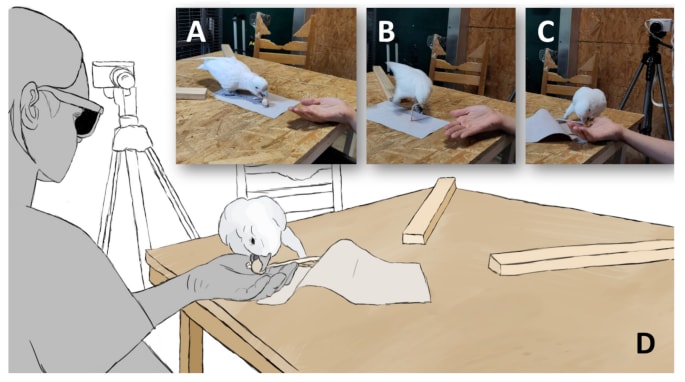
Researchers have discovered that Goffin's cockatoos possess body awareness, enabling them to recognize their own physical form as a potential obstacle. This study provides significant evidence of advanced self-representation in avian cognition.
The Evolution of Avian Self-Awareness
Recent scientific investigations into the cognitive capabilities of Goffin’s cockatoos have yielded breakthrough insights regarding avian self-representation. The study focused on a 'body-as-obstacle' task, a rigorous methodology designed to determine if these birds possess an internal model of their own physical dimensions. By requiring the subjects to step off a mat to retrieve a reward, researchers could observe whether the birds understood that their own weight and position were the causal factors preventing the movement of the object, rather than an external mechanical failure.
Experimental Design and Methodology
The robustness of these findings relies on the clear distinction between the test condition and two separate control conditions. In the test scenario, the cockatoos' bodies functioned as a direct impediment to the task. The results were statistically significant: the birds stepped off the mat significantly more often when their presence was the specific cause of the obstruction. This suggests a sophisticated level of spatial reasoning that extends beyond simple trial-and-error learning, indicating a genuine awareness of the "self" in relation to the physical environment.
Ruling Out Behavioral Artifacts
Critics of animal cognition studies often point to habituation or simple reflexive responses as alternative explanations for complex behavior. However, this study effectively neutralized those concerns. The birds demonstrated near-perfect performance during pre-test phases, confirming that the action of stepping off the mat was not a default response to environmental discomfort or the physical sensation of the mat moving beneath them. Because the subjects were already habituated to the equipment, the researchers could confidently isolate cognitive processing from mere sensory reaction.
Implications for Comparative Cognition
This discovery places Goffin’s cockatoos in an elite group of species known to possess body awareness, a trait previously thought to be limited to higher primates and a few other mammals. By demonstrating that these birds can distinguish between situations where their body is a causal obstacle versus those where it is irrelevant, the study challenges long-standing anthropocentric views on animal intelligence. It implies that the neural architecture required for self-representation may have evolved independently in the avian lineage, potentially linked to the complex problem-solving skills observed in the Psittaciformes order.
Future Research and Broader Context
As we look forward, these findings open new avenues for understanding the evolution of consciousness in non-human animals. If cockatoos can navigate the world with an internal map of their own physical form, it suggests that their "mental toolkit" is far more flexible than previously assumed. Future studies will likely aim to determine if this self-representation extends to other complex cognitive tasks, such as tool use or social navigation, further refining our understanding of how these avian minds process the world around them.