A 1,000-mile cloud on Mars may reveal physics never seen in nature
Source Entity
Tereza Ondráčková, wired.com
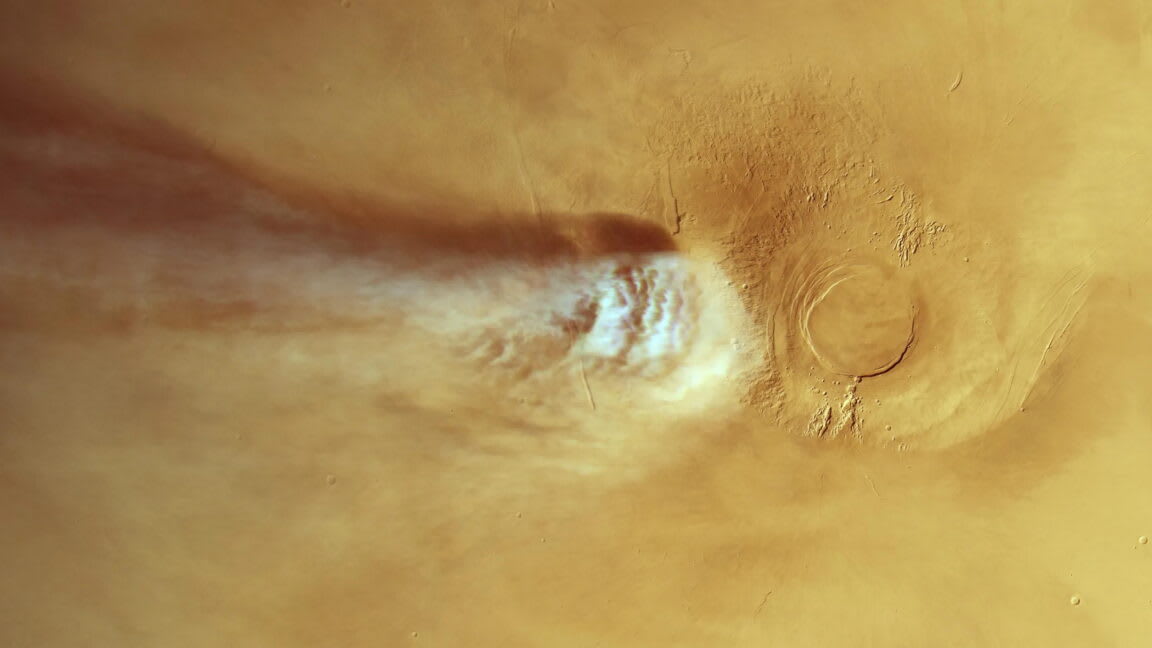
Researchers have successfully modeled the mysterious 1,000-mile-long Arsia Mons Elongated Cloud on Mars. The findings suggest the cloud is driven by previously unobserved atmospheric physics, potentially revealing new insights into planetary meteorology.
The Mystery of the Martian AMEC
For years, astronomers have been captivated by a peculiar, recurring phenomenon on the surface of Mars: the Arsia Mons Elongated Cloud (AMEC). Emerging consistently during the Martian spring and summer, this wispy, thin formation stretches over 1,000 miles—a distance comparable to the span between New York and Kansas City. Since its initial documentation by a probe in 2018, the cloud has defied simple meteorological explanation, appearing near the volcano Arsia Mons each morning before dissipating as the day progresses.
Breaking the Modeling Barrier
Until recently, the AMEC remained an atmospheric enigma, with scientists struggling to create a coherent model that could replicate its life cycle. The breakthrough arrived when researchers successfully modeled the cloud’s formation for the first time. By simulating the unique conditions surrounding the Martian volcano, the team uncovered that the cloud’s existence might be predicated on physical processes that have never been directly observed in any planetary atmosphere, including Earth’s.
Unprecedented Atmospheric Physics
This discovery is significant because it challenges our current understanding of how ice crystals form and behave in low-pressure, thin-atmosphere environments. If the AMEC is indeed driven by novel physics, it suggests that the Martian atmosphere serves as a unique laboratory for fluid dynamics. The interaction between the topography of Arsia Mons and the specific thermal cycles of the Martian morning creates a localized environment where standard terrestrial atmospheric models fail to fully capture the complexity of the cloud’s elongation.
Contextualizing Martian Meteorology
Understanding the AMEC is not merely an exercise in cataloging Martian weather; it is essential for future mission planning. As humanity looks toward potential human exploration of Mars, the ability to predict atmospheric behavior—including massive, recurring formations like the AMEC—becomes a safety and logistical priority. The discovery that this cloud relies on previously unknown physical processes underscores the necessity for more refined meteorological monitoring of the Red Planet.
Broader Implications for Planetary Science
Beyond the immediate findings, this research highlights how much remains unknown about the atmospheres of our neighboring worlds. The fact that a 1,000-mile-long feature can exist on a planet we have studied for decades without a clear physical mechanism for its creation demonstrates the limitations of remote sensing and current atmospheric modeling. This advancement provides a foundation for future studies, potentially allowing scientists to apply these new physical insights to other celestial bodies with similar volcanic and atmospheric profiles.
Conclusion
The successful modeling of the Arsia Mons Elongated Cloud marks a pivotal shift in planetary science. By identifying that the cloud is governed by previously unobserved physical interactions, researchers have opened a new door into understanding the volatile nature of the Martian climate. As further data is collected, these findings will likely reshape our understanding of how ice-forming processes function outside of Earth's atmosphere, marking a significant milestone in our quest to comprehend the physics of the solar system.